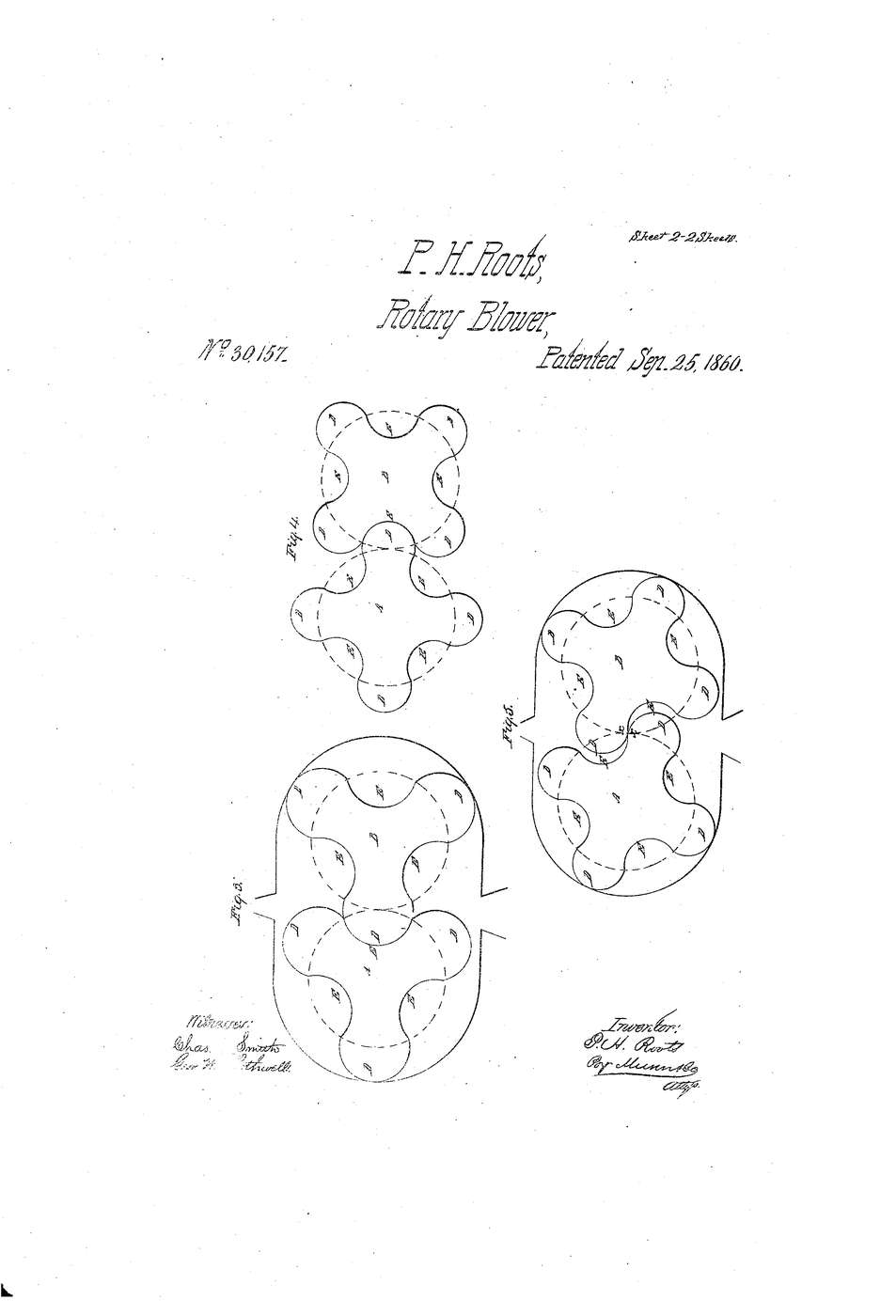


Roots Blower
A fan is easy and cheap, and it has one weakness: push back against it and it gives up. Raise the pressure downstream — a deep mine, a choked furnace — and a fan's airflow collapses just when you need it most.
A Roots blower does not care about back-pressure. Two figure-of-eight lobes counter-rotate in a close-fitting case, and on every turn they scoop a fixed pocket of air from the inlet and carry it bodily to the outlet. It is a positive-displacement machine: so many litres per revolution, whether the outlet is open air or a blast furnace.
The trick is that the two lobes never touch. They are turned by a pair of external gears that keep them meshing with a hair's clearance — sealing the air in without grinding metal on metal.
US Patent 30,157, "Blower" (Improvement in Rotary Blowers), granted 25 September 1860 to Philander H. Roots of Connersville, Fayette County, Indiana.
说明
Read the claim: rotary, positive displacement
Read the claim: rotary, positive displacement
Roots claims an "improvement in rotary blowers": two rotating lobes that move air by trapping and carrying it, not by flinging it. Note the difference from a fan.
Test a fan against back-pressure first
Test a fan against back-pressure first
Run a small fan into an open bag, then pinch the neck. The airflow collapses as pressure builds. Record how quickly it stalls — this is the problem to beat.
所需工具:
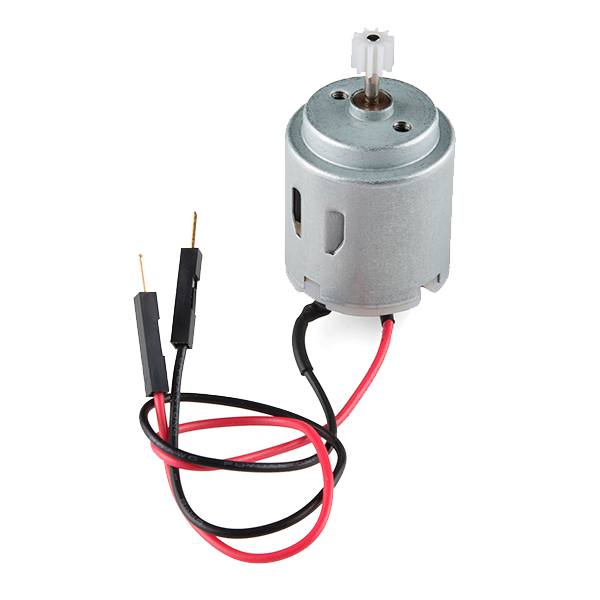 Hobby Motor - Gear
Cut two identical two-lobe rotors
Cut two identical two-lobe rotors
Cut two figure-of-eight rotors from MDF, identical. Each is two lobes 90° apart on a hub. Their shape must let them mesh without jamming.
此步骤所需材料:
 中密度纤维板1 张
所需工具:
 钢锯
钢锯 什锦锉套装
什锦锉套装Mount them on parallel shafts in a close case
Mount them on parallel shafts in a close case
Set the two rotors on parallel shafts inside a snug case with an inlet and an outlet. Space the shafts so the lobes almost touch as they pass.
此步骤所需材料:
 低碳钢圆棒2 个
Turn them by hand and watch them collide
Turn them by hand and watch them collide
Rotate the shafts by hand with no gears. The lobes clash and jam — nothing keeps their timing. That failure sets up the key insight.
Add a pair of equal external gears
Add a pair of equal external gears
Fit two equal gears on the shaft ends so the rotors are forced to turn in exact opposite step. Now the lobes mesh with a gap and never touch.
此步骤所需材料:
 POM(聚甲醛)齿轮坯套装1 套
Turn the geared pair and follow one air pocket
Turn the geared pair and follow one air pocket
Rotate slowly and watch a pocket of air get scooped at the inlet, carried around the case wall, and pushed out the outlet. That carrying action is positive displacement.
Measure the volume moved per revolution
Measure the volume moved per revolution
Connect the outlet to a syringe and count how far the plunger moves per turn. Volume per revolution is a fixed number — the defining property of the machine.
所需工具:
 实验室注射器
Load the outlet and measure again
Load the outlet and measure again
Restrict the outlet and repeat. The volume per revolution is almost unchanged — unlike the fan in step 2, which stalled. Back-pressure barely touches it.
Double the speed and confirm the flow doubles
Double the speed and confirm the flow doubles
Turn twice as fast for the same time. Roughly twice the air. Flow is set by speed, not by how hard the air is pushing back.
所需工具:
 秒表
秒表Feel for leakage past the lobes
Feel for leakage past the lobes
Hold the outlet shut and turn slowly. Some air slips back through the tiny clearances. The closer the fit, the less slip — which is why the gears, not the lobes, take the load.
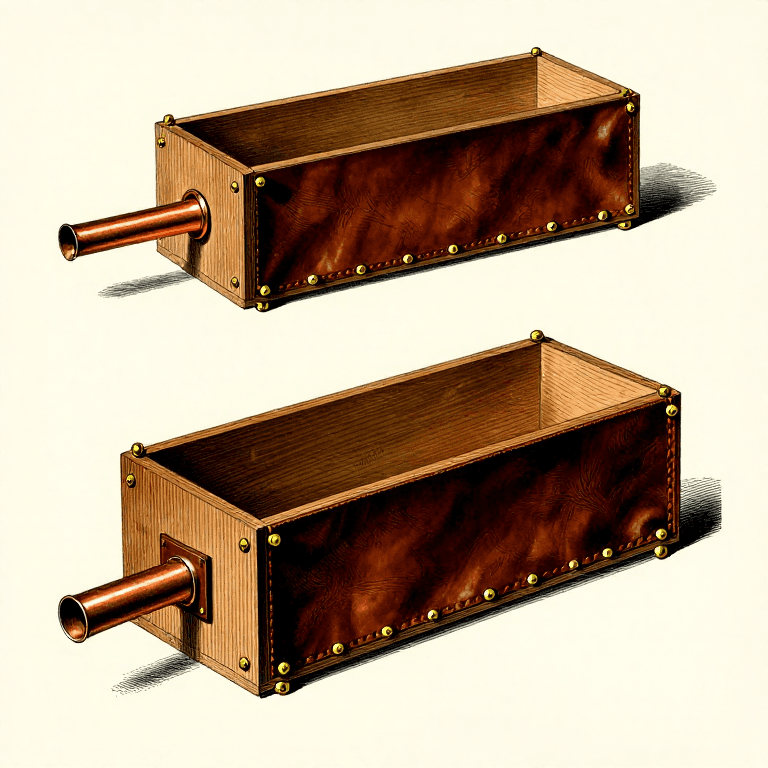
Compare against the box bellows it replaced
Compare against the box bellows it replaced
A bellows delivers air in gusts and must be re-filled; the blower delivers a steady, continuous stream. Note which one a furnace would rather have.
History & Context — the water wheel that failed into a blower
History & Context — the water wheel that failed into a blower
The patent. US 30,157, "Blower", granted 25 September 1860 to Philander H. Roots of Connersville, Fayette County, Indiana. Read the specification and it says "I, P. H. Roots" in the singular — so this patent is Philander's. The famous "Roots brothers" is a real partnership: Philander and his brother Francis Marion Roots ran a woollen mill together and the P. H. & F. M. Roots Company grew out of it, and Francis holds patents of his own. But crediting US 30,157 to "the brothers" overstates what this document says — a good reminder to read the inventor line, not the company name.
The origin is a genuine accident. The story, which the Roots company itself told, is that the brothers were building a water-driven motor for their mill — two lobed rotors meant to be spun by flowing water. It ran poorly as a motor. But someone spun it by hand and felt it blow a strong draught of air out the other side. They had built a good air pump while trying to build a bad water motor, and had the sense to patent the machine for what it actually did. Run one of these devices backwards and it is a motor; run it forwards and it is a blower — steps 7 to 9 are the blower direction.
Why positive displacement matters. A fan or centrifugal blower accelerates air and relies on that speed to push it along; raise the downstream pressure and the air simply slides back past the blades (step 2). A Roots blower instead encloses a fixed pocket of air between a lobe and the case and walks it from inlet to outlet, so it moves the same volume per revolution almost regardless of pressure (step 9). That is exactly what a deep mine, a blast furnace or a grain elevator needs — guaranteed air against a stubborn load.
The detail that makes it work is the gears. The two lobes must not touch, or they would grind themselves to dust in minutes. A pair of equal timing gears on the shaft ends holds them in perfect opposite step with a fine clearance, so they seal against each other aerodynamically without ever making contact (steps 5 and 6). The lobes carry the air; the gears carry the load. That division of labour is the invention.
Where it went. Roots blowers ventilated mines, forced blast furnaces, aerated sewage and moved grain for a century, and the identical geometry — two meshing lobes, external timing gears — became the Roots-type supercharger that force-feeds air into a racing or truck engine. A device invented in an Indiana woollen mill in 1859 is still bolted to the top of engines today.
相关蓝图
这些蓝图共享知识——技术、材料或原理



CC0 公共领域
此蓝图以 CC0 协议发布。你可以自由复制、修改、分发和使用此作品,无需征得许可。
通过购买蓝图中的产品支持创客,他们将获得 创客佣金 (由供应商设定),或创建此蓝图的新版本并将其作为连接包含在你自己的蓝图中以分享收入。