艺术
美容与健康
工艺
文化与历史
娱乐
环境
食品与饮料
逆向工程
科学
体育
技术
可穿戴设备
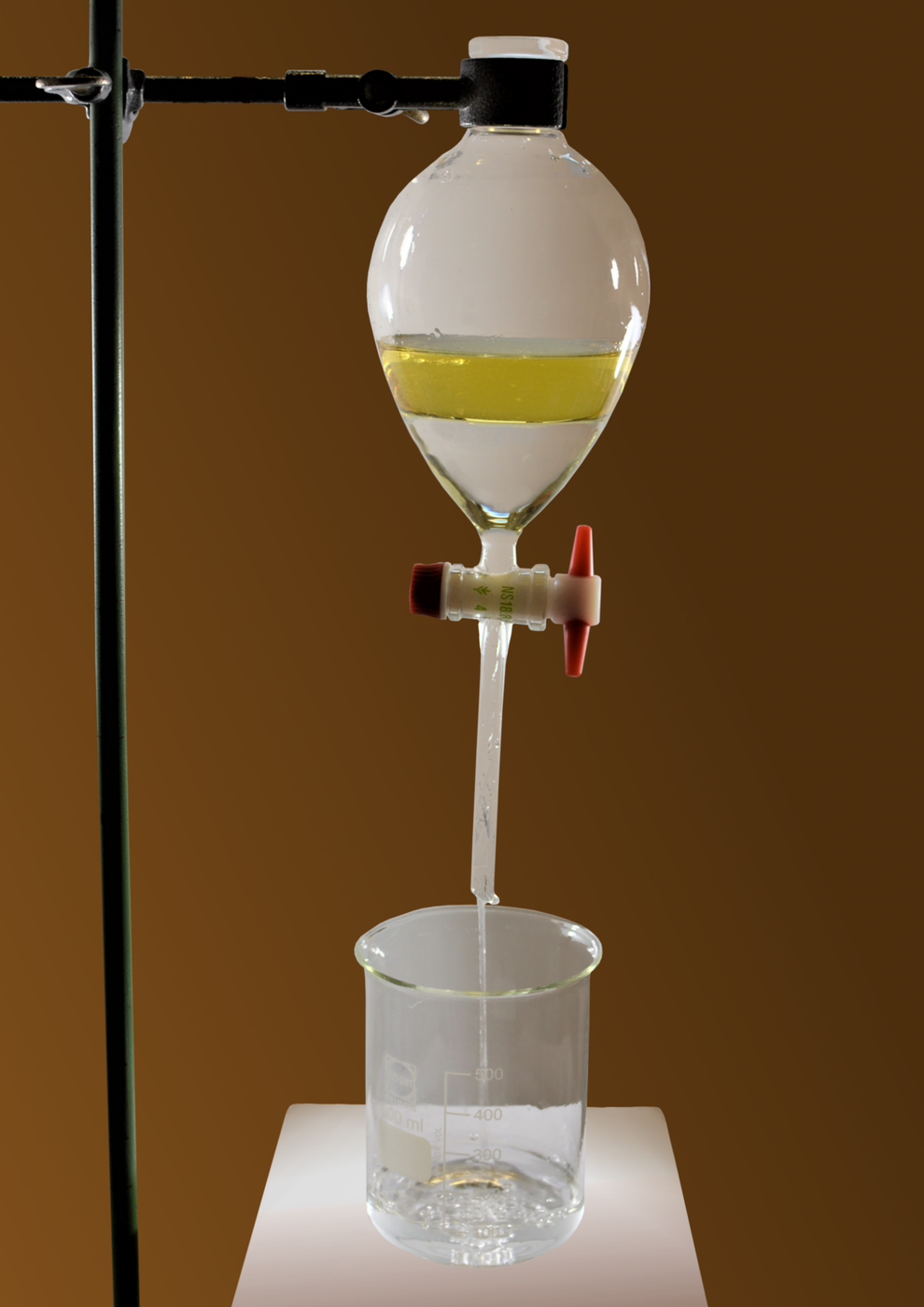


The Separating Funnel and the Partition Coefficient
Distillation separates by boiling point, and pays the latent heat to do it. This rung separates by something cheaper: by what a substance PREFERS.
Shake a mixture with two liquids that will not mix, let them settle, and every dissolved substance distributes itself between the two layers in a fixed ratio — its partition coefficient. Nernst wrote the law down in 1891. It sounds modest, and it is the single idea underneath every rung that follows in this batch: a chromatography column is nothing but this same partition repeated a few thousand times in a row, with one of the two phases held still and the other flowing past.
Build it first with your hands and a funnel, where you can watch the colour move from one layer to the other, and every later rung stops being magic.
初学者
3 hours
说明
1
1
Find two liquids that refuse to mix
Find two liquids that refuse to mix
Pour water into a jar, add an equal depth of cooking oil, shake, and set it down. Within a minute you have two clean layers with a sharp line between them.
They separate because water molecules attract each other far more strongly than they attract oil, so mixing costs energy the system will not pay. That line is the interface, and everything in this blueprint happens across it. Note which layer sits on top: here the oil, because it is less dense. You will need to know which tap-end to drain, and getting it wrong is how a first attempt is lost.
所需工具:
 玻璃罐
玻璃罐2
2
Charge the funnel — and never fill it more than two-thirds
Charge the funnel — and never fill it more than two-thirds
Close the tap. Pour in your water layer, then your solvent layer, filling no more than two-thirds. Stopper it.
The empty third is not caution, it is what lets you shake. A full funnel cannot mix and will spit past the stopper the moment you invert it. Check the tap is actually shut before anything goes in — this is the mistake everyone makes once, and the floor tells you immediately.
此步骤所需材料:
 乙醇——实验级,95 %50 毫升
所需工具:
 分液漏斗
分液漏斗 硼硅玻璃烧杯
3
3
Shake, and VENT
Shake, and VENT
Hold the stopper down with one hand and the tap with the other. Invert, shake gently once, then — still inverted, tap pointing away from you and everyone else — OPEN THE TAP to vent. You will often hear it hiss.
Volatile solvents build pressure the instant they are shaken, and a funnel that is not vented fires its stopper across the room. Vent after every few shakes, never point the tap at a face, and shake gently: a violent shake makes an emulsion, a milky layer that refuses to settle and can cost you the whole run.
所需工具:
分液漏斗 密闭式护目镜
 丁腈手套
丁腈手套4
4
Let it settle, then drain the bottom layer only
Let it settle, then drain the bottom layer only
Stand the funnel in a ring, remove the stopper — it will not drain with the stopper in — and let the interface sharpen. Open the tap and run the LOWER layer out into a beaker, closing it the instant the interface reaches the tap.
Then pour the upper layer out of the TOP, not through the tap. Draining it past the residue in the stem is how the two layers get remixed at the last moment, and it is the commonest way a clean separation is thrown away.
所需工具:
分液漏斗硼硅玻璃烧杯5
5
Watch a dye choose a side
Watch a dye choose a side
Now make it visible. Add a drop of a water-soluble food colour to a water/solvent pair and shake: the colour stays in the water. Repeat with a plant dye extracted in alcohol and it will move the other way.
Nothing has reacted. The molecule has simply found the phase it is more comfortable in, and the ratio it settles at is a property of that molecule, not of how hard you shook. That reproducible ratio is what makes separation a measurement rather than a knack.
此步骤所需材料:
 食用色素1 瓶
所需工具:
分液漏斗 带刻度移液管(莫尔式)
6
6
Extract three times with a third of the solvent
Extract three times with a third of the solvent
Split your solvent into three equal portions and extract three times in a row, combining the three extracts, rather than extracting once with all of it.
This is the whole trick, and the notebook proves why. Every extraction leaves a fraction behind; doing it three times leaves a fraction of a fraction of a fraction. The difference is not small, and it is the reason a chromatography column — which is thousands of tiny extractions in series — separates things a single shake never could.
此步骤所需材料:
乙醇——实验级,95 %60 毫升所需工具:
分液漏斗硼硅玻璃烧杯带刻度移液管(莫尔式)7
7
How much is left behind
How much is left behind
正在加载 Jupyter 笔记本…
所需工具:
 数字天平
数字天平8
8
Break an emulsion when you make one
Break an emulsion when you make one
Sooner or later a shake gives you a milky middle layer that will not clear. Do not shake it more.
Three things work, in order of how little they cost you: wait, because many emulsions settle in twenty minutes; add a spoonful of salt to the water layer, which raises its ionic strength and squeezes the organic phase out; or swirl gently rather than shaking on the next attempt. An emulsion is not a mistake in your technique so much as a sign the two phases are closer in character than you assumed — which is itself information about your solvent choice.
所需工具:
分液漏斗相关蓝图
这些蓝图共享知识——技术、材料或原理
CC0 公共领域
此蓝图以 CC0 协议发布。你可以自由复制、修改、分发和使用此作品,无需征得许可。
通过购买蓝图中的产品支持创客,他们将获得 创客佣金 (由供应商设定),或创建此蓝图的新版本并将其作为连接包含在你自己的蓝图中以分享收入。