艺术
美容与健康
工艺
文化与历史
娱乐
环境
食品与饮料
逆向工程
科学
体育
技术
可穿戴设备

Sorting by Size: Why a Screen Never Makes a Clean Cut
Crushing makes a range of sizes. Almost nothing downstream wants a range, so between every crushing stage and the next there is a machine whose only job is to sort.
The tempting mental model is a knife: smaller than the hole goes through, larger stays on top. It is wrong, and knowing why it is wrong is most of what there is to know about screening. A particle passes only if it arrives over a hole while it is touching the deck, and that is a matter of chance — a chance that collapses toward zero as the particle approaches the size of the hole.
So a screen sorts by probability, the material that is nearly the right size is the material it handles worst, and 'screening efficiency' is a number with a definition rather than a compliment. This rung derives the probability, generates the partition curve from it, and then builds a deck.
中级
About 3 hours
说明
1
1
Prove it with a sieve and a stopwatch
Prove it with a sieve and a stopwatch
Take a sieve and a sample of material with a good spread of sizes. Weigh the sample.
Now sieve it in timed stages: shake for fifteen seconds, weigh what has gone through, put the oversize back on and repeat, six or eight times. Record the cumulative mass passed against total shaking time.
The curve rises steeply and then flattens, and it never quite stops rising. There is no moment at which the sieve is 'finished'. That is not a fault in your technique; it is the probability in step 3 showing itself, because the material still on the deck at the end is the material closest in size to the holes.
This is also the correct way to run any sieve analysis: shake until the mass passing in a further period is negligible, and say in your notes what 'negligible' meant. An analysis without a stated end point is not reproducible.
Do it a second time with a doubled sample. The same sieve, the same shaking, more material — and it will be markedly worse, because the particles at the bottom of a deep bed never reach the deck at all.
此步骤所需材料:
 骨料石2 公斤
所需工具:
 粗筛
粗筛 细目筛
细目筛 分级筛
分级筛 数字天平
数字天平 秒表
秒表 防尘口罩
防尘口罩2
2
Build a deck and give it a stroke
Build a deck and give it a stroke
A screen deck is a frame, a tensioned cloth and a way of shaking it.
Build the frame square and stiff, and **tension the cloth**. A slack screen cloth is the commonest fault on a working screen: it absorbs the stroke instead of transmitting it, so the material is not lifted, and it flexes at every wire crossing until it fatigues and splits. Tension it in both directions and check it after the first hour of running.
Incline the deck. On an inclined screen gravity moves the material along and the stroke lifts it clear of the cloth; twenty degrees is a usual starting point. Steeper moves the material faster, which means fewer presentations per particle, which means — from step 3 — a worse cut. Everything on a screen trades capacity against efficiency and there is no setting that escapes it.
Drive it with an out-of-balance mass, which is what Bell's patent does. A weight bolted off-centre on a shaft gives a circular stroke; two counter-rotating shafts give a straight one. Start with a small out-of-balance and increase it: the material should be thrown clear of the deck on each stroke and land further down, travelling in a series of small hops rather than sliding.
Balance and guard exactly as in the hammer rung: an out-of-balance mass at speed is a serious force, and everything bolted to a vibrating screen unbolts itself.
此步骤所需材料:
 编织筛网1 个
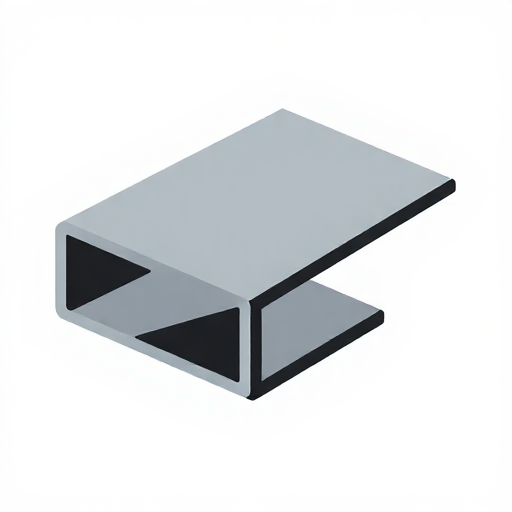 低碳钢角钢2 个
 机螺钉16 个
 立式轴承座(KP08)2 个
所需工具:
 振动电机
振动电机 MIG 焊机
 自动变光焊接面罩
 充电式电钻
充电式电钻 钻头套装
钻头套装 扳手套装
扳手套装 量角器
量角器 水平尺
水平尺 卷尺
卷尺 透明安全眼镜
 皮革工作手套
 护耳器
护耳器3
3
The probability of passing, and what it costs near the aperture
The probability of passing, and what it costs near the aperture
正在加载 Jupyter 笔记本…
4
4
The partition curve, and what efficiency means
The partition curve, and what efficiency means
正在加载 Jupyter 笔记本…
5
5
Blinding, pegging, and the bed that is too deep
Blinding, pegging, and the bed that is too deep
Three failures account for nearly every screen that has stopped working, and none of them is the machine.
**Pegging** — near-size particles wedged in the apertures. The deck loses open area steadily until it is a solid plate. Caused by too much near-size and too little stroke. Look at the cloth against the light: a pegged deck is obvious in two seconds and invisible from above.
**Blinding** — damp fines bridging over the holes. Same symptom, different cause, and it gets worse as the material gets finer. Heated decks, rubber panels that flex, and ball trays under the deck all exist to beat it.
**Bed too deep** — the fines at the bottom of a thick bed never reach the cloth. The screen is then sorting the top of the bed and passing the rest along, and no amount of extra stroke will help, because the problem is that the undersize is not in contact with the deck. A bed about four times the aperture deep at the discharge end is a common rule of thumb; deeper than that, split the feed across two decks rather than pushing it.
The diagnostic that distinguishes them: stop the feed and let the deck run clear. Pegging and blinding are still visible on the empty cloth. A deep bed is not.
此步骤所需材料:
编织筛网1 个所需工具:
卷尺 直尺
直尺 数码显微镜皮革工作手套防尘口罩透明安全眼镜
6
6
History and context
History and context
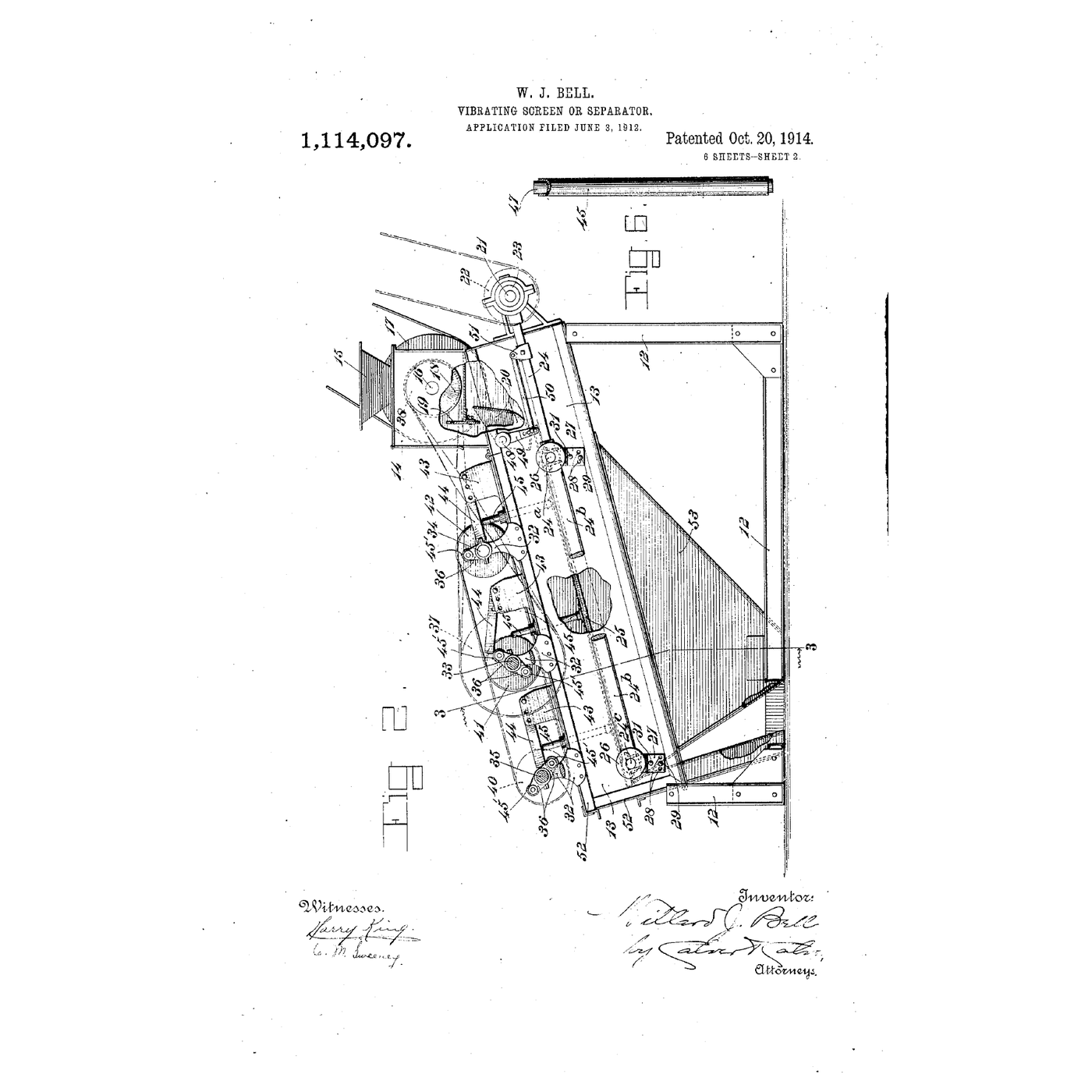
**US 1,114,097, 'Vibrating Screen or Separator', W. J. Bell, application filed 3 June 1912, granted 20 October 1914.** The drawing's sheet 2 shows the machine plainly: an inclined deck in a suspended frame, shaken rather than swept.
That distinction is what the vibrating screen is for. The older answer was a **trommel** — a slowly rotating drum of perforated plate — and a trommel is gentle, tolerant and very inefficient, because a particle in a trommel spends most of its time in a rolling bed and very little of it in contact with the screening surface. A vibrating deck throws every particle clear and lets it land again, several times a second, which is exactly the 'presentations' term in step 3. The whole gain is in that one variable.
A second verified patent from the same decade, **US 1,459,846, B. A. Mitchell, 'Vibrating Screen', filed 1920 and granted 26 June 1923**, shows how quickly the type was elaborated.
**Honest limits.** Screening gets impractical below about half a millimetre dry, because the cloth blinds and the open area collapses; below that, sorting is done wet, or by settling velocity in a classifier or a cyclone, which is a different machine sorting by a different property. A screen is a poor choice for sticky or clay-bearing feed at any size. It is a large machine for the tonnage it handles, because the deck area is set by the hardest cut and not by the average one. And its efficiency figure is only comparable against another figure calculated the same way — 'ninety-five per cent efficient' is meaningless without the definition beside it.
所需工具
20相关蓝图
这些蓝图共享知识——技术、材料或原理
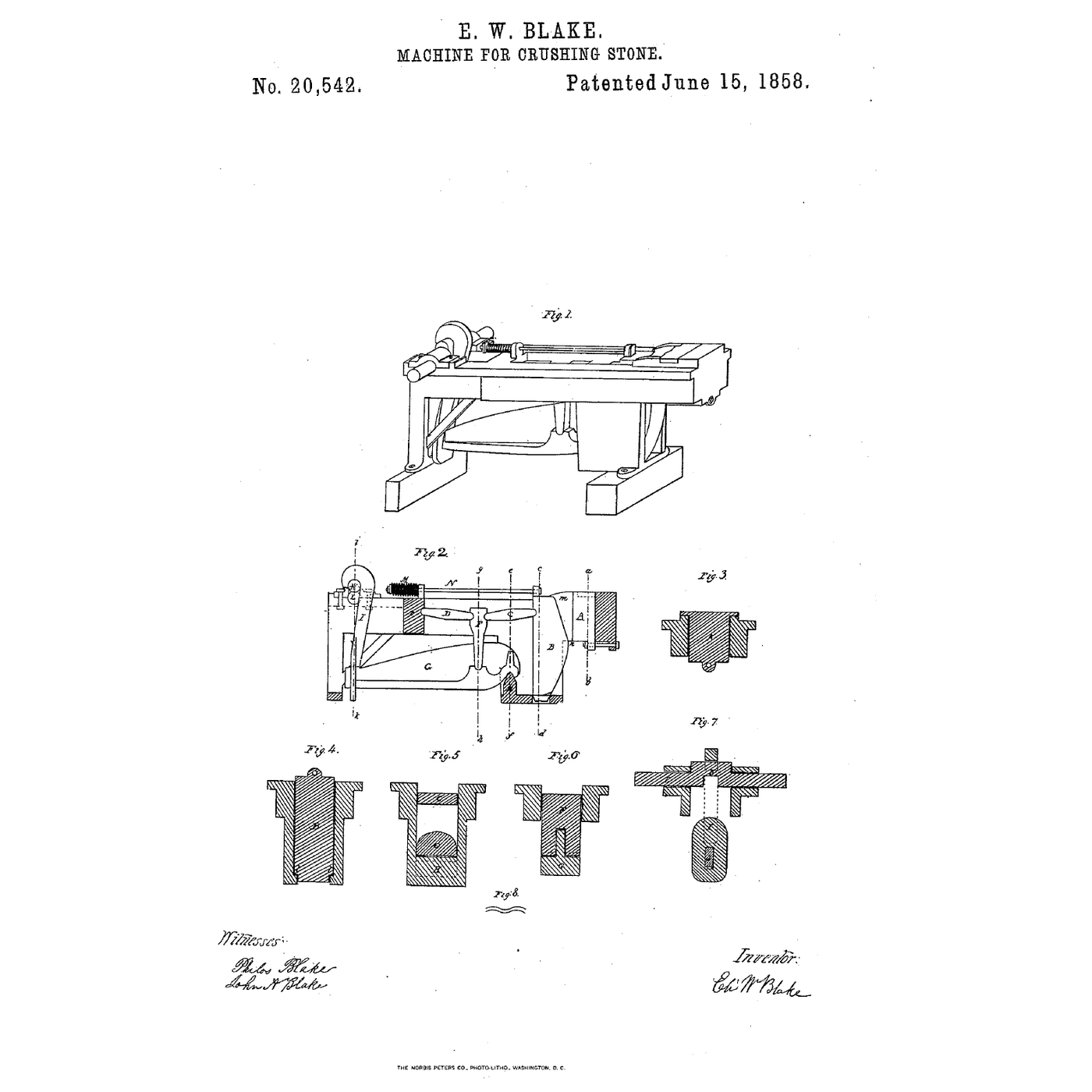
Breaking Stone by Compression: The Nip Angle Decides Everything
Martin 创作
金属加工
15
0
0
0
0
0
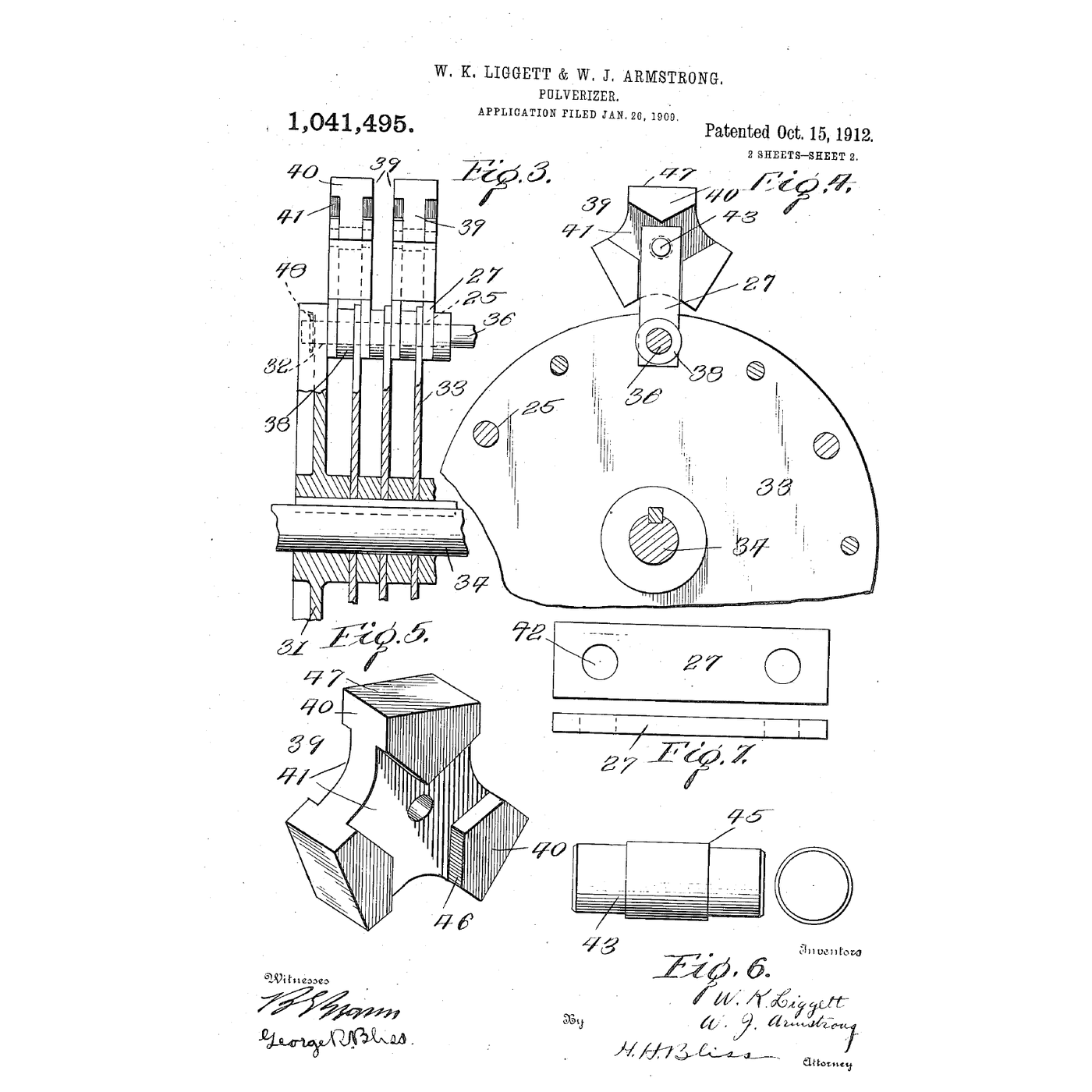
Breaking by Impact: The Swing Hammer and the Grate That Sets the Size
Martin 创作
金属加工
11
0
0
0
0
0
Grinding in a Tumbling Mill: Critical Speed, and Why the Media Are Graded
Emma 创作
力学
9
0
0
0
0
0
Ore Dressing
Mary 创作
金属加工
31
0
0
0
0
0
Cyclone Separator
Emma 创作
工程
41
0
0
0
0
0
CC0 公共领域
此蓝图以 CC0 协议发布。你可以自由复制、修改、分发和使用此作品,无需征得许可。
通过购买蓝图中的产品支持创客,他们将获得 创客佣金 (由供应商设定),或创建此蓝图的新版本并将其作为连接包含在你自己的蓝图中以分享收入。