艺术
美容与健康
工艺
文化与历史
娱乐
环境
食品与饮料
逆向工程
科学
体育
技术
可穿戴设备



Stiffness Out of Shape: Corrugating, Beading and the Turned Edge
Thin sheet is strong and floppy at the same time, and the two facts are easy to confuse. The metal in a roofing sheet will happily carry a tonne in tension. Lay it flat across two trestles and it will not carry its own weight.
The fix is not thicker metal. It is **shape**. Roll waves into the sheet, or turn its edges up, or press a bead down the middle of a panel, and the bending stiffness multiplies by hundreds without adding a gram per square metre of coverage.
This is the cheapest thing in engineering and it is why almost every sheet metal object you own has ribs, flanges, swages and folded edges on it. This rung rolls corrugations by hand, measures what they are worth on a real span, and does the integral that explains it.
初学者
About 3 hours
说明
1
1
Measure how bad a flat sheet is, so you have a baseline
Measure how bad a flat sheet is, so you have a baseline
Cut two identical strips of 0.7–1.0 mm sheet, about 300 mm long and 100 mm wide. Deburr both. Keep one flat.
Support the flat one on two blocks 250 mm apart and hang a known weight from the middle — a bag of washers on a hook, weighed on the digital scale, is fine. Measure the sag at mid-span with the steel rule against a straightedge, or with a dial indicator if you have one.
Write down three numbers: **span**, **load**, **deflection**. Deflection is the thing you are going to divide into later; everything in this rung is a ratio against this first measurement.
Do not be gentle. Use enough weight that the sag is millimetres rather than tenths, because you are about to compare it against something that barely moves and you need the flat reading to be big enough to measure honestly.
Note also what the sheet does when you take the load off. If it stays bent, you passed its yield and the comparison is spoiled — start again with less weight. Stiffness is an *elastic* property; a permanent set is a different measurement altogether.
此步骤所需材料:
 镀锌钢板 0.9 mm1 个
 铝板1 个
铝板1 个所需工具:
 航空剪
航空剪 去毛刺刀
去毛刺刀 直尺
直尺 6 英寸数显卡尺
 数字天平
数字天平 台虎钳
台虎钳 透明安全眼镜
 皮革工作手套
 实验记录本(带复写页)
2
2
Put waves in the second strip and measure it again
Put waves in the second strip and measure it again
Now corrugate the other strip. Three ways, in order of what a small shop is likely to have:
**A brake.** Fold alternate creases across the strip at a regular pitch — 25 mm is convenient — each to about 30°, alternating up and down. This gives a folded profile rather than a rounded one, and it works just as well; the notebook's sinusoid is a convenience, not a requirement.
**A vise and a bar.** Clamp the strip between the vise jaws with a round bar laid along the line and press it over with a second bar. Slow, and the pitch wanders, which is itself worth seeing.
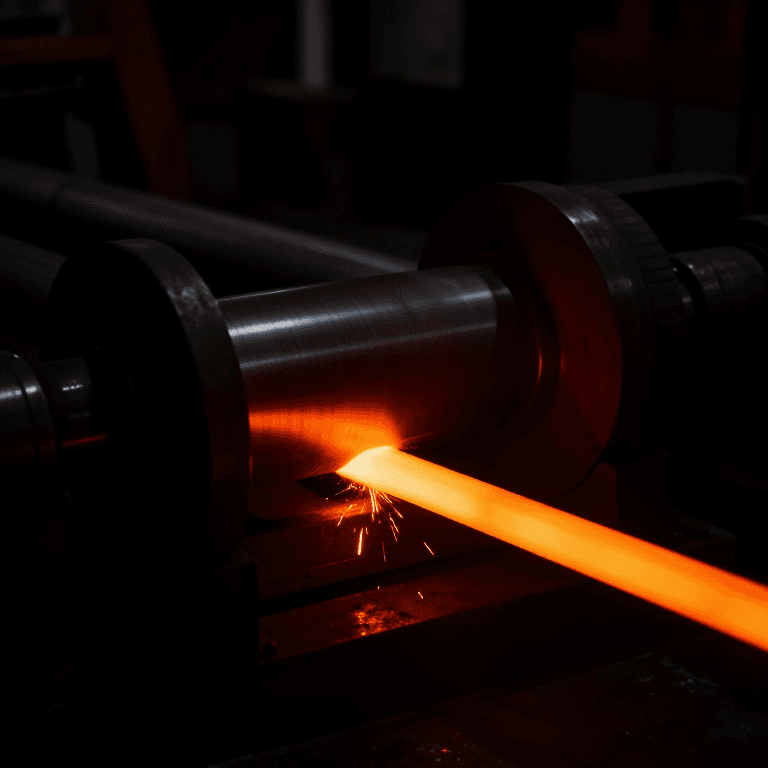
**Rollers.** If you have a bead roller or a corrugating roller like the one in the photograph on this page, run the strip through. Note how little force it takes compared with the brake: the rolls form a short length at a time, exactly as the nibbler did in rung 1.
Measure the finished strip. It is now **shorter in plan** than it was flat, because the metal went into the waves — measure how much, because that is the metal cost the notebook computes. Measure the depth of the corrugation with the calipers.
Then repeat the deflection test from step 1: same span, same load, same method. Compare.
Be ready for the result to be difficult to measure at all, because the corrugated strip may not visibly move under a load that bent the flat one by ten millimetres. If so, increase the load until you can read it, and record the new load — the ratio you want is (load/deflection) for each, not deflection alone.
此步骤所需材料:
镀锌钢板 0.9 mm1 个所需工具:
 液压折弯机(12 吨)台虎钳
 台虎钳压力机附件
 铁砧
铁砧 圆头锤
圆头锤 橡胶锤直尺6 英寸数显卡尺数字天平透明安全眼镜皮革工作手套实验记录本(带复写页)
3
3
The integral behind it
The integral behind it
正在加载 Jupyter 笔记本…
所需工具:
 坐标纸
坐标纸4
4
The small versions: a bead, a swage, a turned edge
The small versions: a bead, a swage, a turned edge
Corrugating a whole panel is the extreme case. Most sheet metal parts use the same physics in small doses, and each has a name worth knowing because each solves a different problem.
**A flange.** Turn the edge up 90°. Step 3 computed what this does — a 10 mm flange on a 200 mm panel is a large multiple — and it is the reason the lid of almost every box you own has a turned rim.
**A hem.** Fold the edge flat back on itself, 180°. It stiffens the edge a little; what it really does is **bury the sheared edge** from rung 1, so the part is safe to handle and cannot cut anyone. On a part that will be touched, a hem is not optional.
**A bead or swage.** A rounded rib rolled into the middle of a flat panel, where there is no edge to turn. It works the same way — it moves metal off the neutral axis — and it has a second job: it breaks up the flat area so the panel cannot drum or oil-can. That click-clack a cheap panel makes when you press it is a flat area with no bead in it.
Make one of each on scrap, 100 mm long, and test each one by hand against the plain strip. You will feel the difference without instruments; that is how large the effect is.
One thing to notice: a bead **shortens** the panel across its width, exactly as the corrugation did. If a beaded panel has to be a particular size, the bead's metal has to be in the flat blank — same arithmetic as rung 2's bend allowance, applied to a curve. Roll the bead on a test piece and measure the shrinkage before you cut the real blank.
此步骤所需材料:
镀锌钢板 0.9 mm1 个铝板1 个 黄铜板1 个
所需工具:
液压折弯机(12 吨) 白铁工手动折边钳台虎钳
 成型砧铁砧圆头锤橡胶锤
 无反弹锤6 英寸数显卡尺直尺去毛刺刀透明安全眼镜皮革工作手套
5
5
History and context
History and context
**Attribution, stated honestly.** Corrugated iron is credited to **Henry Robinson Palmer**, engineer to the London Dock Company, who was granted a **British patent in 1829** for indented or corrugated metallic sheets. No United States patent number is asserted here: the sources reachable from this bench give the British filing without a number that can be checked, and an unverified number is worse than none. The mechanism is not in doubt, and the mechanism is what this rung teaches.
Its timing is the interesting part. Palmer's patent is 1829; **hot-dip galvanising** — already in the catalogue as its own rung — arrives in the 1830s. Corrugation made thin sheet stiff enough to span, and zinc made thin sheet last outdoors. Neither is much use without the other, and together they produced a building material that could be shipped flat, rolled on site and put up by two people. Within twenty years it was roofing the goldfields of Australia and California, and it has never stopped.
**What makes it a great piece of engineering** is that it is free. It adds no material per square metre of coverage, needs no new alloy, requires one pass through a set of rolls, and is completely reversible in the sense that you can see exactly why it works. The whole effect is the $y^2$ in the integral.
**Honest limits.** A corrugation is stiff in **one direction only** — along the waves. Across them, a corrugated sheet is *less* stiff than flat, because the profile can open and close like a concertina. That is why corrugated roofing needs purlins running across the waves and why a corrugated wall panel is not a shear panel. Nor can it be walked on between purlins, however stiff it feels.
It also costs metal for coverage, and the notebook prices that honestly: the 18 mm profile needs about **13 %** more sheet than flat to cover the same roof, and a 35 mm one needs over **40 %**. The stiffness is nearly free at shallow depths and stops being free well before the profile runs out of useful depth.
相关蓝图
这些蓝图共享知识——技术、材料或原理




CC0 公共领域
此蓝图以 CC0 协议发布。你可以自由复制、修改、分发和使用此作品,无需征得许可。
通过购买蓝图中的产品支持创客,他们将获得 创客佣金 (由供应商设定),或创建此蓝图的新版本并将其作为连接包含在你自己的蓝图中以分享收入。