
艺术
美容与健康
工艺
文化与历史
娱乐
环境
食品与饮料
逆向工程
科学
体育
技术
可穿戴设备
Suminagashi
English
HanaChan

创建者

HanaChan

27. 七月 2026JP
1
0
0
0
0

Suminagashi

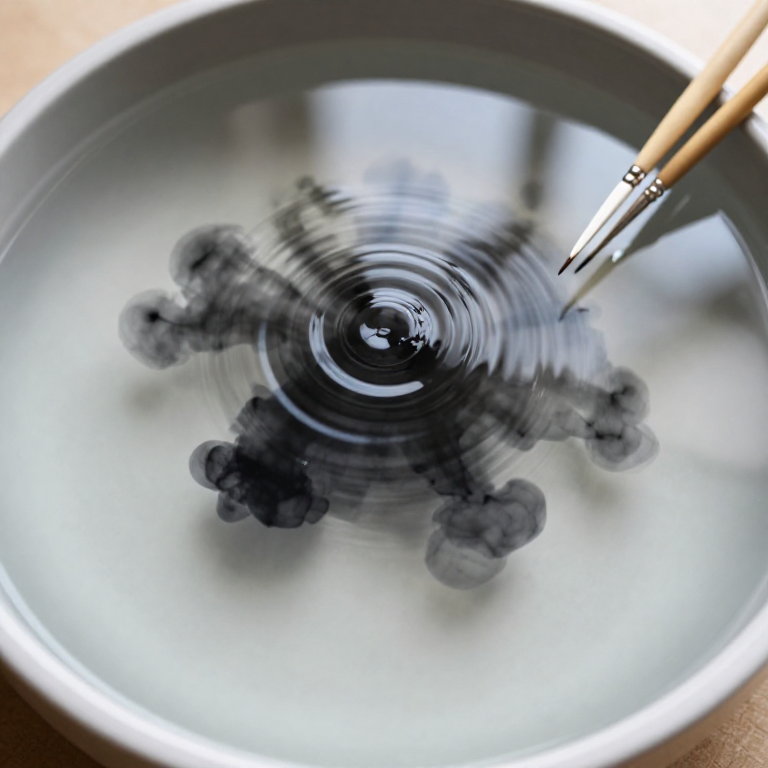
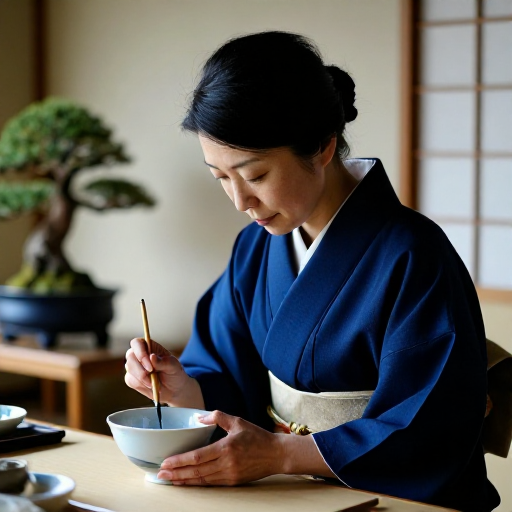
Suminagashi is written with the characters for "ink" and "flowing". You drop ink on the surface of water and lift it off with paper. That is all of it.

The mechanism is surface tension. A brush of ink and a brush carrying pine resin are touched to the water alternately. The resin repels the ink, so each touch pushes the ink outward into a ring around that point. You are not drawing the pattern — you are pushing it out with a repelling force.

That is why suminagashi lines look unlike any line drawn by hand. What a person decides is where to put each drop. Everything after that is decided by the water.

初学者
2 hours

说明

1

Fill a shallow tray with water

Take a shallow tray a little larger than your paper and fill it 3-5 cm deep. The depth is irrelevant — everything that happens, happens on the surface film.

2

Let the water settle

Leave the filled tray for half an hour until the surface is completely still. You cannot draw a circle on moving water.

3

Use water at room temperature

Cold water will not let the ink spread. Water close to room temperature spreads most readily.

4

Prepare two brushes

Two fine brushes: one for ink, one for the repellent. Never let them mix — once they do, neither brush works properly again.

所需工具:

Paintbrush SetPaintbrush Set
5

Grind the ink on the thin side

Grind sumi ink on a stone and keep it slightly dilute. Ink that is too thick is heavy and sinks instead of floating.

此步骤所需材料:

Sumi Ink StickSumi Ink Stick1
6

Prepare the repellent

Charge the second brush with pine resin — or, failing that, a very dilute dish detergent. The surfactant lowers the water's surface tension locally and pushes the ink aside.

7

Touch one point of ink to the surface

Bring the ink brush tip gently onto the water. Do not push it in. The moment it touches, the ink opens into a circle.

8

Touch the repellent to the same centre

Touch the repellent brush to the centre of the circle you just made. The ink is driven outward into a ring. Miss the centre and the rings will not be concentric.

9

Alternate the two

Ink, repellent, ink, repellent, always at the same centre. Twenty or thirty rings build up. Count as you go and you can reproduce it later.

10

Blow across the surface

Once the rings are there, breathe gently across the water or fan it. The rings drift into a grain like wood. This single move is the "flowing" in the name.

11

Lay the paper down once

Lower washi from the centre outward onto the surface. There is no second attempt — lift it and the pattern is destroyed.

此步骤所需材料:

Watercolour PaperWatercolour Paper1
12

Lift after a few seconds

Wait two or three seconds, take an edge and lift at a steady speed. Too fast and the pattern smears; too slow and the paper takes up too much water.

13

Clean the surface before the next sheet

Lay newspaper on the water to lift off leftover ink and oil. Whatever remains from the last pattern will show up in the next one.

14

Dry flat

Dry the sheet flat rather than hanging it. Hung up, the ink runs downward with the water and the rings stretch.

15

Pull ten sheets in a row

Make ten prints the same way and lay them out. No two are alike. That it cannot be repeated is not a failure — it is the nature of the technique.

16

History & Context

Paper of the Heian court. Suminagashi was practised in Japan in the Heian period, some twelve centuries ago. It was used mainly by the aristocracy, for the decorated papers on which poetry was written and for official documents. It is a technique for ornamenting paper, developed at a time when paper itself was precious.

The name says what it is. Ink, and flowing. Not drawn — floated. The word describes the method exactly.

The resin does the work. Ink alone simply spreads and disperses. Alternating a resin-charged brush pushes the ink aside so it survives as a ring — a surfactant lowering surface tension locally, which is also why modern practitioners can substitute dilute detergent. The pattern is made by the repellent, not by the ink.

Different from Western marbling. Turkish ebru and European marbled papers float colours on a thickened size — gum tragacanth and the like — and comb them into intended designs. Suminagashi works on plain water, uses no comb, and does not control the pattern. Same idea of floating and lifting; opposite philosophy.

Choosing not to control. Ten sheets give ten different results. Other traditions would treat that as a defect; suminagashi treats it as the point. The maker sets the conditions and the water sets the form — and that division of labour has not moved in twelve hundred years.

材料

2

所需工具

1

CC0 公共领域

此蓝图以 CC0 协议发布。你可以自由复制、修改、分发和使用此作品,无需征得许可。

通过购买蓝图中的产品支持创客,他们将获得 创客佣金 (由供应商设定),或创建此蓝图的新版本并将其作为连接包含在你自己的蓝图中以分享收入。

讨论

(0)

登录 加入讨论

加载评论中...