艺术
美容与健康
工艺
文化与历史
娱乐
环境
食品与饮料
逆向工程
科学
体育
技术
可穿戴设备

Taste as You Go: The Five Dials You Can Actually Turn
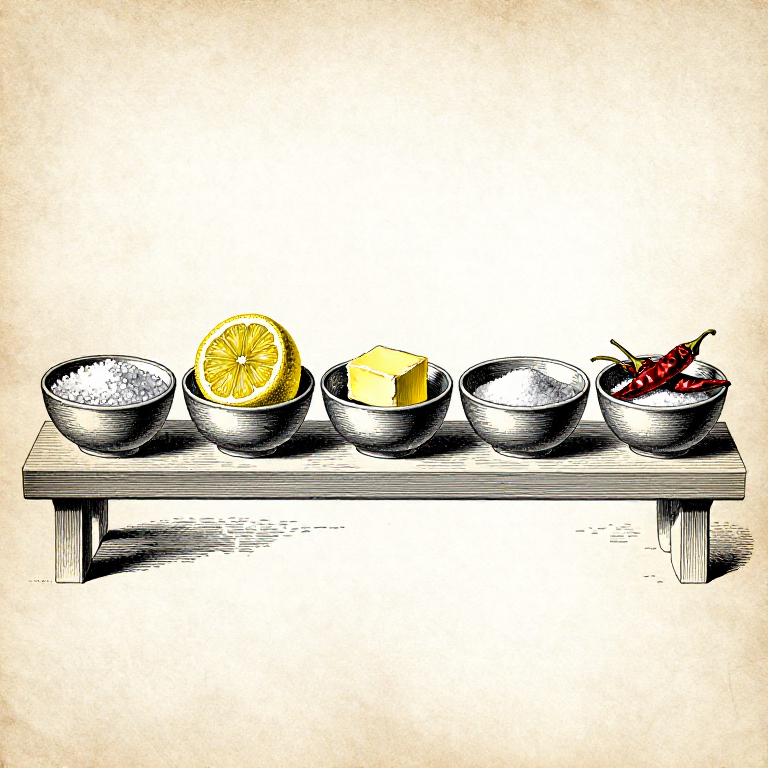
"Needs something" is the most common thing said over a pan, and it is almost always one of five things: SALT, ACID, FAT, SWEETNESS, or HEAT-as-in-chilli. Knowing the list turns a vague dissatisfaction into a decision.
Most of the time it is salt. The second most of the time it is acid — a squeeze of lemon or a splash of vinegar — and a dish that tastes flat and heavy despite being correctly salted is nearly always asking for it.
Tasting is a measurement, and the measurement rungs apply directly: taste at serving temperature, change one thing at a time, and adjust in small steps because you can always add and never take away.
初学者
2 hours
说明
1
1
Taste at the temperature it will be eaten
Taste at the temperature it will be eaten
Cold food tastes less salty and less sweet than the same food hot. A sauce corrected while lukewarm will be over-salted on a hot plate, and a chilled soup seasoned while warm will taste of nothing.
So bring the spoonful to serving temperature before judging it, or at least know which direction the error will run. For anything served cold, deliberately over-season slightly and check again once chilled.
Use a clean spoon every time — taste into a second spoon rather than returning the one that has been in your mouth to the pot. That is not fussiness; it is the same reason the chemistry batch insists on clean glassware.
此步骤所需材料:
 氯化钠(盐)1 个
所需工具:
 木质搅拌勺
木质搅拌勺 搅拌盆套装
搅拌盆套装 汤勺
汤勺2
2
Work down the list in order
Work down the list in order
**Salt** first, because it makes everything else more detectable and because it is usually the answer. **Acid** second: lemon, vinegar, wine, yoghurt, a chopped tomato — it cuts richness and makes a heavy dish feel lighter without removing anything.
**Fat** third: butter, oil, cream. It carries aroma compounds that water cannot, rounds sharp edges, and gives the mouth something to hold onto. A thin-tasting sauce is often short of fat rather than of flavour.
**Sweetness** fourth, in small amounts, to balance acidity or bitterness rather than to make the dish sweet. **Chilli heat** last, because it is the hardest to take back and the easiest to add at the table.
此步骤所需材料:
 柠檬汁(鲜榨)1 个
 特级初榨橄榄油1 个氯化钠(盐)1 个
 黑胡椒粒1 个
所需工具:
木质搅拌勺汤勺 大玻璃搅拌盆
3
3
One change at a time, in small steps
One change at a time, in small steps
Add one thing, stir, wait a moment, taste again. Add salt and lemon together and you have no idea which helped, and if it has gone wrong you do not know which to correct.
That is the change-one-thing-at-a-time rung, and it applies to a pan exactly as it does to a bench. A cook who adjusts three things at once learns nothing from a dish that came out well.
Small steps, because there is no reverse gear. Over-salted soup can be diluted, which weakens everything else too; over-chillied is very difficult; over-sweet is nearly impossible. Half of what you think you need, then taste again.
此步骤所需材料:
氯化钠(盐)1 个柠檬汁(鲜榨)1 个所需工具:
木质搅拌勺 数字厨房秤
数字厨房秤4
4
Write down what it took
Write down what it took
When a dish comes out well, write down what you actually did — the weights, the pull temperature, the final adjustment, how long it rested. Otherwise the next attempt is a fresh experiment rather than a second run of a good one.
Write down the failures too, and why. "Too salty — used the fine salt in the kosher measure" is a line that prevents the same mistake for ever; "was too salty" prevents nothing.
That is the whole batch in one habit. Salt by weight, temperatures not times, one change at a time, taste at serving temperature — none of it is worth much unless what you learn survives until the next time you cook.
所需工具:
数字厨房秤 速读温度计
速读温度计相关蓝图
这些蓝图共享知识——技术、材料或原理
CC0 公共领域
此蓝图以 CC0 协议发布。你可以自由复制、修改、分发和使用此作品,无需征得许可。
通过购买蓝图中的产品支持创客,他们将获得 创客佣金 (由供应商设定),或创建此蓝图的新版本并将其作为连接包含在你自己的蓝图中以分享收入。