艺术
美容与健康
工艺
文化与历史
娱乐
环境
食品与饮料
逆向工程
科学
体育
技术
可穿戴设备
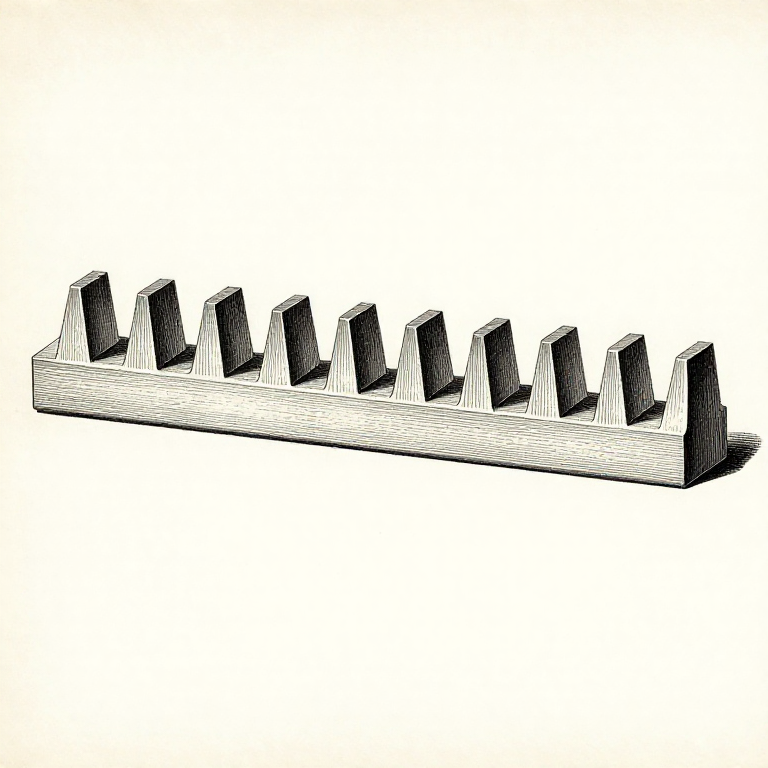


The Involute: Why Gear Teeth Are That Shape and No Other
Gear teeth are not an arbitrary shape that someone settled on. Almost every gear made since the nineteenth century uses one curve — the **involute** — and it is used because it is the only practical shape with one specific property.
**A pair of involute gears transmits rotation at a constant ratio even if the centre distance is slightly wrong.** Every other tooth form loses its smoothness the moment the shafts are not exactly where they should be, which in any real machine is always.
That tolerance to centre distance error is what made mass-produced gearing possible, and it is worth understanding rather than taking on trust.
高级
3 hours
说明
1
1
What an involute is
What an involute is
**Wind a string round a circle, hold the end, and unwind it keeping it taut.** The path the end traces is an involute of that circle. The circle is the **base circle**, and it is the only circle that matters to the shape of the tooth.
The property that follows immediately: at every instant the taut string is **tangent to the base circle and normal to the curve**. So when two involutes touch, the line of force between them is the common tangent to the two base circles — the same straight line, wherever in the mesh they happen to be touching.
That line is the **line of action**, and the fact that it does not move is the whole of why the involute works:
**The ratio is constant**, because the line of action always crosses the centre line at the same point.
**The direction of the force on the tooth is constant**, so the bearing loads do not fluctuate as each tooth passes.
**Moving the centres apart changes nothing but the pressure angle.** The base circles are unchanged, so the line of action is still their common tangent, and the ratio is still the ratio of the base circles. This is the property no other tooth form has.
**The cycloidal form**, used in clocks and in some older machinery, is smoother and more efficient at low load and is intolerant of centre distance error. That is exactly the trade a clock can accept and a gearbox cannot.
此步骤所需材料:
 正齿轮组(钢,20 齿)1 个
所需工具:
 放大目镜
放大目镜 量角器
量角器2
2
Pressure angle: what the number chooses
Pressure angle: what the number chooses
The **pressure angle** is the angle between the line of action and the common tangent to the pitch circles — in effect, how steeply the force pushes.
**14.5 degrees** was the old standard, and survives in a great deal of older machinery. Smoother and quieter, and it needs at least 32 teeth to avoid undercutting.
**20 degrees** is the modern standard almost everywhere. Stronger teeth — thicker at the root — and a pinion can go down to 17 teeth.
**25 degrees** is used for heavily loaded gearing. Stronger again, noisier, and higher bearing loads.
**The trade is direct:** a larger pressure angle gives a thicker, stronger tooth root and pushes the shafts apart harder. The force on the tooth splits into a tangential component, which does the work, and a radial component, which does nothing but load the bearings — and the radial component is the tangential one times the tangent of the pressure angle. At 20 degrees that is 36% of the useful force, at 25 degrees it is 47%.
**Two gears must share a pressure angle as well as a module.** A 20 degree gear and a 14.5 degree gear of the same module will mesh badly, wear quickly, and be noisy — and they will physically go together, which is what makes this a trap.
此步骤所需材料:
正齿轮组(钢,20 齿)2 个所需工具:
量角器放大目镜3
3
Contact ratio: why more than one tooth must be engaged
Contact ratio: why more than one tooth must be engaged
**Contact ratio** is the average number of tooth pairs in contact at any instant, and it must be greater than one or the drive stops between teeth.
**A contact ratio of 1.6** means that for 60% of the time two pairs are carrying the load and for 40% only one is. That is typical for a standard 20 degree spur pair, and it is the reason a tooth is designed for the whole load rather than half of it.
**Higher is better** for smoothness and noise. It is increased by more teeth, a smaller pressure angle, or a longer addendum.
**Below 1.2 the drive becomes rough**, because the load transfers abruptly from one pair to the next with nothing overlapping.
**Helical gears solve this differently.** The teeth are cut at an angle, so contact begins at one end of a tooth and sweeps across — engagement is gradual and several teeth are always in contact. That is why helical gearing is dramatically quieter, and the cost is an **axial thrust** along the shaft that the bearings must take.
**Double helical, or herringbone**, uses two opposite helices so the thrusts cancel. All the quietness, no thrust, and a gear that is much harder to cut — which is why it is found on large expensive drives and nowhere else.
此步骤所需材料:
正齿轮组(钢,20 齿)1 个 锥齿轮组(钢,1:1)1 个
所需工具:
放大目镜4
4
How the shape is actually made
How the shape is actually made
The involute is generated rather than copied, and that is why the catalogue's gear-cutting machines look the way they do.
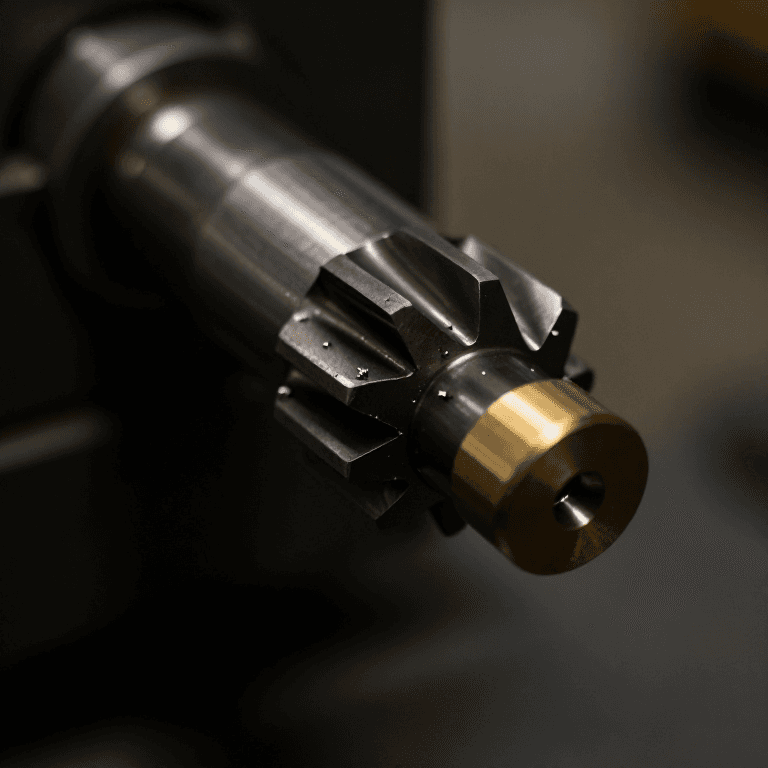
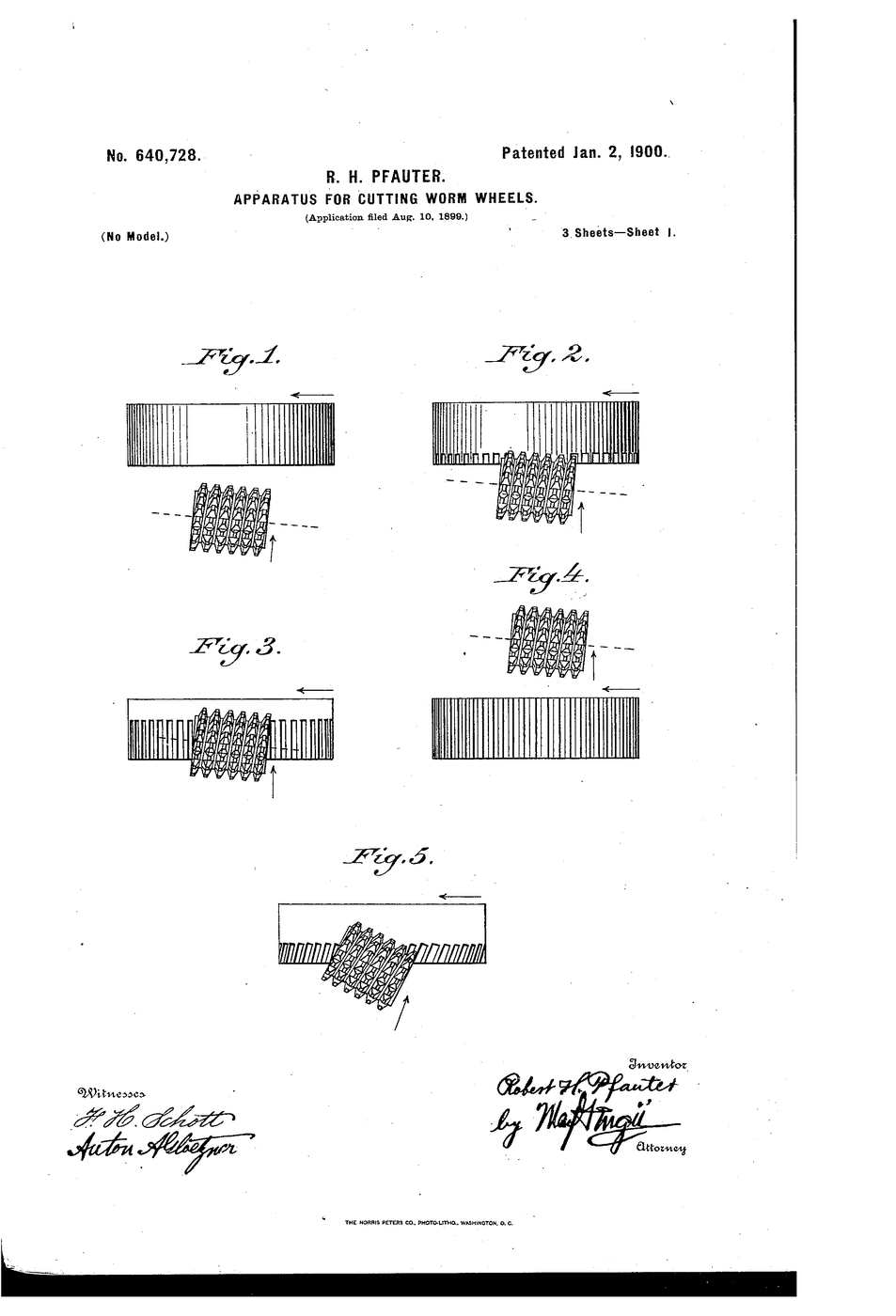
**Hobbing.** A hob is essentially a worm with cutting edges, and it is rolled against the blank as both rotate in a fixed ratio. The tooth shape is the envelope of all the positions the cutter passes through — the involute appears as a consequence of the rolling, and is never cut directly. One hob cuts every tooth count of its module, which is the enormous practical advantage.
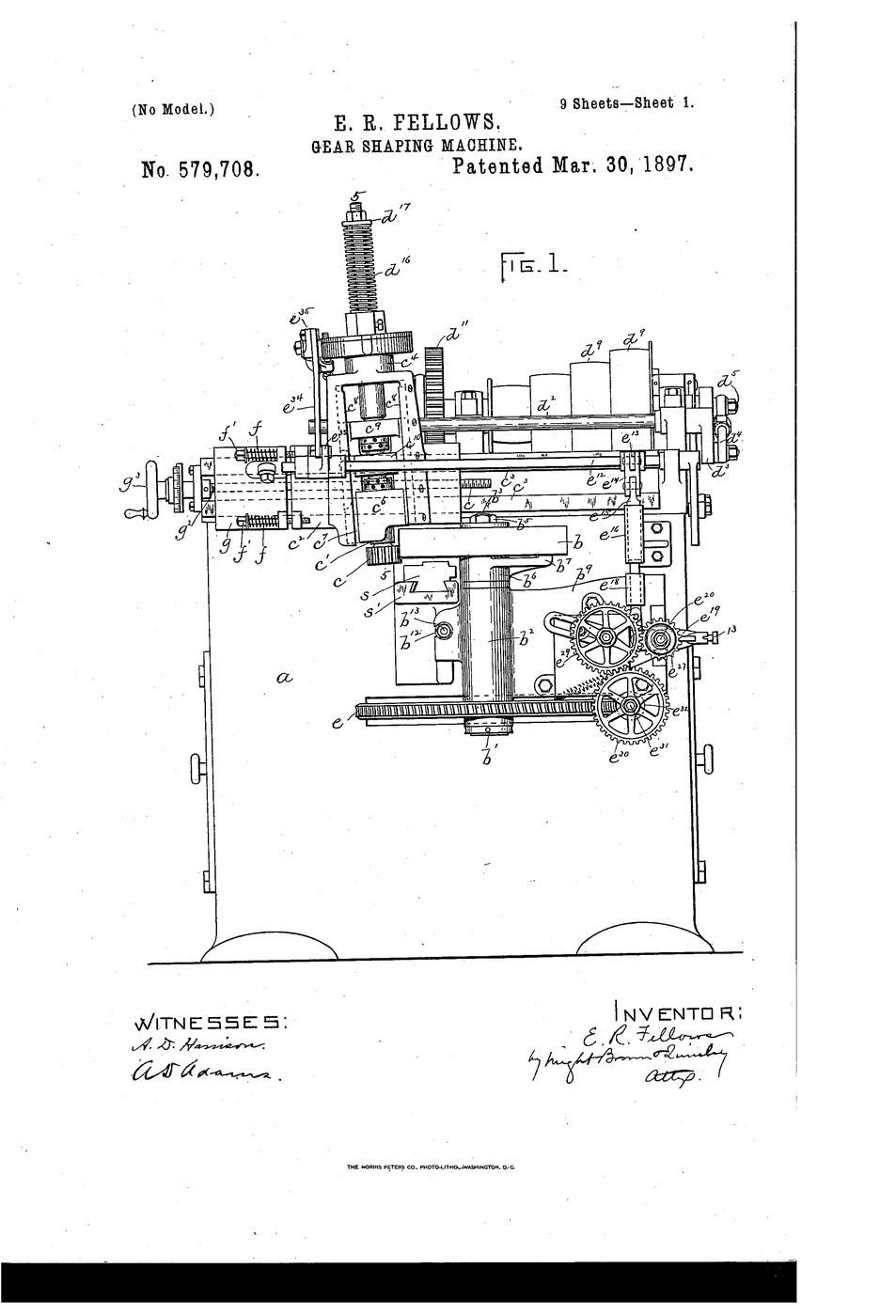
**Shaping.** A Fellows shaper uses a cutter shaped like a gear, reciprocating while it and the blank rotate together. It generates the same envelope, and it can cut internal gears and gears up against a shoulder, which a hob cannot.
**Form milling** cuts the space between teeth with a cutter shaped like the space. Simple, works on any milling machine, and needs a different cutter for each range of tooth counts — the eight-cutter sets — because the correct shape changes with the tooth count. It is an approximation, and good enough for many purposes.
**For strength, the finish matters as much as the shape.** A ground or shaved tooth flank carries far more load than an as-cut one, because the peaks of the roughness are where pitting starts.
此步骤所需材料:
正齿轮组(钢,20 齿)1 个 交换齿轮组1 个
所需工具:
放大目镜 6 英寸数显卡尺
相关蓝图
这些蓝图共享知识——技术、材料或原理


CC0 公共领域
此蓝图以 CC0 协议发布。你可以自由复制、修改、分发和使用此作品,无需征得许可。
通过购买蓝图中的产品支持创客,他们将获得 创客佣金 (由供应商设定),或创建此蓝图的新版本并将其作为连接包含在你自己的蓝图中以分享收入。