艺术
美容与健康
工艺
文化与历史
娱乐
环境
食品与饮料
逆向工程
科学
体育
技术
可穿戴设备
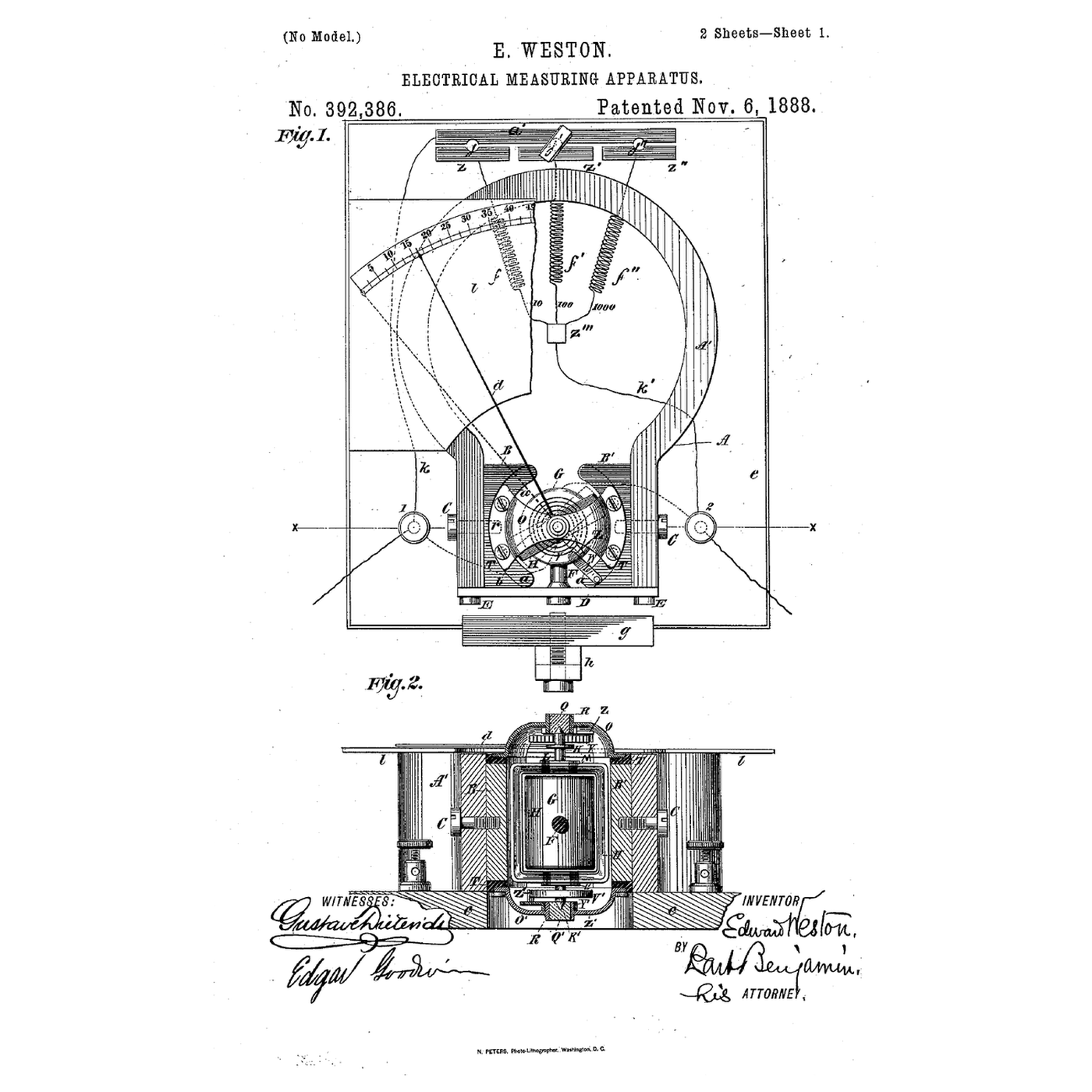


The Moving-Coil Meter: A Coil, a Spring and a Radial Field
A needle that swings across a scale in proportion to the current: the moving-coil meter was the standard electrical instrument for a century. Edward Weston's patents of 1888 made it portable and accurate. A light coil of fine wire on jewelled pivots sits between the poles of a permanent magnet, around a fixed iron cylinder; hair springs hold it at zero and carry the current in; the coil is wound on a copper frame that damps its swing so the needle settles instead of oscillating.
The iron cylinder is the clever part. It makes the magnetic field in the gap radial, so the coil's torque does not change as it turns, and the scale comes out evenly spaced.
This rung shows why in a notebook, then builds a thread-suspended galvanometer and demonstrates the damping.
中级
About 5 hours
说明
1
1
Read Weston's patent
Read Weston's patent
US 392,386 and US 392,387, 'Electrical Measuring Apparatus', Edward Weston, dated 6 November 1888 (the second a division of an application filed 17 March 1888). The current circulates *"through a coil or loop in the circuit, which coil is supported so as to be free"* to turn against *"a uniform resilient resistance"*, so that its movement *"shall be directly proportional"* to the current. The coil *"incloses a frame … of copper"*, and the patent explains that combining a *"diamagnetic mass with the said coil"* prevents *"undue oscillation"* — eddy-current damping.
2
2
Why the scale is linear
Why the scale is linear
正在加载 Jupyter 笔记本…
3
3
Build a thread-suspended galvanometer
Build a thread-suspended galvanometer
Print a rectangular coil former 20 × 20 mm and wind 50 turns of enamelled copper wire on it. Hang it by a single cotton thread from a bracket, so it can twist freely; bring the two wire ends down as fine, loose flexible leads. Glue a drinking-straw pointer to the top and a paper protractor scale behind it.
Place two neodymium magnets either side of the coil, one north-facing, one south-facing. Connect a 1.5 V cell through a resistor from the resistor kit (a few hundred ohms) and the multimeter in series. The coil turns until the thread's twist balances it. Try four resistors: deflection against current should be close to a straight line while the angle is small.
此步骤所需材料:
 漆包铜线1 卷
 PETG线材10 克
 棉线1 卷
棉线1 卷 钕磁铁套装1 套
 电阻套件1 套
 鳄鱼夹测试线1 套
所需工具:
 FDM 3D 打印机
 万用表
万用表 量角器
量角器4
4
Damp it by shorting the coil
Damp it by shorting the coil
Disconnect the cell and give the coil a small twist by hand. It swings back and forth many times before settling.
Now join the two coil leads together with a clip and twist it again. It settles almost at once. Moving through the field, the coil generates a current in its own shorted circuit, and that current's force opposes the motion — the same effect Weston got from the copper frame, and the same one the eddy-current brake in this catalogue uses.
所需工具:
鳄鱼夹测试线5
5
History and context
History and context
**US 392,386 and US 392,387, 'Electrical Measuring Apparatus', Edward Weston, dated 6 November 1888.** Arsène d'Arsonval had built a moving-coil galvanometer with a suspended coil in 1882; Weston made it robust and portable with pivots, springs, a permanent magnet and the radial field. Weston's company made the instruments that measured the electrical industry for decades.
**Honest limits.** A moving-coil movement responds only to direct current — on AC it needs a rectifier. It draws current from the circuit it measures (the next rung). Pivots wear, springs age, and a strong knock or overload bends the needle.
材料
6- 1 卷占位符
- 10 克占位符
- 1 卷占位符
- 1 套占位符
- 1 套占位符
相关蓝图
这些蓝图共享知识——技术、材料或原理



CC0 公共领域
此蓝图以 CC0 协议发布。你可以自由复制、修改、分发和使用此作品,无需征得许可。
通过购买蓝图中的产品支持创客,他们将获得 创客佣金 (由供应商设定),或创建此蓝图的新版本并将其作为连接包含在你自己的蓝图中以分享收入。