艺术
美容与健康
工艺
文化与历史
娱乐
环境
食品与饮料
逆向工程
科学
体育
技术
可穿戴设备



The Perforated Paper Roll: Bonds That Break One Sheet at a Time
A roll of paper divided into sheets needs lines of weakness that part at a gentle pull — but only one at a time, and without tearing across the sheet.
Seth Wheeler of Albany, New York, filed US 459,516 on 10 June 1891; it is dated 15 September 1891. His "wrapping or toilet paper roll" has sheets "only partially separated", with the points of attachment between them placed "alternately out of parallel lines" through the roll, so that a pull on the free end "will not be transmitted in a direct line through a series of sheets" and each sheet separates easily on its own. His drawing shows the roll hung on a simple fixture with the paper coming over the top.
This rung works out how much paper a roll holds and what the bonds must carry, and tests rolls with different bond patterns.
初学者
About 2 hours
说明
1
1
Length on a roll and bond strength
Length on a roll and bond strength
正在加载 Jupyter 笔记本…
2
2
Where continuous paper comes from
Where continuous paper comes from
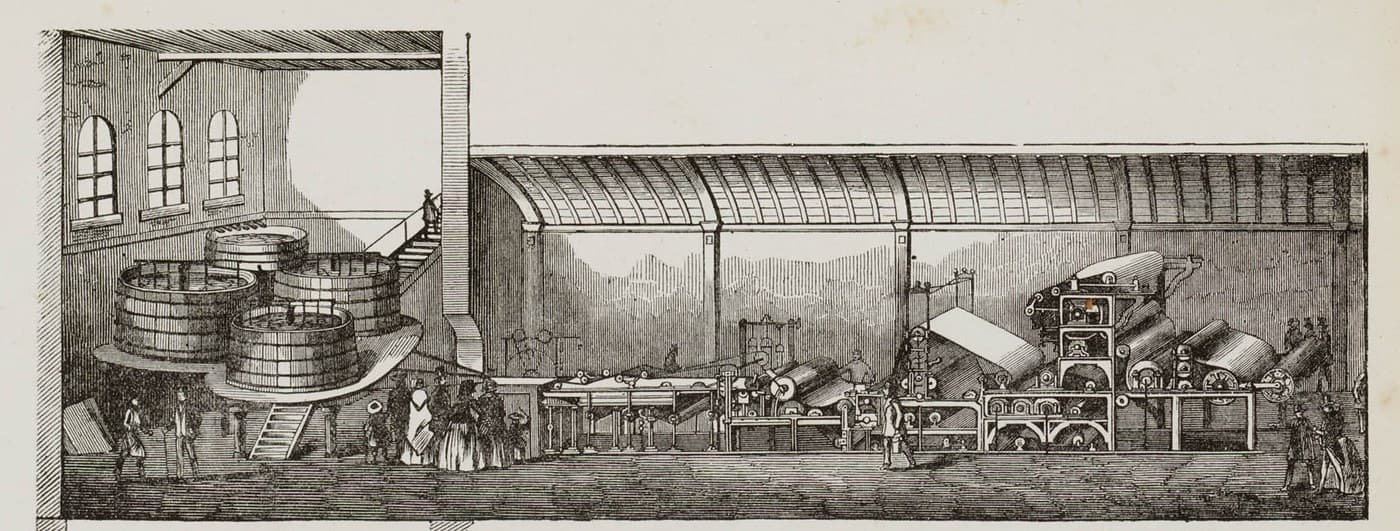
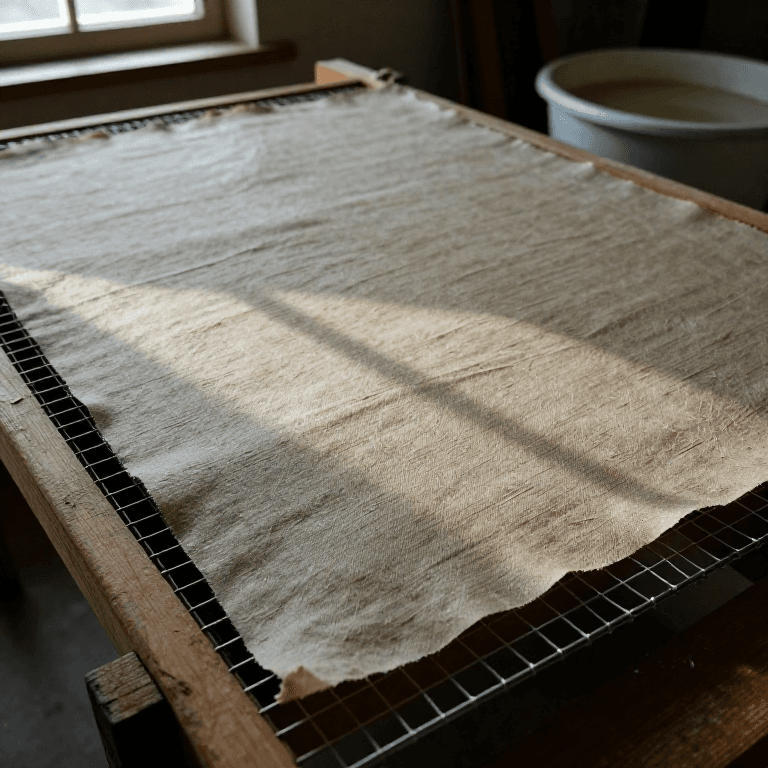
Rolls of paper became possible when paper was made in a continuous web. The embedded blueprint shows the machine.
3
3
Read US 459,516
Read US 459,516
Wheeler's roll is "so constructed that the points of attachment and severance between the sheets will be alternately out of parallel lines running through the whole body of the sheets, so that a pull upon the free end of the web will not be transmitted in a direct line through a series of sheets, but will be diverted by the spaces opposite the connecting points of the sheet pulled upon, thereby producing a transverse strain upon the next line of connecting points sufficient to break them."
Earlier roll-makers had put "the connecting points or bonds in parallel lines, or nearly so", so that if the free end were pulled in line with them "a long series of sheets may be drawn from the roll unless the free movement of the roll is prevented by friction or other means." Other inventors had instead built holders to stop the roll unwinding — "more or less complicated, liable to derangement, and expensive".
In Fig. 1 the points e and e′ lie near the margins and "alternate through the whole roll"; nearer the centre (f, f′) "they should be narrower to avoid any probability of tearing into the body of the sheets". Other figures show two points alternating with one, and an oblique form of sheet. "My improved roll may be used on the simplest holders."
4
4
Make bond patterns and pull them
Make bond patterns and pull them
Cut three long strips of paper towel. On each, every 11 cm, cut across the strip with a craft knife on the cutting mat, leaving bonds uncut: on the first, two 5 mm bonds at the edges on every line; on the second, one 5 mm bond alternating from edge to edge line by line, as Wheeler did; on the third, one 5 mm bond in the middle of every line.
Roll each strip onto a card tube, hang it on a dowel and pull the free end at a steady rate, sometimes straight and sometimes towards one side. Count how many sheets come off per pull and whether any sheet tears across. Hook the spring scale to the end to read the parting force.
此步骤所需材料:
 厨房纸巾1 个
 卡纸1 个
卡纸1 个 硬木销钉1 个
 卫生纸1 个
所需工具:
 手工刀
手工刀 自愈式切割垫
 直尺
直尺 测力计(弹簧秤)
5
5
A paper roll that misbehaves
A paper roll that misbehaves
Perforated roll troubleshooting.
Flow
Loading...
6
6
History and honest limits
History and honest limits
**Seth Wheeler** of Albany, New York, filed US 459,516 on 10 June 1891; it is dated 15 September 1891. He claims a roll of partially separated sheets whose points of attachment are arranged out of line from sheet to sheet.
**Honest limits.** Roll sizes, paper thickness and tear forces in the notebook are examples; tearing depends on the fibre, the moisture and the pull's direction.
相关蓝图
这些蓝图共享知识——技术、材料或原理




CC0 公共领域
此蓝图以 CC0 协议发布。你可以自由复制、修改、分发和使用此作品,无需征得许可。
通过购买蓝图中的产品支持创客,他们将获得 创客佣金 (由供应商设定),或创建此蓝图的新版本并将其作为连接包含在你自己的蓝图中以分享收入。