艺术
美容与健康
工艺
文化与历史
娱乐
环境
食品与饮料
逆向工程
科学
体育
技术
可穿戴设备
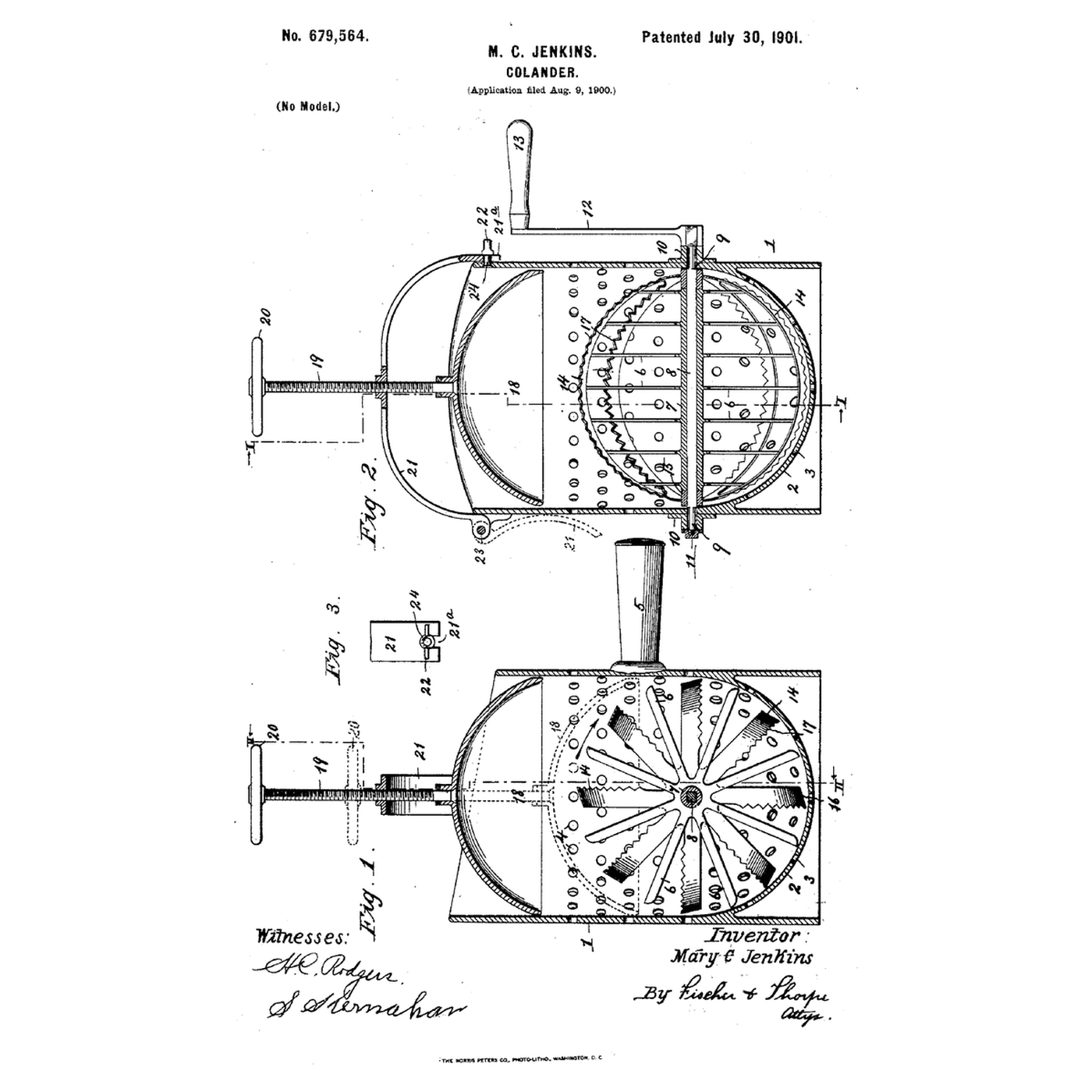


The Pressing Colander: Knives, Loops and a Plunger Over a Perforated Bowl
Making jelly starts with getting the juice out of cooked fruit: pressing it through a colander by hand with a spoon is slow and leaves much behind.
Mary C. Jenkins of Kansas City, Kansas, received US 679,564, dated 30 July 1901 (filed 9 August 1900), for a colander "for the purpose of cutting up raw or cooked fruits and pressing out their juices preparatory to making jellies, syrups, apple-float": a perforated cylinder with a hemispherical bottom, a crank-turned shaft carrying knives and pressing loops, and a plunger on a screw that presses the fruit to the dasher and keeps it from being thrown out.
This rung models how pressure and pulp fineness set the juice flow, then presses cooked apples with and without pressing and weighs the juice.
初学者
About 2 hours
说明
1
1
Pressure, pulp and juice
Pressure, pulp and juice
正在加载 Jupyter 笔记本…
2
2
Pressing food through holes
Pressing food through holes
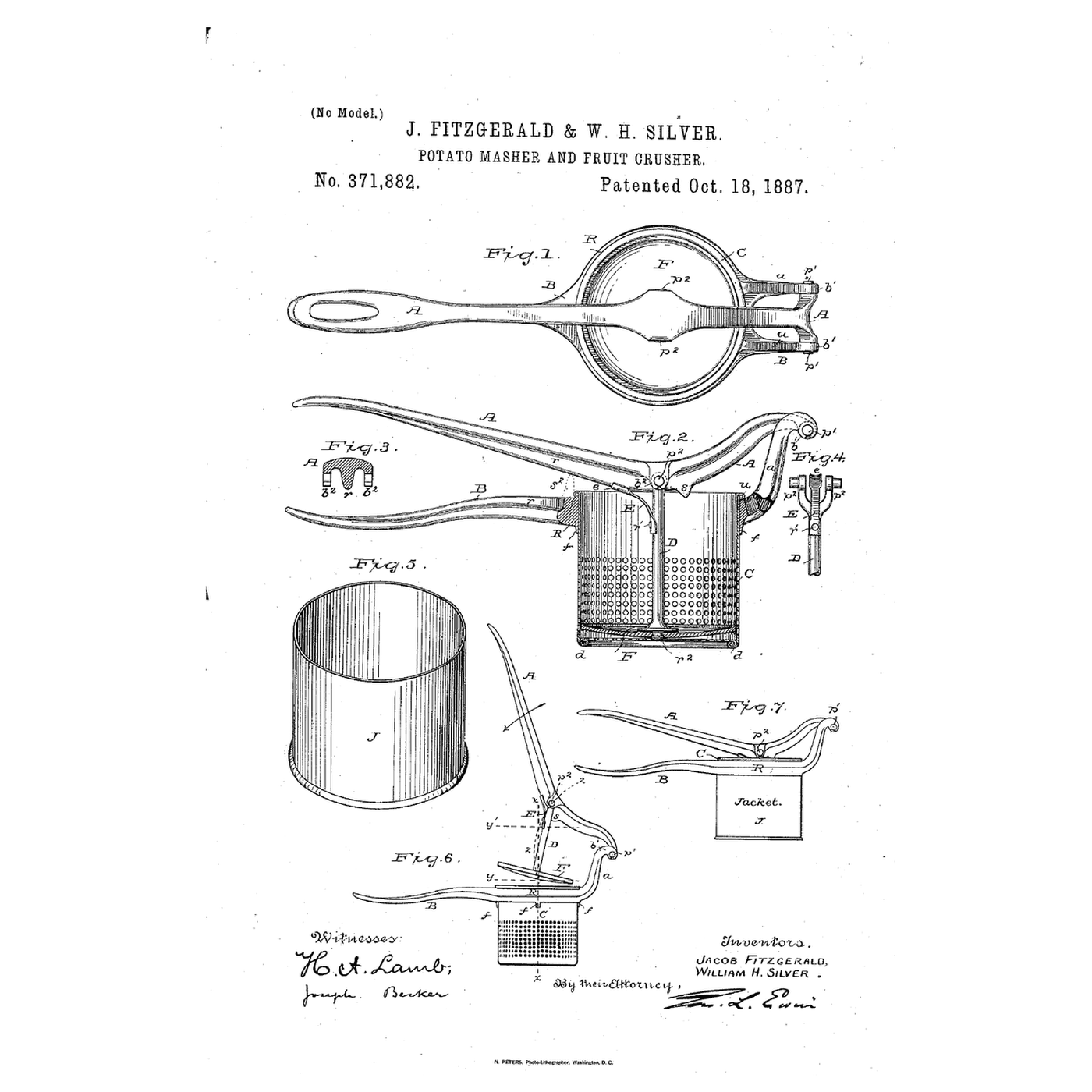
The ricer presses cooked potato through a perforated cup. The embedded blueprint shows it.
3
3
Read US 679,564
Read US 679,564
"My invention relates to improvements in colanders; and my object is to provide a utensil of this character for the purpose of cutting up raw or cooked fruits and pressing out their juices preparatory to making jellies, syrups, apple-float, &c."
"The face portions 16 of said loops are arranged to present an inclined surface to the hemispherical bottom in order that when rotating in the direction indicated by the arrow in Fig. 1 they will catch and press the fruit against the bottom 2 and force the juice through the perforations thereof, while the serrated rear edges 17 of the loops will thoroughly macerate the smaller particles of fruit not cut by the knives by pressing them against said bottom 2. In order that the dasher may the more effectually perform its work, I press the fruit in contact therewith by a vertically-operating plunger, which also prevents the fruit or a portion thereof from being cast out of the cylinder by the rotating dasher."
4
4
Press cooked apples two ways
Press cooked apples two ways
Quarter and simmer six apples in a little water until soft; let them cool until safe to handle. Divide into two equal weights.
Put the first half in a colander over a bowl and let it drain for ten minutes without pressing; weigh the juice. Put the second half in and press it with a spoon or a masher for ten minutes, stirring as Jenkins's loops do; weigh that juice. Compare juice per 100 g of fruit. Keep hands off hot fruit; it holds heat.
此步骤所需材料:
 苹果6 个
苹果6 个 水0.5 升
所需工具:
 滤盆
滤盆 碗
碗 数字天平
数字天平 秒表
秒表5
5
A colander that clogs or lets pulp through
A colander that clogs or lets pulp through
Pressing colander troubleshooting.
Flow
Loading...
6
6
History and honest limits
History and honest limits
**Mary C. Jenkins** of Kansas City, Kansas, filed US 679,564 on 9 August 1900; it is dated 30 July 1901. The cylinder may be "glass, porcelain, or other suitable material".
**Honest limits.** The patent gives no sizes. Viscosity, permeabilities, pressures, area and pulp thickness in the notebook are examples; Darcy's law is only a rough guide for a squeezed pulp.
相关蓝图
这些蓝图共享知识——技术、材料或原理



CC0 公共领域
此蓝图以 CC0 协议发布。你可以自由复制、修改、分发和使用此作品,无需征得许可。
通过购买蓝图中的产品支持创客,他们将获得 创客佣金 (由供应商设定),或创建此蓝图的新版本并将其作为连接包含在你自己的蓝图中以分享收入。