艺术
美容与健康
工艺
文化与历史
娱乐
环境
食品与饮料
逆向工程
科学
体育
技术
可穿戴设备



The Reversible Sad-Iron Stand: Feet That Lock to the Board
A hot iron has to rest somewhere between strokes. On a board that tips, the stand can slide off with it.
Susan T. Inesly of New York received US 148,706, dated 17 March 1874 (filed 10 December 1873), for a sad-iron holder "constructed with feet on one side and a vertical rim or flange on its other, whereby said holder can be reversed to present either face for supporting the iron". Bars screwed to the ironing board take the feet, so the holder "is not liable to slide off the same if the board be tilted".
This rung works out the tilt at which a stand starts to slide, and the force the bars must then take. You then make a stand with locating feet and test it on a tilted board.
初学者
About 2 hours
说明
1
1
The tilt that starts a slide
The tilt that starts a slide
正在加载 Jupyter 笔记本…
2
2
What the stand holds
What the stand holds
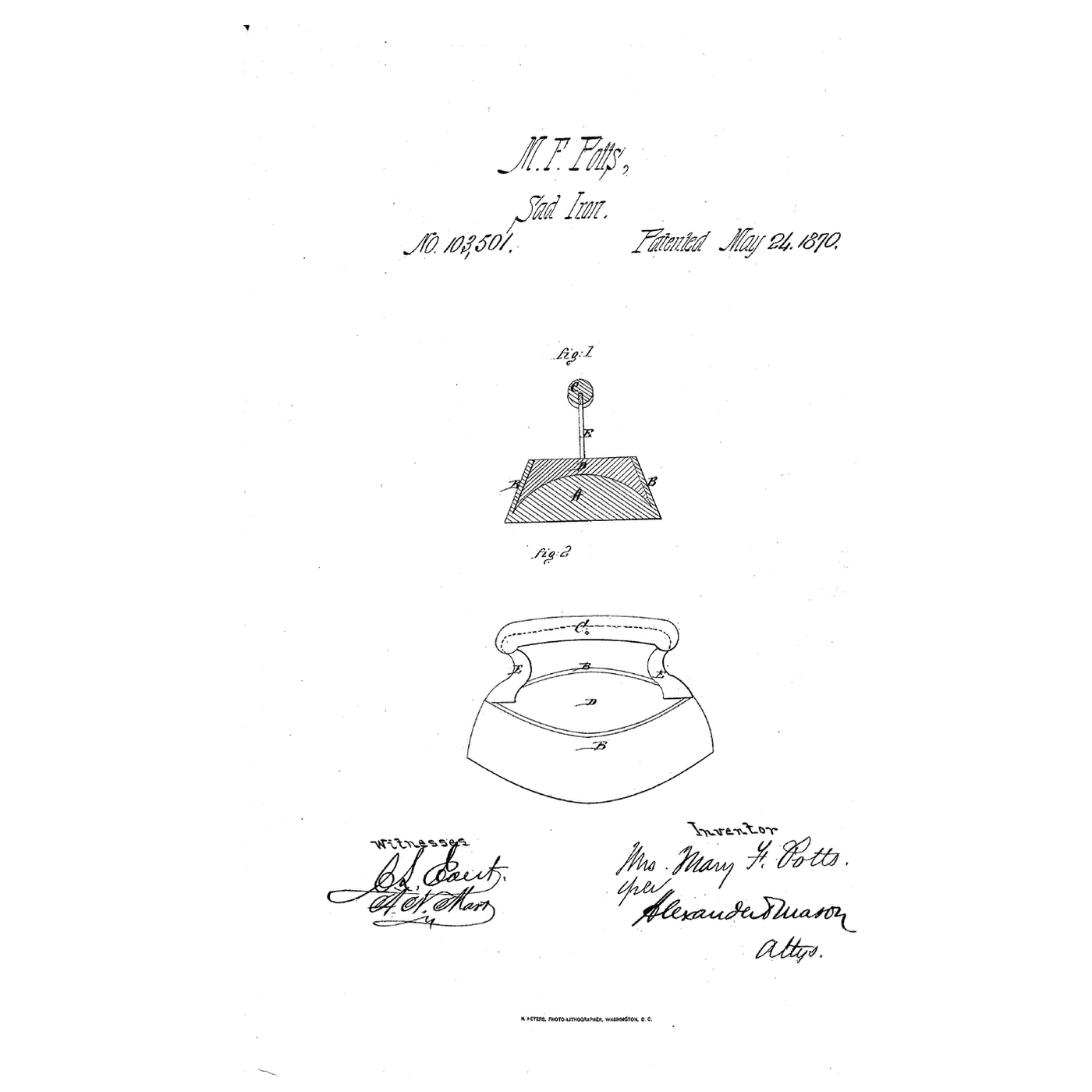
The embedded blueprint covers the sad iron itself: a heavy iron heated on the stove, set down between strokes.
3
3
Read US 148,706
Read US 148,706
"The object of this invention is to furnish a sad-iron holder which is capable of the uses of the ordinary holders, and which can be reversed or either side turned up to support the iron, while it may be securely held in place on an ironing board or table, if desired."
"The said brackets or bars D are intended to be used on ironing-boards for the purpose of preventing the holder from sliding off the same, as when putting on or taking off a skirt, when the board must be tilted; but for ordinary table-use they are not essential."
4
4
Make a stand with locating feet and tilt it
Make a stand with locating feet and tilt it
Cut an iron-shaped plate from steel sheet with the tin snips and file the edges smooth. Rivet two short folded strips under it as feet. Along the edge of the other face, rivet a strip bent up as a low rim, so the plate can be used either way up.
Screw two short wooden bars to a board, with holes drilled to take the feet.
First set the stand on the bare board, load it with a weight and tilt the board slowly. Read the angle on the protractor when it starts to slide; the tangent of that angle is your friction coefficient. Then drop the feet into the bars and tilt again. Compare with the notebook.
此步骤所需材料:
 钢板1 个
钢板1 个 抽芯铆钉8 个
 松木板1 个
 木螺钉4 个
所需工具:
 锅垫
锅垫 铁皮剪
铁皮剪 金属锉
金属锉 充电式电钻
充电式电钻 量角器
量角器 配重
配重5
5
A stand that slides, rocks or scorches
A stand that slides, rocks or scorches
Iron stand troubleshooting.
Flow
Loading...
6
6
History and honest limits
History and honest limits
**Susan T. Inesly** of New York filed US 148,706 on 10 December 1873; it is dated 17 March 1874.
**Honest limits.** The notebook uses one friction coefficient for starting and sliding, and treats the stand as a block. A real stand can tip before it slides. The masses, friction values and angles are examples. Your tilt measurements are the measurement.
相关蓝图
这些蓝图共享知识——技术、材料或原理



CC0 公共领域
此蓝图以 CC0 协议发布。你可以自由复制、修改、分发和使用此作品,无需征得许可。
通过购买蓝图中的产品支持创客,他们将获得 创客佣金 (由供应商设定),或创建此蓝图的新版本并将其作为连接包含在你自己的蓝图中以分享收入。