艺术
美容与健康
工艺
文化与历史
娱乐
环境
食品与饮料
逆向工程
科学
体育
技术
可穿戴设备
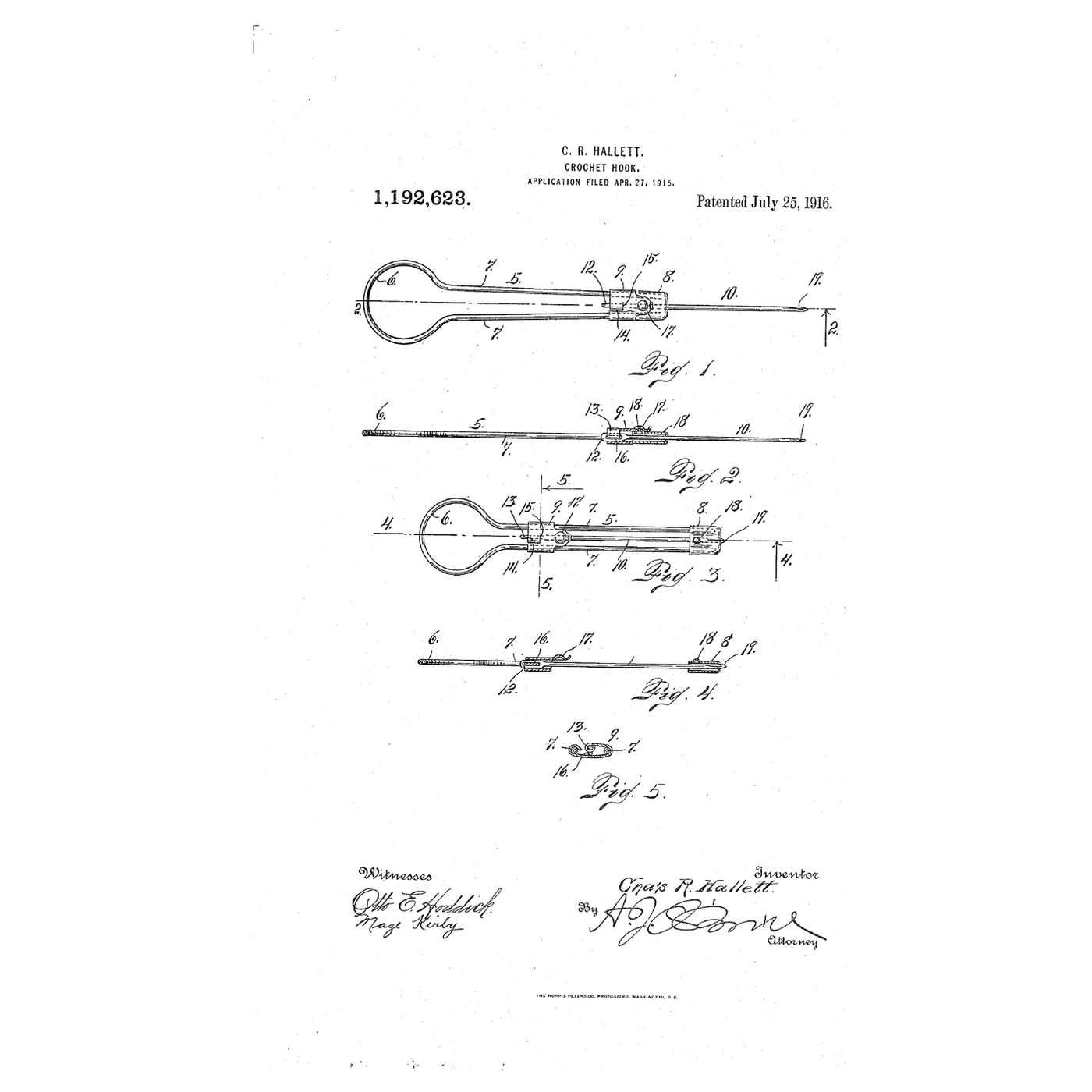


The Spring-Loop Sliding Crochet Hook: The Hook Draws In and Holds Its Thread
Crochet laid down loses its thread, and a hook fixed in its handle is always its full length.
Charles R. Hallett of Denver, Colorado, received US 1,192,623, patented 25 July 1916, for a crochet hook "which, when the hook is not in use, may be adjusted to hold the thread employed in the work so that when the user resumes the work after a period of cessation, no delay is required for the purpose of finding the thread." The handle is a single loop of spring wire whose arms are joined by a band; a clasp sliding on the arms carries the needle, locked forward by a spring lip over a stud on the band, and drawn back it pulls the hook against the band with the thread in it.
This rung works out how hard the arms grip the clasp, then bends the loop, makes the band, clasp and needle, and leaves a chain of stitches parked on it.
高级
About 5 hours
说明
1
1
Grip of the spring arms
Grip of the spring arms
正在加载 Jupyter 笔记本…
2
2
A needle on spring wire before it
A needle on spring wire before it
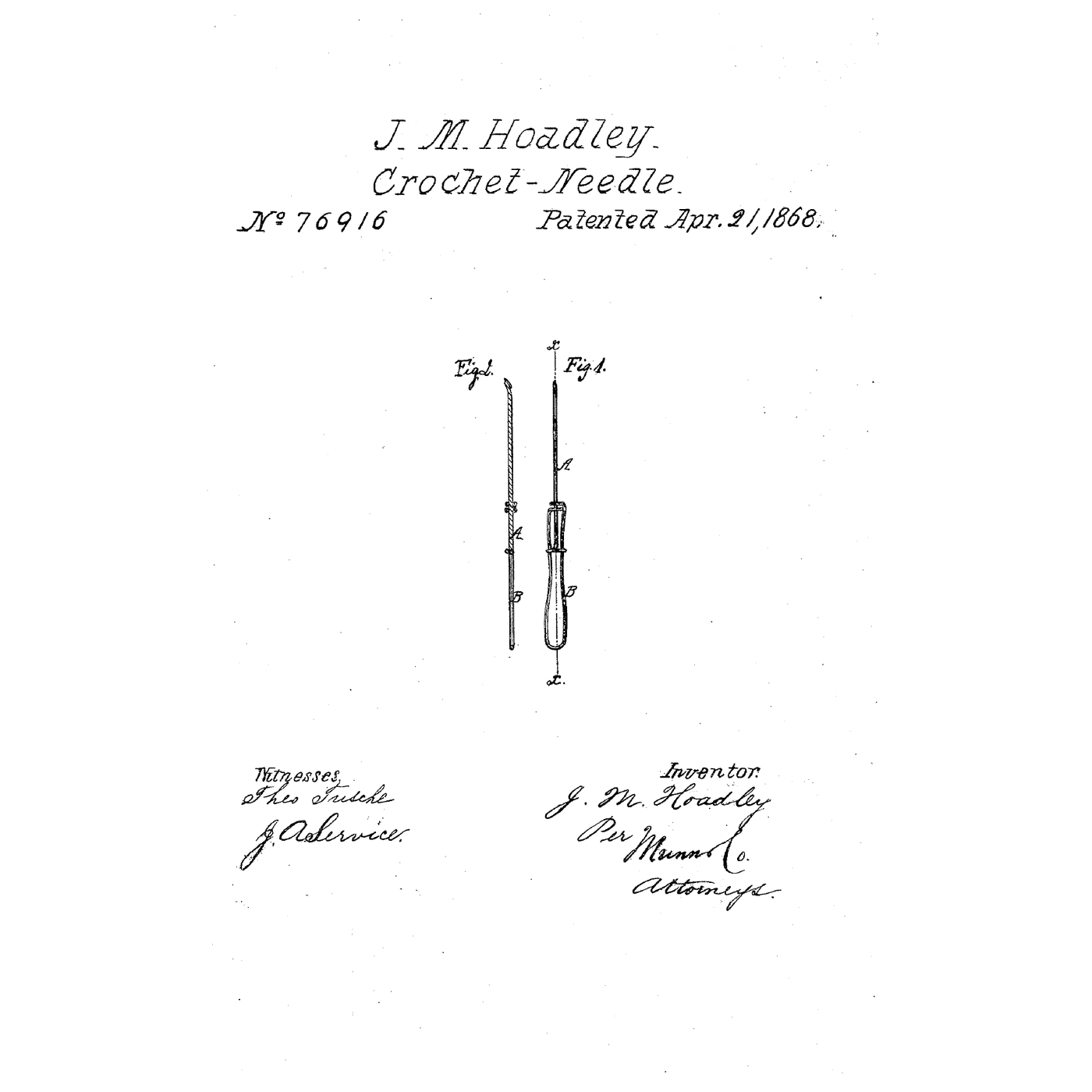
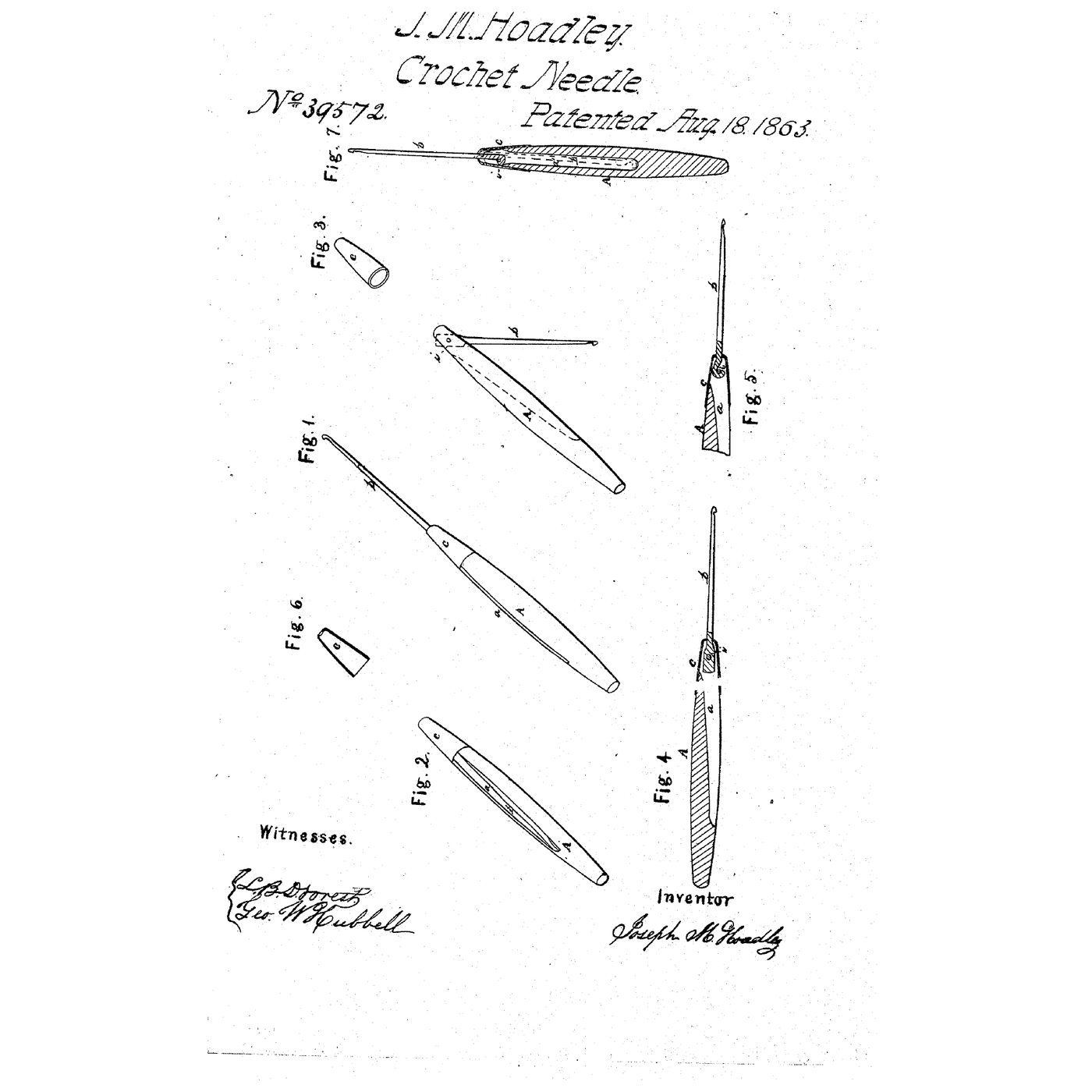
The embedded blueprint slides a crochet needle on a holder of tempered wire that grips it. Hallett's whole handle is one spring-wire loop, and a clasp on its arms carries the needle in and out.
3
3
Read US 1,192,623
Read US 1,192,623
"Let the numeral 5 designate the body or handle of the instrument, which as shown in the drawing, is formed from an integral piece of relatively strong spring wire, arranged in the form of a closed loop, the closed end of the loop consisting of an approximately circular part 6 which merges into spring arms 7 arranged in approximately parallel relation."
"At the same time, the hook 19 of the needle will draw the thread with it and retain the thread as long as the device is in the collapsed or inactive position. As the clasp is moved rearwardly, the arms 7 are compressed or moved inwardly toward each other to cause them to change their normal or slightly diverging position as illustrated in Fig. 1, to the parallel position illustrated in Fig. 3."
4
4
Bend the handle and fit the hook
Bend the handle and fit the hook
**Handle.** Bend 1.6 mm spring steel wire round a 35 mm dowel into a circle, cross the ends and bend both straight on as arms 9 cm long, so that with their front ends 6 mm apart they stand 3 mm wider apart where they leave the circle.
**Band.** Cut a strip of brass sheet 8 × 30 mm, wrap it round both arm ends with the arms 6 mm apart, squeeze it tight with pliers and set it with epoxy, leaving a gap between the arms for the needle. Raise a small dome on its rear face with the centre punch.
**Needle.** Cut 11 cm of 3 mm steel rod. File a hook with a throat about 1 mm deep at one end. Hammer the other 8 mm flat on the anvil and drill two 2 mm holes side by side, filing them into one long eye.
**Clasp.** Cut brass sheet 10 × 30 mm. Slit a tongue in its middle on two sides and bend it down; bend the sides round the two arms 6 mm apart so it slides, and grips harder as it is drawn back toward the circle. Pass the needle through the band, hook its eye on the tongue and close the tongue with pliers. Cut a spring lip on the clasp's front edge and punch a dimple in it that snaps over the dome.
**Test.** With the hook out, crochet a chain of 20 stitches, catch the thread and draw the clasp back. Hang the spring scale on the clasp and read the pull that moves it; then carry the work about and see whether the thread is still held.
此步骤所需材料:
 弹簧钢丝1 个
 黄铜板1 个
 双组分环氧胶1 个
 低碳钢圆棒0.15 米
 纱线1 个
纱线1 个所需工具:
 圆嘴钳
圆嘴钳 平口钳
平口钳 铁皮剪
铁皮剪 什锦锉套装
什锦锉套装 锉刀(手用锉)
 台虎钳
台虎钳 锤子
锤子 铁砧
铁砧 中心冲
中心冲 充电式电钻
充电式电钻 钻头套装
钻头套装 弹簧秤
弹簧秤 6 英寸数显卡尺
 透明安全眼镜
5
5
A hook that slips, will not lock or drops its thread
A hook that slips, will not lock or drops its thread
Spring-loop sliding crochet hook troubleshooting.
Flow
Loading...
6
6
History and honest limits
History and honest limits
**Charles R. Hallett** of Denver, Colorado, filed US 1,192,623 on 27 April 1915; it was patented 25 July 1916. The needle 10's inner end has an eye or elongated opening 12, entered by a lip 13 on the clasp 9, formed by slitting the clasp at 14 and 15 and bending the freed part through the eye; the clasp's forward spring lip 17 has a recess that takes a small convex projection 18 on the band 8, and yields to a pull on the clasp. The shank moves freely through the band between the arms' ends, and drawn back the instrument is shorter. His claims cover the handle and needle with a spring lip and projection that lock them extended, and the handle of spaced arms joined by a spring and a band open between them, with the clasp and its lip in the needle's eye.
**Honest limits.** A band set with epoxy and a hand-filed needle stand in for his. The notebook treats each arm as a straight cantilever; its sizes and friction are examples. The pull you read is the result.
相关蓝图
这些蓝图共享知识——技术、材料或原理



CC0 公共领域
此蓝图以 CC0 协议发布。你可以自由复制、修改、分发和使用此作品,无需征得许可。
通过购买蓝图中的产品支持创客,他们将获得 创客佣金 (由供应商设定),或创建此蓝图的新版本并将其作为连接包含在你自己的蓝图中以分享收入。