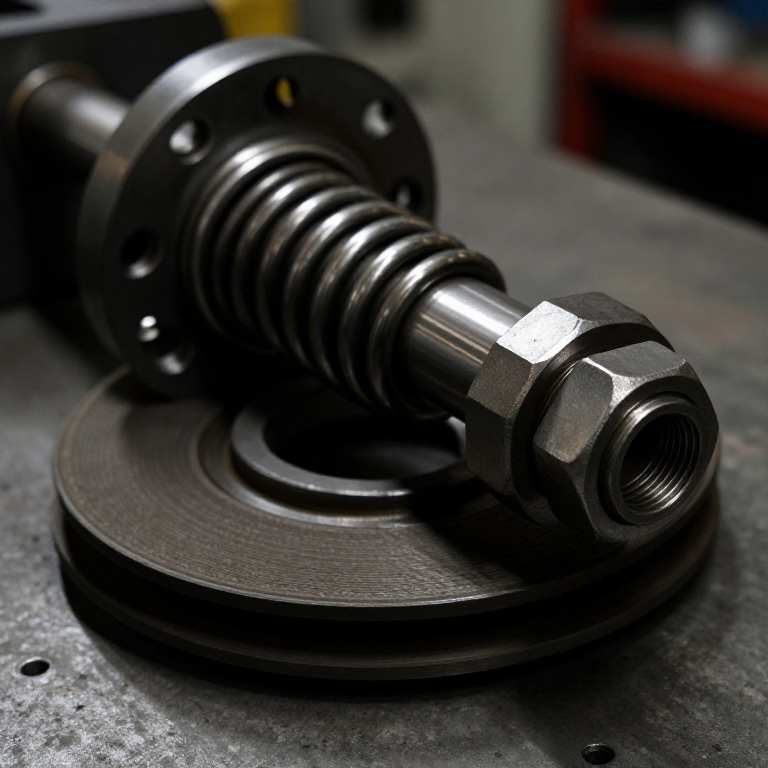


Torque Limiter
说明
Build the friction stack
Build the friction stack
Two driving faces, one driven plate between them.
- Cut two 90 mm flanges and one 90 mm centre plate from 18 mm ply faced with 6 mm aluminium.
- Bore all three 8.0 mm.
- Key the two outer flanges to the shaft with M5 cup point set screws × 2.
- Leave the CENTRE plate free to rotate on the shaft, and fit the output sprocket or pulley to it.
- Face the centre plate with leather or cork on both sides.
Why a facing material. Metal on metal has a friction coefficient that changes with surface finish, temperature and the slightest trace of oil, so the slip torque wanders. Leather, cork or a woven lining is far more stable, and a stable coefficient is the whole point of a device whose job is to slip at a KNOWN torque.
Two friction faces rather than one doubles the torque for the same spring force, because both sides of the centre plate carry it. Multi-plate limiters simply extend that idea.此步骤所需材料:
 波罗的海桦木胶合板1 张
 铝扁条1 个
 凹端紧定螺钉2 个
 铝圆棒1 个
所需工具:
 曲线锯
曲线锯 充电式电钻
充电式电钻 钻头套装
钻头套装 内六角扳手组
 锉刀套装
锉刀套装 6 英寸数显卡尺
Add the spring and the adjusting nut
Add the spring and the adjusting nut
The spring sets the clamping force; the nut sets the spring.
- Fit a compression spring behind the outer flange, over the shaft.
- Thread the shaft end M10, or fit a captured M10 hex nut and washer to compress the spring.
- Add a locknut so the setting cannot drift.
- Mark a scale on the shaft or hub so spring compression can be measured and repeated.
Mark the scale before you calibrate. A torque limiter whose setting cannot be recorded and returned to is not a safety device — it is an adjustable mystery. Commercial limiters have a graduated collar for exactly this reason.
Use a spring whose working range you can actually measure. A very stiff spring reaches its limit in a fraction of a turn, making the setting almost impossible to control by hand.此步骤所需材料:
 压缩弹簧套装1 套
 平垫圈4 个
 六角螺母2 个
所需工具:
内六角扳手组6 英寸数显卡尺 台虎钳锉刀套装
Calibrate it — three settings, measured
Calibrate it — three settings, measured
An uncalibrated limiter protects nothing in particular.
- Clamp the shaft so it cannot turn.
- Wrap a cord round the output plate at a known radius and hang weights until it slips.
- Torque = weight × radius. Record it against the spring compression.
- Tighten the nut by a measured amount and repeat.
- Repeat once more, then plot torque against spring compression.
所需工具:
6 英寸数显卡尺内六角扳手组台虎钳Test the failure it is for — and the one it is not
Test the failure it is for — and the one it is not
Know both what it protects and what it does not.
- Set the limiter to a modest torque and drive the output against a gradually increasing load. It slips smoothly at the set point.
- Let it slip for thirty seconds, then stop and feel the friction faces.
- Now jam the output SUDDENLY at speed and observe.
- Compare what happened in the two cases.
所需工具:
充电式电钻 秒表6 英寸数显卡尺
Choosing the weak link, and history
Choosing the weak link, and history
Designing in a deliberate weak point is a mature engineering habit and it appears everywhere: the electrical fuse, the pressure relief valve, the shear pin, the crumple zone. In each case the designer decides in advance what will fail, so that the failure is cheap, safe and predictable rather than random and expensive.
Where friction limiters are standard: agricultural power take-off shafts, where a baler or mower can hit a stone; conveyor drives; machine tool feeds; and the packaging machinery whose jams would otherwise bend a screw conveyor. All are places where overloads are routine rather than exceptional, so a device that resets itself is worth far more than one that must be replaced.
Against the shear pin: the limiter slips and recovers with no parts consumed and no downtime, but its torque drifts as the linings wear or get contaminated. The shear pin fails at a precise, repeatable load determined by a known cross-section of a known material, but the machine stops dead until someone fits a new pin. Resettable and approximate against absolute and single-use — and which is right depends entirely on how often you expect the overload and how bad an unnoticed drift would be.
The dangerous failure mode to know about: a friction limiter that has been slipping repeatedly gets hot, glazes its linings and can end up transmitting LESS torque than intended — or, if contaminated and then dried, considerably more. Both are silent. Re-calibrating periodically is part of using one properly.
CC0 公共领域
此蓝图以 CC0 协议发布。你可以自由复制、修改、分发和使用此作品,无需征得许可。
通过购买蓝图中的产品支持创客,他们将获得 创客佣金 (由供应商设定),或创建此蓝图的新版本并将其作为连接包含在你自己的蓝图中以分享收入。