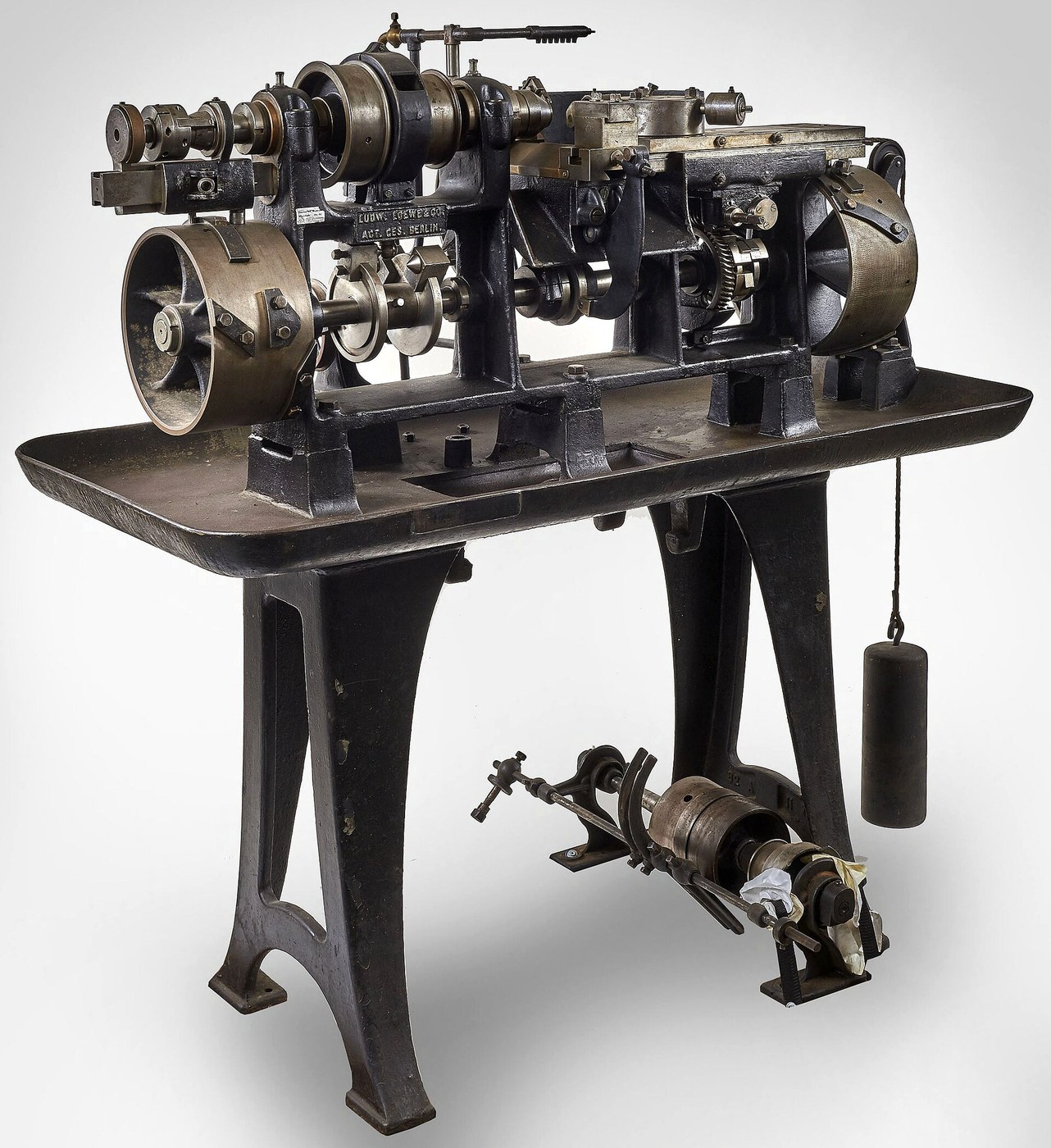


Turret Lathe
说明
Build the turret head with six stations
Build the turret head with six stations
A hexagonal block that carries every tool the job needs.
- Cut a hexagonal turret 120 mm across flats from 18 mm ply faced with 6 mm aluminium, or from solid aluminium bar.
- Bore each of the six faces 12 mm to take a tool holder shank.
- Bore the centre 8.0 mm for its pivot.
- Fit a M5 cup point set screw in each face to clamp its tool.
- Check every bore is the same distance from the centre with the caliper.
Equal radius from the centre is what makes indexing meaningful. If one station sits 0.5 mm further out than the rest, the tool in it cuts 0.5 mm deeper on every part — and because the machine is doing the same thing every cycle, that error repeats perfectly. A turret lathe converts a setup error into a production run of identical wrong parts.
Bore the six faces in one setup if you possibly can, rotating the blank rather than moving the drill. That is the same stack-drilling logic used on the linkages, applied around a circle.此步骤所需材料:
 波罗的海桦木胶合板1 张
 铝扁条1 个
 凹端紧定螺钉6 个
所需工具:
 钢丝锯(曲线锯)
 充电式电钻
充电式电钻 钻头套装
钻头套装 锉刀套装
锉刀套装 6 英寸数显卡尺
 组合角尺
组合角尺 中心冲
中心冲Make the indexing detent — repeatability is the product
Make the indexing detent — repeatability is the product
The turret must return to precisely the same six positions, every cycle, for years.
- Drill six detent holes in the turret's underside, 60 degrees apart, on a common radius.
- Fit a spring-loaded tapered plunger in the saddle beneath, to drop into each hole.
- Make the plunger's taper match the hole's chamfer so it pulls the turret into position as it seats.
- Add a lock lever that clamps the turret once indexed.
A tapered detent is self-centring; a cylindrical one is not. A parallel pin in a parallel hole can sit anywhere within the clearance, so each index lands slightly differently. A taper wedges into the hole and forces it to the same place every time, taking up its own wear as it goes. That distinction is the difference between a machine that makes identical parts and one that nearly does.
Test it by indexing a full turn six times and measuring the same station's position each time. The spread of those readings is your machine's repeatability, and it is the number that decides what the machine is worth.此步骤所需材料:
 压缩弹簧套装1 套
 铝圆棒1 个
 平垫圈4 个
 六角螺母2 个
所需工具:
充电式电钻钻头套装 锪孔钻头套装锉刀套装6 英寸数显卡尺
 内六角扳手组
Mount the turret on a saddle with adjustable stops
Mount the turret on a saddle with adjustable stops
Each tool must advance to its own depth and stop there without measurement.
- Build a saddle sliding on bed ways of aluminium angle, fixed with M5 × 30 socket head cap screws × 6, M5 flat washers × 12 and M5 hex nuts × 6.
- Fit a lever or screw feed to advance the saddle toward the work.
- Make a stop bar with six adjustable stops, one per turret station.
- Set each stop so its tool reaches exactly the right depth and goes no further.
The stops are what remove the operator's judgement. Without them, the depth of every hole and every bore depends on someone watching a dial. With them, the machine physically cannot go too far, so an unskilled operator produces the same part as a skilled one. That transfer of skill from the person into the machine's setup is what mass production actually is.
Setting the six stops is the setup, and it takes far longer than making one part. Turret lathes only pay off in quantity — which is the honest economic limit of the whole approach.此步骤所需材料:
 铝角材1 个波罗的海桦木胶合板1 张平垫圈12 个六角螺母6 个凹端紧定螺钉6 个
所需工具:
 曲线锯充电式电钻钻头套装内六角扳手组组合角尺6 英寸数显卡尺
Run a batch and measure what repetition buys
Run a batch and measure what repetition buys
The claim is consistency. Prove it with a batch and a caliper.
- Set up a simple part needing three operations — face, drill, chamfer.
- Make one part the conventional way, resetting the tool between operations. Time it.
- Now make ten parts on the turret, indexing between operations.
- Measure the same dimension on all ten and compute the spread.
- Compare that spread with the single hand-set part's accuracy, and compare the times.
此步骤所需材料:
铝圆棒1 个所需工具:
6 英寸数显卡尺 秒表内六角扳手组
What it started, and history
What it started, and history
Stephen Fitch built an eight-station turret lathe in 1845 in Middletown, Connecticut, for making percussion locks — a government contract for interchangeable firearm parts. That context matters: the American arms industry drove interchangeable manufacture because armouries needed parts that fitted without hand fitting, and the turret lathe was one of the machines that made it possible.
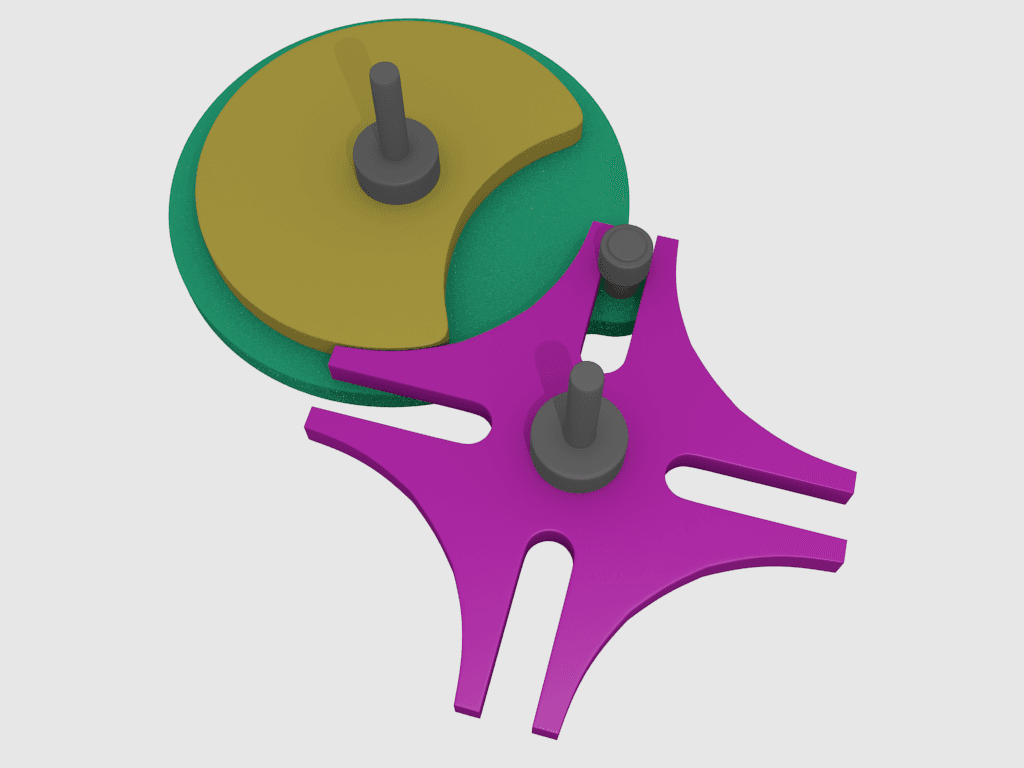
What it inherited. Maudslay's screw-cutting lathe gave it the slide rest, the leadscrew and the idea that a tool should be carried by the machine rather than the hand. The turret adds only one thing to that: several tools, indexed, each returning to a repeatable position. The indexing detent is the same self-centring principle as the dividing head's tapered plunger, and the Geneva drive in this catalogue solves the same problem for continuous motion.
What it led to. Add automatic indexing, automatic feed and a cam drum to sequence the operations, and the turret lathe becomes the automatic screw machine — Spencer's, already in this catalogue, from 1873. Replace the cam drum with a stored program and it becomes the CNC lathe. The whole line of descent is visible from this machine, and every step is about moving decisions out of the operator and into the setup.
Its honest limits: long setup, so it is uneconomic below a certain quantity; limited to work that suits a fixed sequence of tools; and the setup skill it demands is considerable even though the operation skill is not. It moved the skill rather than eliminating it — which is a more accurate description of most automation than the one usually offered.
所需工具:
6 英寸数显卡尺材料
8- 1 张占位符
- 1 个占位符
- 6 个占位符
- 1 套占位符
- 1 个占位符
- 16 个占位符
- 8 个占位符
- 1 个占位符
相关蓝图
这些蓝图共享知识——技术、材料或原理



CC0 公共领域
此蓝图以 CC0 协议发布。你可以自由复制、修改、分发和使用此作品,无需征得许可。
通过购买蓝图中的产品支持创客,他们将获得 创客佣金 (由供应商设定),或创建此蓝图的新版本并将其作为连接包含在你自己的蓝图中以分享收入。