
Gas Mantle
A gas flame is a poor lamp. Most of what a burning gas jet gives you is heat and a yellow glare from glowing soot, and if you burn the gas cleanly — with enough air — the light almost disappears. Cleaner burning meant dimmer lighting, which is an unhelpful trade.
Welsbach's answer separates the two jobs. Let the gas burn as cleanly and hotly as it likes, and put something in the flame whose job is to glow. A fabric mesh soaked in metal salts and burned away leaves a fragile ceramic skeleton that sits in the hot gas and radiates brilliant white light.
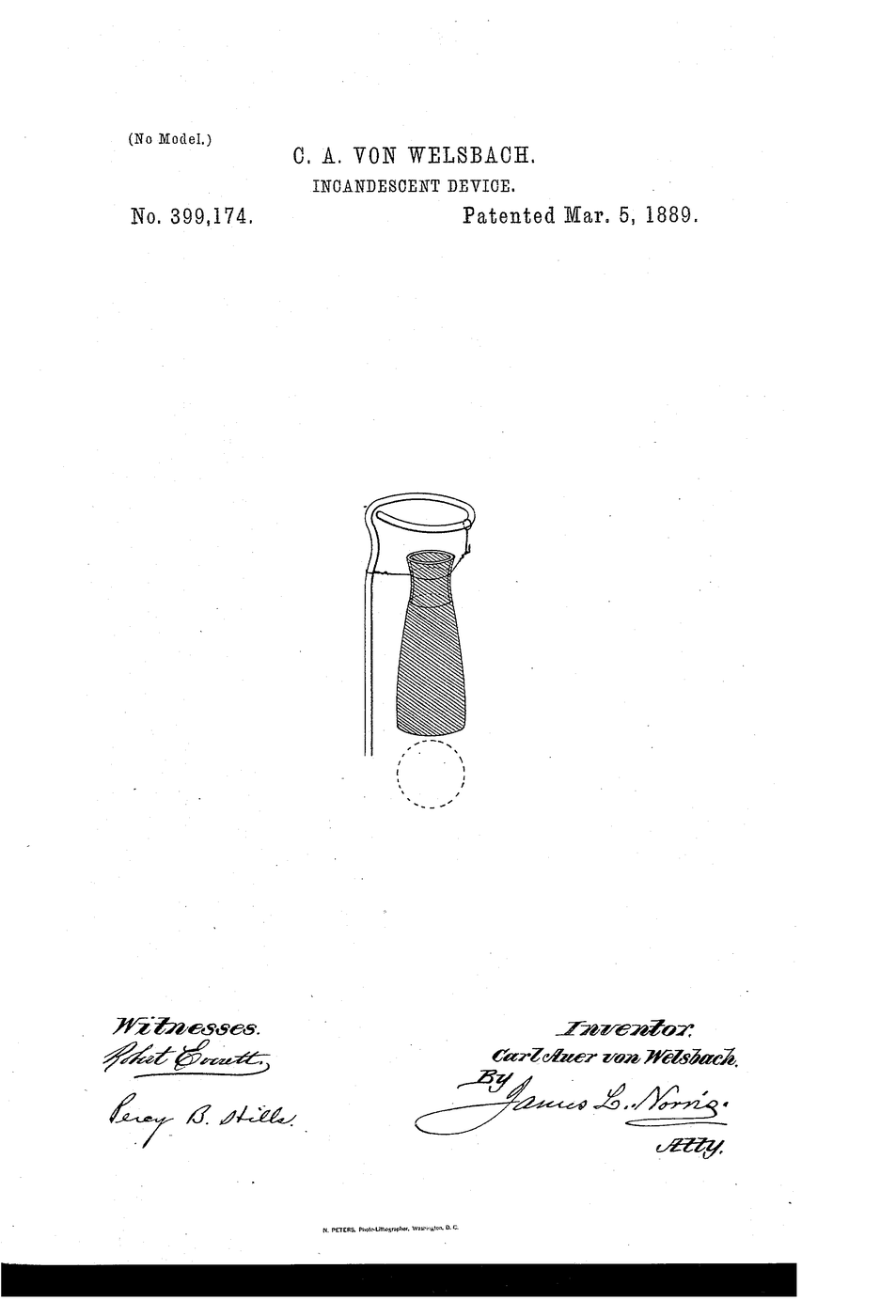
The patent does not claim the mantle — it claims the liquid. Its stated object is "to provide a novel solution for impregnating a fabric, thread, or other combustible material". The cloth is scaffolding; the chemistry is the invention.
US Patent 399,174, "Incandescent Device", granted 5 March 1889 to Carl Auer von Welsbach, described in the specification as "a subject of the Emperor of Austria-Hungary, residing at Vienna". His earliest priority is 1 November 1885.
⚠ This blueprint uses modern mantles only. Antique mantles are radioactive — see the final step, which everyone should read.
说明
Read the stated object of US 399,174
Read the stated object of US 399,174
The patent's object is "to provide a novel solution for impregnating a fabric, thread, or other combustible material". The claim is a solution, not a lamp part.
Work outdoors with safety glasses on
Work outdoors with safety glasses on
Open flame and a burning-off step. Work outside or under extraction, glasses on, nothing flammable within a metre.
所需工具:
 透明安全眼镜
Burn a bare gas flame and measure its light
Burn a bare gas flame and measure its light
Light the torch with the air hole closed — a yellow, sooty flame. Hold the light meter 300 mm away and record the reading.
所需工具:
 硬钎焊喷枪
硬钎焊喷枪 测光表(入射/反射)
Open the air hole and measure again
Open the air hole and measure again
Open the air so the flame goes blue and hot. Measure at the same distance. The light drops sharply while the heat rises. That is the problem Welsbach faced.
Hold a wire in the blue flame
Hold a wire in the blue flame
Put a steel wire into the hot blue flame. It glows orange. A hot flame can make a solid emit light even when the flame itself is nearly invisible.
所需工具:
 钢丝钳
钢丝钳Examine an unburned modern mantle
Examine an unburned modern mantle
Take a new camping mantle. It is limp woven fabric stiff with dried salts. Note that it is still cloth at this stage.
此步骤所需材料:
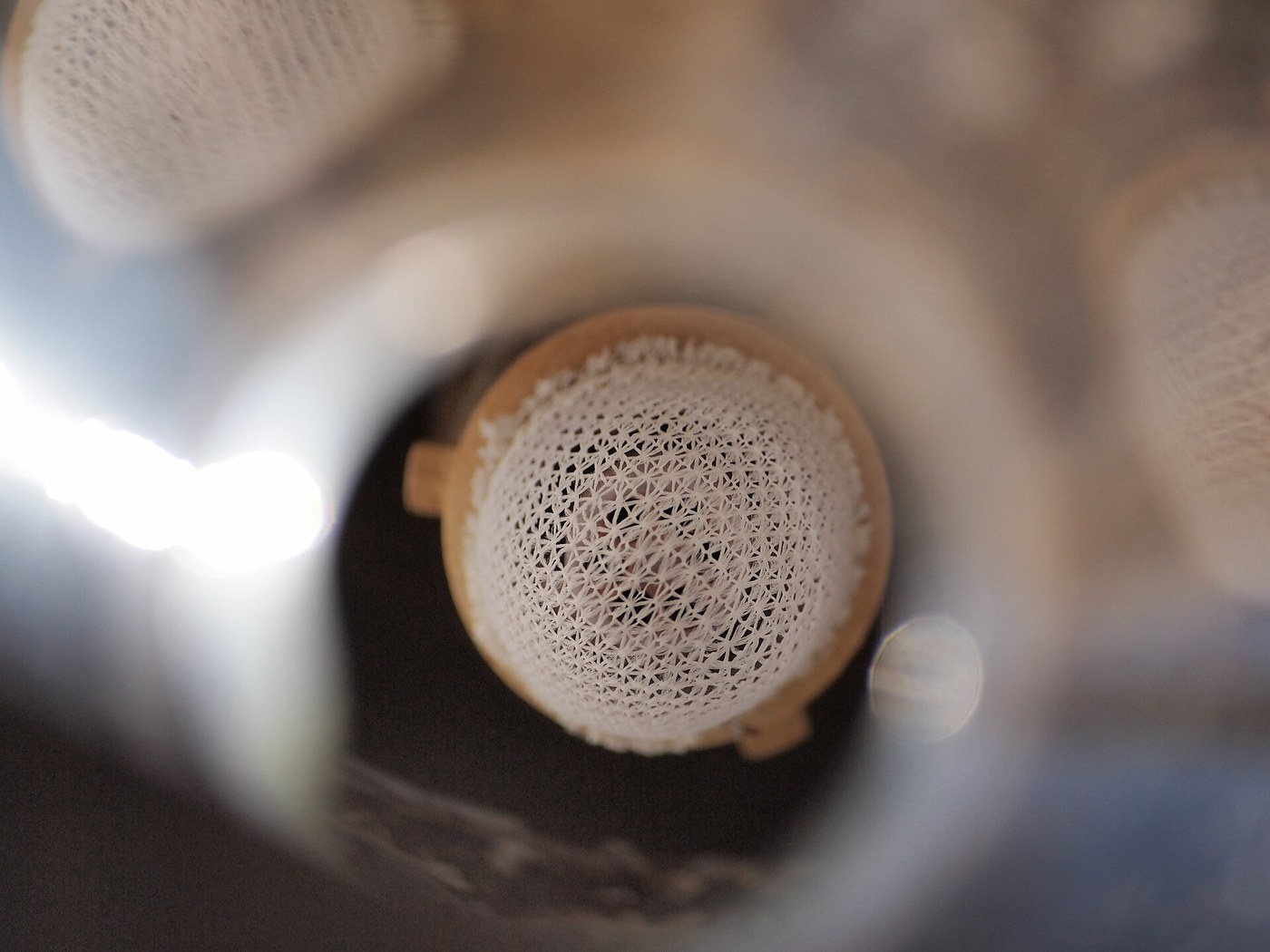 气灯纱罩(钇,露营用)1 个
Tie the mantle over the burner
Tie the mantle over the burner
Tie it so it hangs symmetrically around the flame path. An off-centre mantle burns through on one side.
Burn off the fabric
Burn off the fabric
Light the mantle and let the cloth burn away completely. It shrinks and turns to a grey shell. The fabric was only a former — the oxide skeleton is the lamp.
Do not touch it again
Do not touch it again
The burnt mantle has almost no strength. One touch collapses it. This fragility is the mantle's permanent practical drawback.
Light the gas through the mantle and measure
Light the gas through the mantle and measure
Run the same blue flame through the mantle and measure light at the same 300 mm. Compare against steps 3 and 4 — the same gas, far more light.
Look at the spectrum through a spectroscope
Look at the spectrum through a spectroscope
View the mantle through the spectroscope. You see a broad continuous band, not the narrow lines of a gas discharge — this is a hot solid radiating.
所需工具:
 手持分光镜
手持分光镜Reduce the gas and watch the light collapse
Reduce the gas and watch the light collapse
Turn the gas down in stages. The light falls much faster than the flame size. Radiated light rises very steeply with temperature, which is why the clean hot flame was worth chasing.
History & Context — the chemist who read the flame, and the thorium problem
History & Context — the chemist who read the flame, and the thorium problem
The patent. US 399,174, "Incandescent Device", granted 5 March 1889 to Carl Auer von Welsbach, whom the specification introduces as "a subject of the Emperor of Austria-Hungary, residing at Vienna". The document also lists his earlier foreign filings, and they matter for dating: France and Belgium on 1 November 1885, Great Britain on 1 November 1885 (No. 13,312), then a long tail through 1886 covering Italy, Spain, Norway, Finland, India, New Zealand, Queensland, Tasmania and the Cape of Good Hope. The invention is 1885, not 1889, and the sheer spread of that list tells you he expected a worldwide market.
The claim is a solution, and that is the right way to read it. The stated object is "to provide a novel solution for impregnating a fabric, thread, or other combustible material". Everything visible about a mantle — the woven mesh, the drawstring, the shape — is disposable scaffolding. Soak the cloth, dry it, burn the cloth away, and what remains is a self-supporting ceramic lattice in the exact shape the fabric had. It is an early and very clean example of using a burnable template to make a shape you could not otherwise form.
Welsbach came to this from rare-earth chemistry, not from lighting. He was a student of Bunsen and spent his career separating elements that nobody could tell apart, splitting "didymium" into praseodymium and neodymium in 1885 — the same year as the mantle's priority date. That background is precisely what the mantle needed: the effect depends on a majority oxide that stays inert and refractory, with a small percentage of a second oxide that does the radiating. Getting the minor constituent to a fraction of a percent is a separation problem, and separation was his craft.
⚠ The awareness note, and it is for everyone. Welsbach's commercial mantles used thorium dioxide with about one percent cerium oxide, and thorium is radioactive. Vintage mantles — in antique lamps, old camping stock, market stalls — are genuinely radioactive and are measurably so on a detector. Intact, in a lamp, they are a minor source; the sensible caution is not to crush, sand or inhale dust from an old mantle, and not to store a boxful in a bedroom. Most mantles sold today, including the one in this build, use yttrium instead and are not radioactive, but the two look identical, so treat any mantle of unknown age as if it were the old kind. This warning is deliberately not gated behind an age check: the people most likely to meet an antique mantle are exactly the people who need to know.
Why publishing the modern version is the honest choice. The mechanism this blueprint demonstrates — clean hot flame plus a refractory solid that radiates — is identical in both formulations, so nothing is lost by using yttrium, and a radioactive material has no place in a build anyone can follow. That is the same call this programme made with sandblasting, where the process is genuine and the silica is substituted. Replace the material, keep the physics, and say plainly what changed and why.
What it displaced, and what displaced it. The Welsbach mantle arrived just as electric lighting was becoming a serious threat to the gas industry, and it bought gas lighting roughly a further generation by making it several times brighter for the same gas. Gas companies adopted it enthusiastically for exactly that reason. It lost in the end to the electric lamp, but not quickly — and it never really went away, since it is still the technology in a camping lantern.
相关蓝图
这些蓝图共享知识——技术、材料或原理

CC0 公共领域
此蓝图以 CC0 协议发布。你可以自由复制、修改、分发和使用此作品,无需征得许可。
通过购买蓝图中的产品支持创客,他们将获得 创客佣金 (由供应商设定),或创建此蓝图的新版本并将其作为连接包含在你自己的蓝图中以分享收入。