艺术
美容与健康
工艺
文化与历史
娱乐
环境
食品与饮料
逆向工程
科学
体育
技术
可穿戴设备
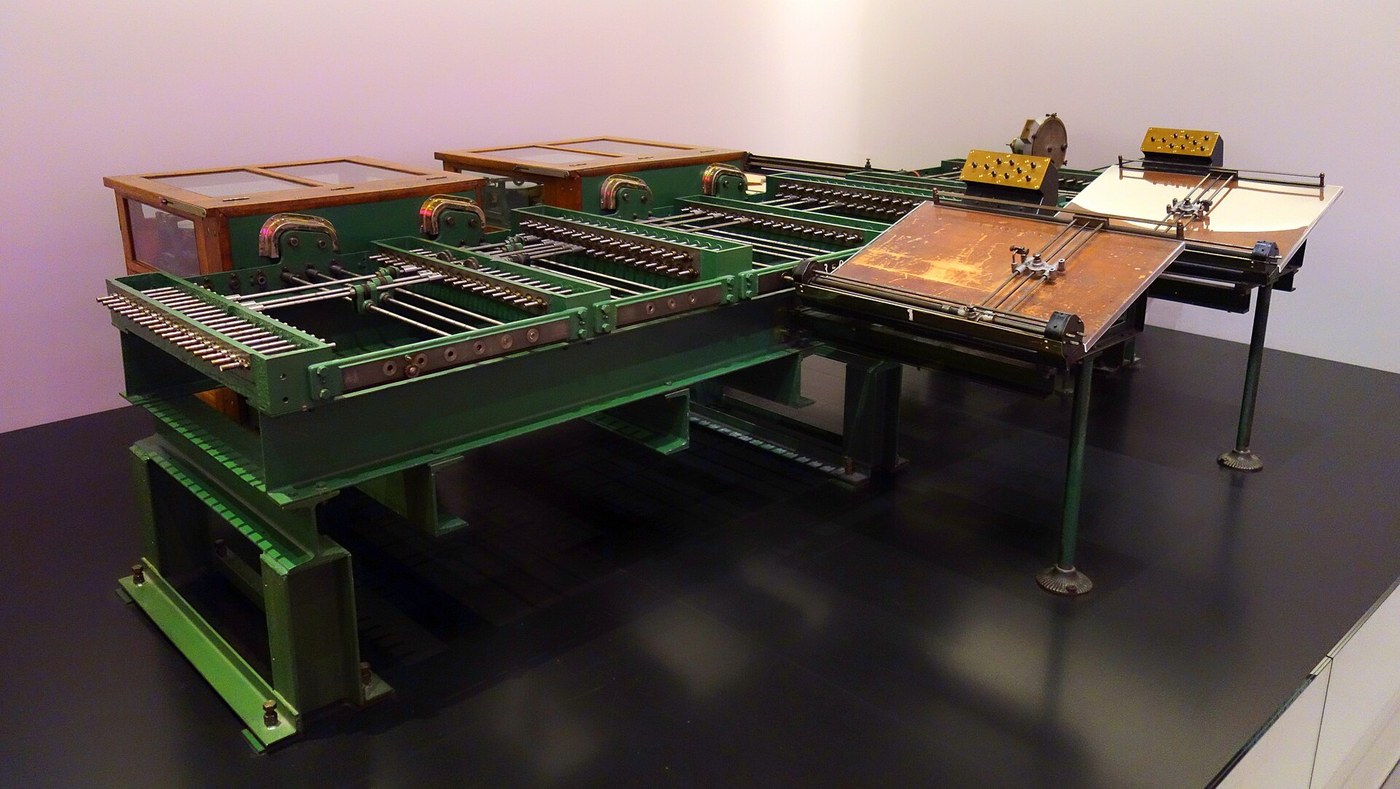


The Wheel-and-Disc Integrator
Stand a small friction wheel on a flat rotating disc with its axle pointing at the centre and its rim touching at radius x. Turn the disc once and the wheel is dragged along an arc of length two-pi-x, so it turns x over r times. Now move the wheel in and out while the disc keeps turning, and every increment of disc rotation adds whatever x happens to be at that instant. The wheel's total rotation is the integral of x, performed by friction, with no numbers anywhere.
William Thomson described this in 1876, together with a scheme for wiring several of them together to solve differential equations, and then could not build it. The reason is in the friction: a wheel pressed onto a disc with a few newtons can deliver perhaps twenty millinewton-metres before it slips, and setting the carriage of the NEXT integrator takes twenty times that. Each unit works; none of them can drive the next.
Vannevar Bush's differential analyser of 1931 solved it by putting a torque amplifier after every wheel. That is not a gearbox - gearing up the torque gears down the motion just as far, and the wheel has no motion to spare. It is a power amplifier: a band rides on a continuously driven capstan, the feeble wheel only has to tighten or slacken the band, and a separate motor does the work. Gains of ten thousand, from a mechanism that is itself a feedback loop, built a year before anybody could analyse one.
The machine that resulted solved ballistics, power-network transients and atomic-physics problems to about a tenth of a per cent per integrator, which was better than anything else available and is exactly the number that later lost to electronics. The op-amp integrator two blueprints further on does the same calculus by putting charge on a capacitor, and it wins because charge does not slip.
中级
4 hours
说明
1
1
A disc, a wheel, and a carriage
A disc, a wheel, and a carriage
Cut a 300 mm plywood disc, true it on the drill, and drive it slowly from the geared motor. Face it with paper for grip.
Make the wheel from an O-ring on a 30 mm hub, on a shaft carried in two bearings, and mount the whole shaft on a carriage that slides along a rail across the disc's radius. Mark the rail in millimetres from the centre.
此步骤所需材料:
 波罗的海桦木胶合板1 张
 O 形圈组合套件1 套件
 滚珠轴承2 个
 低碳钢圆棒300 mm
所需工具:
 充电式电钻
充电式电钻 直流减速电机
 6 英寸数显卡尺
 直尺
直尺 台式电源
台式电源2
2
Integrate something, then find the slip
Integrate something, then find the slip
Park the wheel at a fixed radius, count ten disc revolutions and count the wheel revolutions. The ratio should be the radius ratio; the shortfall is your slip.
Now do a real integral: crank the disc steadily and push the carriage out at a constant rate, so x rises linearly. The wheel should turn as t squared. Read it off at four times and plot against the arithmetic.
此步骤所需材料:
 坐标纸4 张
所需工具:
 秒表直尺
秒表直尺 石墨铅笔套装
 数字转速表
数字转速表3
3
The kinematics, the torque that is missing, and four integrators
The kinematics, the torque that is missing, and four integrators
正在加载 Jupyter 笔记本…
所需工具:
 台式电脑
台式电脑4
4
Compendium: how a whole equation gets wired up
Compendium: how a whole equation gets wired up
The integrator is one unit; the analyser is what you make of six. Every variable in the problem is the angle of a shaft, and the machine is programmed by physically connecting shafts. To solve y-double-prime equals minus y you take a shaft carrying y, feed it to an integrator to get y-prime, feed that to a second to get y, and then couple the second output back to the first input through a reversing gear - a mechanical loop that literally is the differential equation. Addition is a differential gear; multiplying by a constant is a gear ratio; an arbitrary function is a shaped cam or a girl following a curve with a pointer while a servo copies her hand. Setting up one problem took a day or two, and changing a coefficient meant changing a gear.
It is worth knowing why the machines were kept long after electronic computers arrived. An analyser makes an error of a tenth of a per cent per integrator and never blows up, because friction is a physically bounded thing; early numerical integration on a digital machine could be far more accurate or catastrophically wrong depending on the step size, and nothing on the panel told you which. Operators who had watched a shaft turn could see the answer being wrong. That is a real advantage of an analogue machine and it is why the last differential analysers were still running into the 1950s.
材料
5- 1 张占位符
- 1 套件占位符
- 占位符
- 300 mm占位符
- 4 张占位符
相关蓝图
这些蓝图共享知识——技术、材料或原理


CC0 公共领域
此蓝图以 CC0 协议发布。你可以自由复制、修改、分发和使用此作品,无需征得许可。
通过购买蓝图中的产品支持创客,他们将获得 创客佣金 (由供应商设定),或创建此蓝图的新版本并将其作为连接包含在你自己的蓝图中以分享收入。