艺术
美容与健康
工艺
文化与历史
娱乐
环境
食品与饮料
逆向工程
科学
体育
技术
可穿戴设备
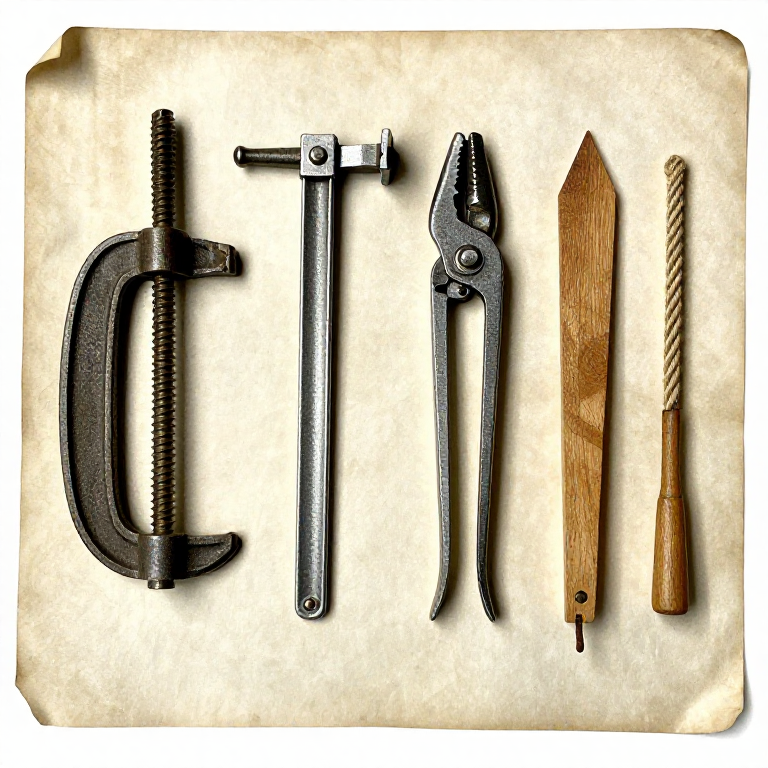


Which Clamp: What Each Type Is For, and Making Your Own
Clamps are the tool everyone runs out of. A glue-up needs more than seems reasonable, they are expensive, and the temptation is to make do with too few — which produces exactly the uneven pressure the pressure rung warns about.
The good news is that clamping force is cheap to improvise. Wedges, rope, weight and rubber all apply real pressure, and several of them cost nothing.
This rung is what each type is genuinely good at, and three ways to have enough of them without buying more.
初学者
3 hours
说明
1
1
The four types and where each belongs
The four types and where each belongs
A G or C CLAMP gives high force in a small throat. It is the one for pressing two thicknesses together hard, and it marks the work unless a block goes under the jaw.
A BAR or SASH CLAMP reaches across a panel or a carcass. Force is moderate and the length is the point. A PIPE CLAMP is the same thing built on a length of pipe, so the reach costs almost nothing and you can make any length you need.
A SPRING CLAMP applies light constant pressure instantly with one hand — right for holding something while you position it, wrong for a structural glue line. Light pressure is genuinely useful: it is what veneer and thin edging want.
所需工具:
 C 形夹
C 形夹 F 夹(滑动夹)
 管夹
管夹 弹簧夹
弹簧夹2
2
Wedges: the oldest clamp, and still one of the best
Wedges: the oldest clamp, and still one of the best
Two shallow wedges driven against each other between the work and a fixed stop generate enormous force, cost nothing, and can be made to any size in minutes.
A shallow taper multiplies force the way any inclined plane does — the same geometry as the screw thread. Folding wedges, a pair driven in opposite directions, keep the pressure square to the joint instead of pushing the work sideways.
They need something to push against: a batten screwed to the bench, a notched board, or a simple frame. Build that once and you have as many clamps as you have wedges, which is as many as you care to saw.
此步骤所需材料:
 硬木板2 个
 干燥软木板2 个
所需工具:
 压力分散垫条
3
3
Rope, rubber and weight
Rope, rubber and weight
A SPANISH WINDLASS is a loop of rope round the work with a stick through it; twist the stick and the loop tightens enormously. It is the right answer for anything round, irregular or awkwardly shaped, where no rigid clamp fits.
Cut bands from an old inner tube for light even pressure round a curve — ideal for holding edging or a repair while it sets. Ordinary WEIGHT works for anything flat: a stack of books on a glued panel applies genuine, perfectly even pressure and costs nothing.
None of these is a compromise. They are the correct tool for specific shapes, and a windlass will out-pull most bar clamps on a chair leg.
此步骤所需材料:
干燥软木板1 个所需工具:
压力分散垫条 木质夹垫块
木质夹垫块4
4
Look after them, and keep the glue off the threads
Look after them, and keep the glue off the threads
Dried glue on a clamp screw makes it stiff and eventually seizes it. Wipe the bar and the jaws after every glue-up, while the squeeze-out is still soft.
Keep a light oil or wax on the threads. A clamp that turns freely gets tightened by feel; one that is stiff gets over-tightened because the resistance you are feeling is the thread, not the joint — which is a real and overlooked cause of starved joints.
Wax the bar of a bar clamp as well, and glue will not stick to it and stain the next piece of work. Store them hanging or in a rack rather than in a pile, for the same reason as every other tool in this series.
所需工具:
F 夹(滑动夹) 棉布C 形夹
相关蓝图
这些蓝图共享知识——技术、材料或原理
CC0 公共领域
此蓝图以 CC0 协议发布。你可以自由复制、修改、分发和使用此作品,无需征得许可。
通过购买蓝图中的产品支持创客,他们将获得 创客佣金 (由供应商设定),或创建此蓝图的新版本并将其作为连接包含在你自己的蓝图中以分享收入。