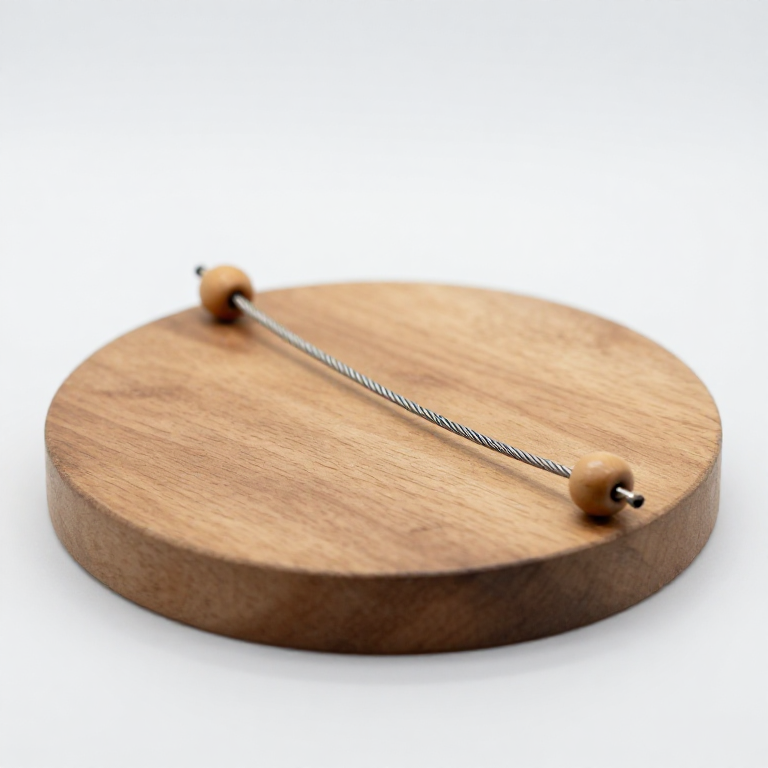


Wire Cutter and Bat
Two of the cheapest tools in a pottery, and between them they solve the last problem of throwing: how to get the pot off the wheel without wrecking it.
The wire cuts the finished pot free of the wheel head — a taut line drawn underneath the foot, which no blade can do without dragging. The bat avoids the problem entirely: a removable disc fixed to the wheel head, so a wide or soft pot is lifted away still sitting on the surface it was thrown on, and never touched at all.
Wire also cuts wedged clay in half to check it. A block sliced through shows its own air pockets in section — which is why the same tool that finishes a pot is the one that inspects the clay before you start.
说明
Cut 600 mm of wire
Cut 600 mm of wire
Cut 600 mm of thin stainless or brass wire. That length leaves plenty to grip either side of a wheel head with a hand's width to spare.
此步骤所需材料:
 细黄铜丝1 米
Turn two small wooden toggles
Turn two small wooden toggles
Turn or whittle two hardwood toggles about 40 mm long and drill each through the middle. Bare wire cuts the fingers the moment you pull it hard.
此步骤所需材料:
 木榫条1 个
Fix a toggle at each end
Fix a toggle at each end
Thread a toggle onto each end and knot the wire so it cannot pull through. Test by pulling hard — a toggle that slips off mid-cut ruins the pot and the hand.
Make a twisted wire as well
Make a twisted wire as well
Make a second cutter from two strands twisted together. A twisted wire leaves a shell-pattern texture on the foot; a plain one leaves it flat. Both are traditional and the mark identifies the tool.
Cut the bat disc
Cut the bat disc
Cut a disc of 12 mm plywood or MDF to match your wheel head — 250-300 mm is typical. Cut it round and true; an out-of-round bat throws the pot off centre before you start.
此步骤所需材料:
 胶合板1 个
所需工具:
 手锯
手锯Find the exact centre
Find the exact centre
Find the centre by drawing two chords and their perpendicular bisectors. Everything about a bat depends on it being centred, so measure rather than eye it.
所需工具:
 直尺
直尺Drill the bat pin holes
Drill the bat pin holes
Measure the spacing of your wheel head's bat pins and drill two matching holes either side of centre. Standard spacing is 250 mm between pins on many wheels — measure yours rather than trusting a number.
Seal the bat
Seal the bat
Seal both faces and the edge with oil or varnish. An unsealed wooden bat drinks water, warps and eventually delaminates.
此步骤所需材料:
 熟亚麻籽油50 毫升
Make a plaster bat as well
Make a plaster bat as well
Cast a second bat in plaster of Paris in a round mould. Plaster pulls water out of the clay, so a pot released reluctantly from wood comes free from plaster on its own as it stiffens.
此步骤所需材料:
 熟石膏2 公斤
Test the bat runs true
Test the bat runs true
Fit the bat, spin the wheel and hold a pencil steady against the edge. A continuous line means it is true; a broken one means it is off centre — re-drill rather than live with it.
Slice a wedged block to check it
Slice a wedged block to check it
Cut a wedged block of clay clean through with the wire and look at the cut face. Air pockets show as holes; unmixed clay shows as streaks. Trapped air is what blows a pot apart in the kiln, and this is the only way to see it before firing.
Cut a thrown pot off the wheel head
Cut a thrown pot off the wheel head
Stop the wheel, hold the wire taut against the head and draw it under the foot in one steady pass, keeping it pressed down the whole way. Lifting mid-pass leaves a ridge in the base.
Flood the cut before lifting
Flood the cut before lifting
Run a little water under the pot after cutting and let it sit a moment. The film breaks the suction so the pot lifts without distorting.
Throw the wide form on a bat instead
Throw the wide form on a bat instead
For a wide bowl or a tall soft form, throw it on a bat and lift the whole bat off. The pot is never gripped at all, which is the only reliable way to move a wide rim before it stiffens.
History & Context
History & Context
As old as the wheel itself. A pot thrown on a rotating head has to come off it, and cutting with a taut line is the answer everywhere the wheel is found. Archaeologists read the base of an ancient pot for exactly this: a spiral drag mark says the pot was cut while the wheel still turned, a straight sweep says it was cut stopped, and a shell pattern says a twisted wire. The tool leaves its signature in the clay and the signature survives firing and burial.
Cord before wire. Before drawn metal wire was cheap, the same job was done with twisted cord, sinew or a length of horsehair — anything that could be pulled taut and stay thin. The change of material did not change the technique at all.
The bat is the smarter tool. A wire solves the problem after the fact; a bat prevents it. Wide bowls, platters and thin-walled forms distort the instant they are gripped, and the only real answer is not to grip them. Wooden bats are stiff and reusable; plaster bats add drying, which releases a pot without any cutting at all. Studios usually keep both, plus a stack of cheap ones so work can sit and stiffen while the wheel goes on being used.
Why the wire also inspects clay. Wedging mixes clay and expels air, but you cannot see inside a block. Cutting it in half and reading the face is the standard check, and it is the reason the wire lives on the wedging bench as much as on the wheel. A pot with a trapped air pocket can burst in the kiln and take its neighbours with it — a two-second cut prevents a lost firing.


CC0 公共领域
此蓝图以 CC0 协议发布。你可以自由复制、修改、分发和使用此作品,无需征得许可。
通过购买蓝图中的产品支持创客,他们将获得 创客佣金 (由供应商设定),或创建此蓝图的新版本并将其作为连接包含在你自己的蓝图中以分享收入。