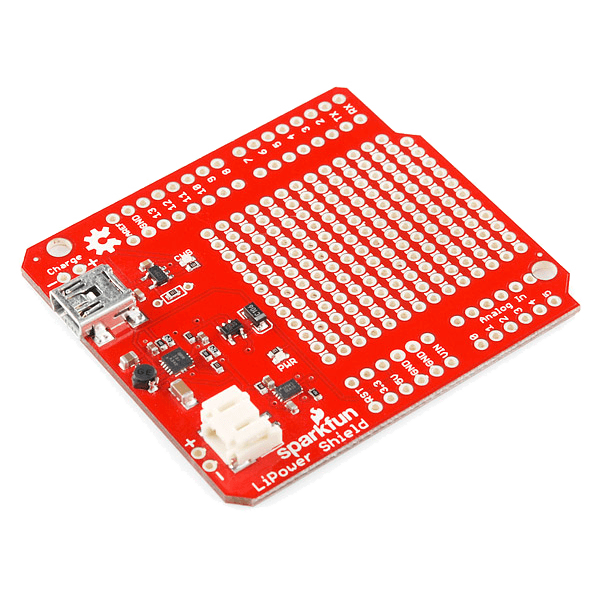
LiPower Shield
Is there anything an Arduino can't do?
Well, for one, most of them can't be powered directly from a 3.7V LiPo battery; much less charge and monitor that battery.
The LiPower Shield takes care of this by combining the functionality of two of our favorite battery power boards: the Power Cell and the Fuel Gauge.
The LiPower Shield allows you to connect a 3.7V single cell Lithium polymer battery which it will boost up to 5V and connect to the Arduino board's 5V pin. The on-board MAX17043G+U IC is connected to the I2C lines (A4 and A5) so that your project can monitor it's own power supply. The configurable alert interrupt pin on the MAX17043G+U IC is broken out to D3 which will activate when the LiPo gets to 32% or lower.
The charging circuit is configured to charge the LiPo at 100mA but by adding a resistor to the supplied through-holes you can boost this to 500mA. There is a mini-USB port on the shield which allows you to charge the battery from a USB power source or you can supply a separate regulated 5V source on the "charge" header.
Note: We've decided to leave the power indicator LED (LED1) and its current limiting resistor (R3) off this board, as they were producing a significant drain on the battery. Please be aware that your board will have a few, shiny, unpopulated pads.
Note: There is a known hardware bug that will allow the LiPo to discharge below the point where the charging circuit will revive it. Thanks to the on-board fuel gauge, however, some clever programming could keep your project from draining the battery as it gets too low.
Documents:
- Schematic
- Eagle Files
- Datasheet (MAX17043G+U)
- Datasheet (MCP73831T)
- Datasheet (TPS61200)
- Example Code
- Product Video
蓝图创作者在客户通过其蓝图购买时获得此比例的佣金