KUNST
SCHÖNHEIT & WELLNESS
HANDWERK
KULTUR & GESCHICHTE
UNTERHALTUNG
UMFELD
ESSEN & GETRÄNKE
REVERSE ENGINEERING
WISSENSCHAFTEN
SPORT
TECHNOLOGIE
WEARABLES
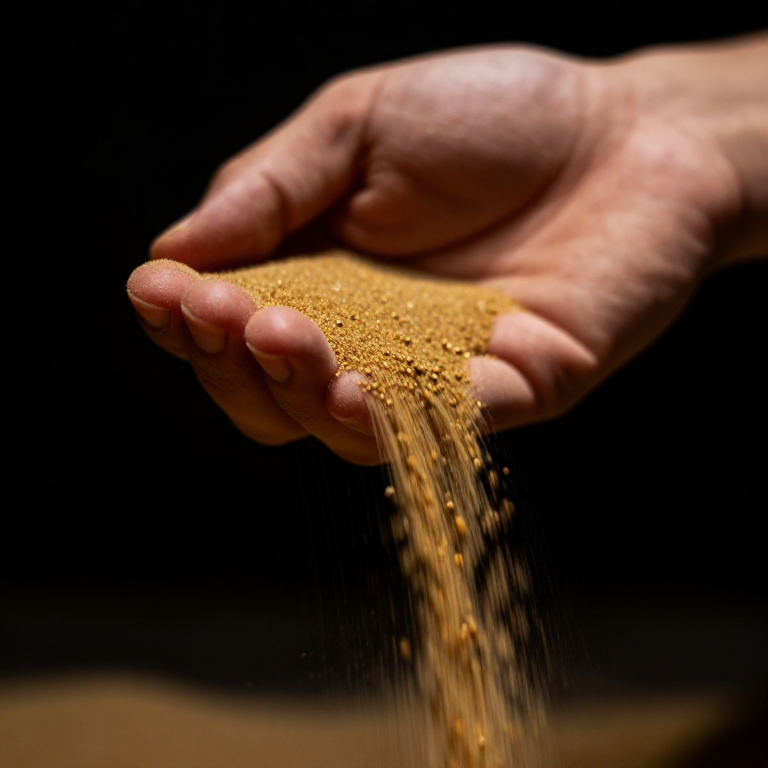


The Sand Reckoner — Count the Grains and Tame Huge Numbers
A hands-on maths project: weigh a pinch of sand, count the grains in a tiny sample, then scale up with powers of ten to estimate the grains in a cup, a bathtub -- even the universe, just as Archimedes did around 250 BC. A Python cell does the giant arithmetic and a compendium shows how exponents were born.
Anfänger
30 minutes
Anweisungen
1
1
Counting the uncountable
Counting the uncountable
Around 250 BC Archimedes set himself a game: to count how many grains of sand would fill the whole universe, and to name that number. He had to invent a new way of writing numbers to do it. You will start the same way -- with real sand.
2
2
Weigh and count a sample
Weigh and count a sample
Weigh out a very small, known amount of dry sand -- say one gram -- on a kitchen scale. Counting every grain is impossible, so count the grains in a TINY measured pinch (a few dozen) and scale up, or estimate. Work out roughly how many grains are in one gram.
Materialien für diesen Schritt:
 Sand1 kg
 Glasgefäße mit Deckel1 Stück
Benötigte Werkzeuge:
 Digitale Küchenwaage
3
3
Scale up with powers of ten
Scale up with powers of ten
Now multiply up. If one gram holds a few thousand grains, a cupful (a couple of hundred grams) holds a few hundred thousand, a bag holds millions, a bathtub holds hundreds of millions. Write each answer as a 1 followed by zeros -- and notice you are just counting the zeros. That count is the 'power of ten', or exponent.
Benötigte Werkzeuge:
 Rechner
4
4
Let the computer scale to the universe
Let the computer scale to the universe
Jupyter-Notebook wird geladen …
Benötigte Werkzeuge:
 Desktop-ComputerRechner
5
5
Compendium: no largest number
Compendium: no largest number
What the sand teaches. (1) Writing a huge number as 10-to-a-power (scientific notation) turns dozens of zeros into a single small exponent -- exactly how scientists write the sizes of atoms and galaxies today. (2) To MULTIPLY two powers of ten you just ADD their exponents (10^63 times 10^24 is 10^87) -- an idea that, centuries later, became logarithms. (3) Archimedes' real point was philosophical: numbers never run out. However vast a pile of sand, you can always name a bigger number. A game about grains quietly invented one of the most useful ideas in mathematics.
Benötigte Werkzeuge
4- Platzhalter
- Platzhalter
- Platzhalter
- Platzhalter
Verwandte Blueprints
Diese Blueprints teilen Wissen — Techniken, Materialien oder Prinzipien

CC0 Gemeinfrei
Dieser Blueprint ist unter CC0 veröffentlicht. Sie dürfen dieses Werk für jeden Zweck frei kopieren, ändern, verbreiten und verwenden, ohne um Erlaubnis zu fragen.
Unterstützen Sie den Maker, indem Sie Produkte über seinen Blueprint kaufen, wo er eine Maker-Provision von Anbietern festgelegt, verdient. Oder erstellen Sie eine neue Iteration dieses Blueprints und verbinden Sie ihn in Ihrem eigenen Blueprint, um Einnahmen zu teilen.