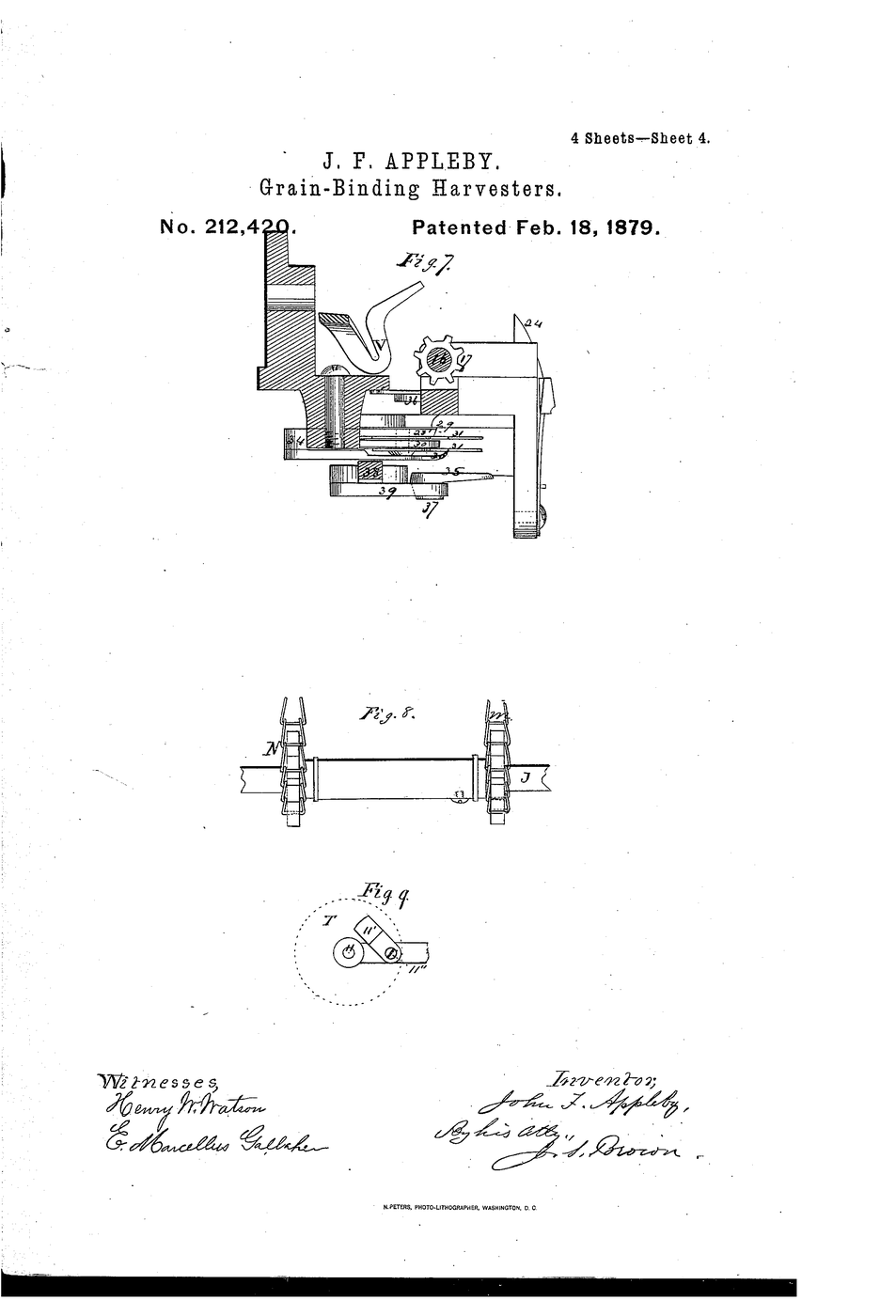


Grain Binder Knotter
The reaper cut the grain and dropped it in a loose swath, and then an army of workers had to walk behind it gathering the stalks into bundles and tying each one by hand with a twist of straw. Cutting was mechanised; binding was not, and it was the bottleneck of the whole harvest.
Appleby's knotter ties the knot automatically — and tying a knot by machine is genuinely hard. A person ties a knot with two hands and judgement; a machine must do it blind, identically, thousands of times an hour. His mechanism wraps twine around each bundle, and a rotating billhook catches both strands, loops them, grips the ends, and pulls them through as a knife cuts the twine free — a finished knot in a single revolution.
Twine, not wire, is the other quiet decision. Wire binders existed, but wire fragments got into the hay and grain, choked cattle and wrecked flour mills. Appleby's apparatus is "designed especially" for twine.
US Patent 212,420, "Improved Grain-Binder for Harvesters", granted 18 February 1879 (filed 1877) to John F. Appleby of West Depere, Wisconsin.
Anweisungen
Read the hard problem the patent solves
Read the hard problem the patent solves
Appleby's binder must tie a knot by machine, blind and identical, thousands of times. Note that this — not cutting — was the unmechanised step.
Tie a bundle by hand and time it
Tie a bundle by hand and time it
Gather a handful of straws and tie a knot around them by hand. Time ten. Record the rate — this is the human bottleneck the machine replaces.
Materialien für diesen Schritt:
 Roggenstroh100 g
 Hanfschnur2 Meter
Benötigte Werkzeuge:
 Stoppuhr
Study the knot your hands make
Study the knot your hands make
Tie a simple overhand knot slowly and note every move your fingers make: cross, loop, tuck, pull. The machine must reproduce each one with cams and a hook.
Shape a billhook from wire
Shape a billhook from wire
Bend stiff wire into a small hook with a hinged jaw — the billhook. This single rotating part does the knotting.
Materialien für diesen Schritt:
 Verzinkter Stahldraht1 Meter
Benötigte Werkzeuge:
 Kombizange
Lay two strands of twine across the hook
Lay two strands of twine across the hook
Bring both strands of twine (the two sides of the loop around the bundle) across the billhook. The hook will catch both at once.
Rotate the hook to wrap the twine
Rotate the hook to wrap the twine
Turn the billhook one full turn. The twine wraps around it into a loop. This wrap is the body of the knot forming.
Open the jaw and grip the strand ends
Open the jaw and grip the strand ends
At the end of the turn, the hinged jaw opens and clamps the free ends of the twine. Now the hook holds what it will pull through the loop.
Cut the twine and strip the loop off
Cut the twine and strip the loop off
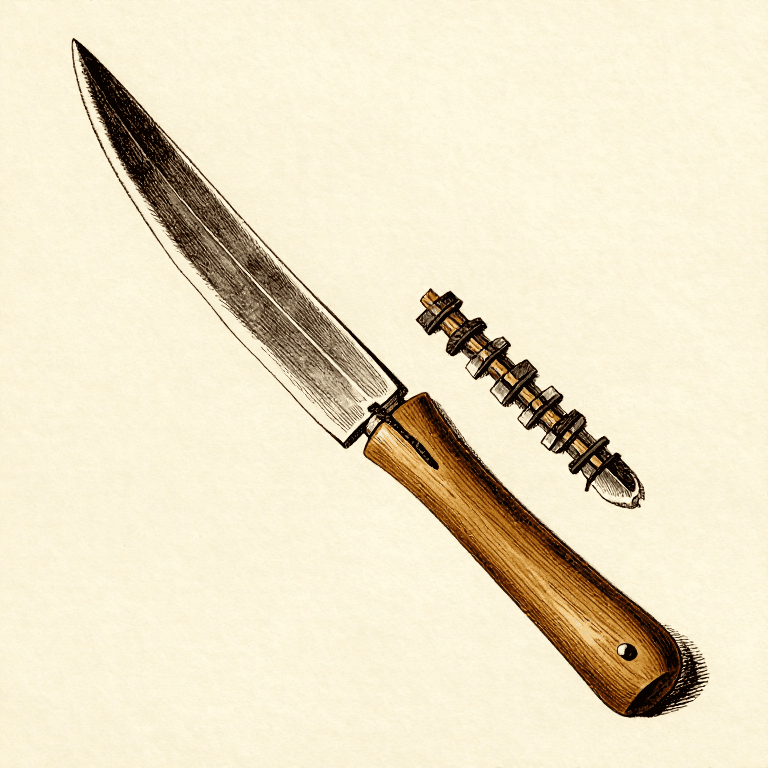
A knife cuts the twine to free the bundle, and a stripper arm pulls the wrapped loop off the hook, over the gripped ends. The ends pull through the loop — and that is the knot.
Benötigte Werkzeuge:
 Bastelmesser
Inspect the knot the machine made
Inspect the knot the machine made
You should have a tidy knot with no hands involved. Wrap, grip, strip — three motions in one turn make a knot every time. Compare it to your hand knot.
Repeat ten times and count failures
Repeat ten times and count failures
Run the sequence ten times. Count how many tie cleanly. Reliability is everything — a binder that misses one knot in twenty drops loose bundles across the field.
Test twine against wire
Test twine against wire
Tie one bundle with soft twine and one with wire. Break each open into a tray of "feed." The wire leaves sharp fragments; the twine does not. This is why twine won.
Time the machine sequence against step 2
Time the machine sequence against step 2
Time one knotter cycle and compare to hand-tying. One turn of one part versus two hands and judgement — and it never tires. That is the harvest bottleneck broken.
History & Context — the knot that finished the harvest
History & Context — the knot that finished the harvest
The patent. US 212,420, "Improved Grain-Binder for Harvesters", filed 1877 and granted 18 February 1879 to John F. Appleby of West Depere, Brown County, Wisconsin. The specification describes a removable binder-frame and a removable cord-tying apparatus driven by a cam-and-rack wheel — and states plainly that "the apparatus is designed especially" for twine, "though many of its features are applicable to binders employing wire for bands."
Why the knotter is such an admired mechanism. Cutting grain by machine was solved decades earlier by the reaper; the stubborn remaining step was binding — gathering each swath into a sheaf and tying it — which still took gangs of workers walking behind the machine. Tying a knot is trivially easy for a human and genuinely difficult for a machine, because it must be done blind, with no judgement, identically, at the pace of the harvest. Appleby's billhook knotter does it by folding the whole hand-motion of a knot — wrap, grip, strip (steps 6 to 8) — into a single rotation of one part. It is often cited as one of the most elegant automatic mechanisms of the nineteenth century, and it was reliable enough to work in dust, wind and vibration all day.
The twine-versus-wire choice was as important as the knot. Wire binders came first and worked, but the story of this batch is a farm system, and wire broke it: fragments of binding wire got into the hay and grain, killed cattle that swallowed them, and jammed and damaged the flour mills downstream. Twine solved all of that — biodegradable, harmless to animals and machinery — which is exactly why Appleby built his knotter around twine (step 11). His mechanism was licensed into the Marsh Harvester and then across the whole industry, turning the reaper into the self-binder that cut and tied in one pass.
Where it lives now. The Appleby knotter did not fade — it moved. When the combine harvester absorbed the cutting and threshing, the knotter went into the baler, and a twine-tying billhook that is a direct descendant of Appleby's 1879 design ties the knots on hay and straw bales to this day. Few farm mechanisms have run essentially unchanged for a century and a half, and this is one of them: the knot you tied by machine in step 9 is the same knot a baler ties in a field right now.
Materialien
3- 100 gPlatzhalter
- 2 MeterPlatzhalter
- 1 MeterPlatzhalter
Benötigte Werkzeuge
3- Platzhalter
- Platzhalter
- Platzhalter
Verwandte Blueprints
Diese Blueprints teilen Wissen — Techniken, Materialien oder Prinzipien


CC0 Gemeinfrei
Dieser Blueprint ist unter CC0 veröffentlicht. Sie dürfen dieses Werk für jeden Zweck frei kopieren, ändern, verbreiten und verwenden, ohne um Erlaubnis zu fragen.
Unterstützen Sie den Maker, indem Sie Produkte über seinen Blueprint kaufen, wo er eine Maker-Provision von Anbietern festgelegt, verdient. Oder erstellen Sie eine neue Iteration dieses Blueprints und verbinden Sie ihn in Ihrem eigenen Blueprint, um Einnahmen zu teilen.