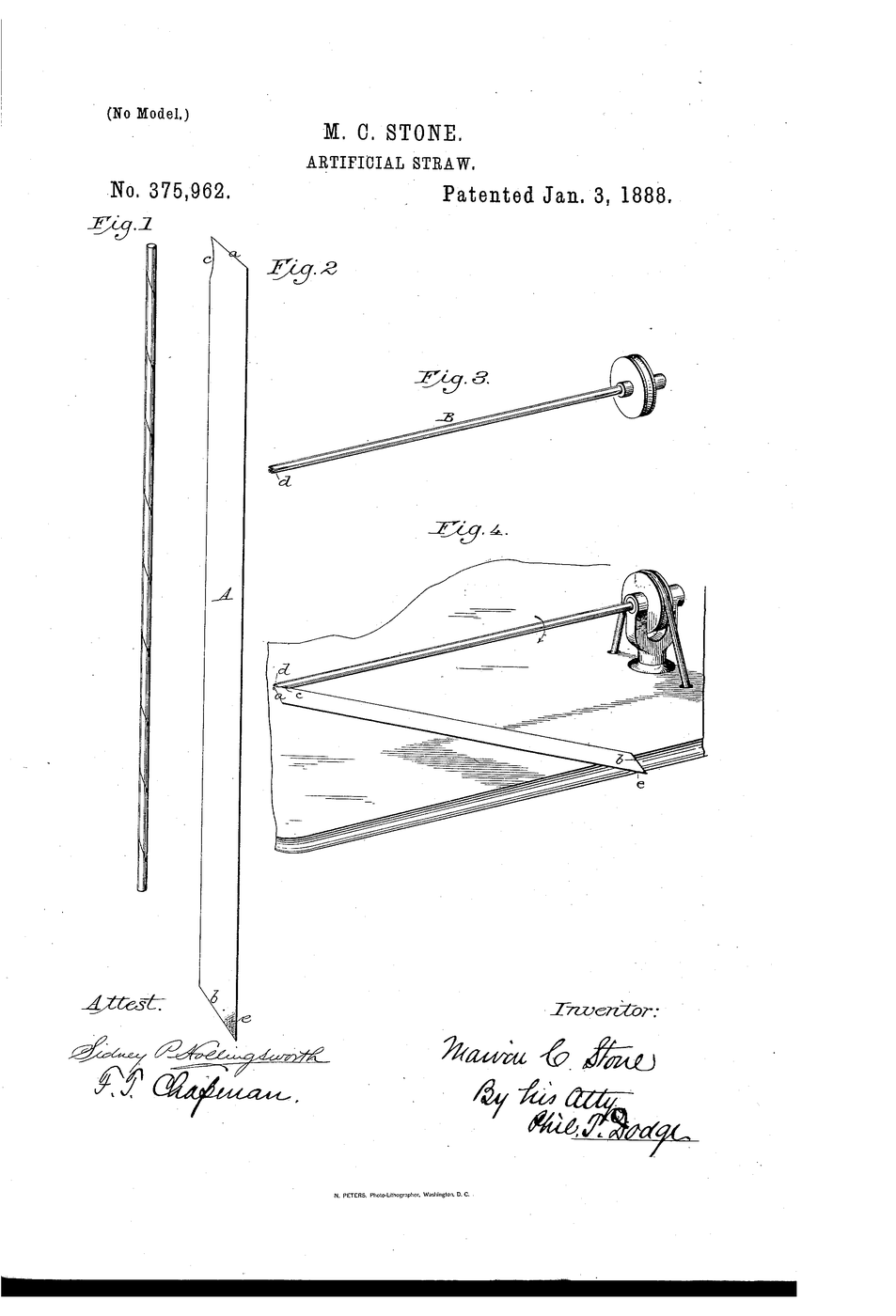


Artificial Straw
Until the 1880s a drinking straw was a straw — a hollow stem of rye grass. It worked for one drink. Then it softened, split along its length, and shed a grassy flavour into whatever you were drinking. In a hot Washington summer, sipping a mint julep through a decaying piece of grass was the normal experience.
Stone's straw is a paper tube that refuses to get wet. Wind a strip of manila paper spirally on a spindle, paste the outer edge down, and dip the whole thing in molten paraffin. The wax seals the spiral seam and stops the paper absorbing anything, so the tube stays rigid in liquid and tastes of nothing.
US Patent 375,962, plainly titled "Artificial Straw", filed 11 May 1887 and granted 3 January 1888 to Marvin C. Stone. He claims the wound-and-waterproofed tube offers "greater strength and freedom from liability to crack or split" than the natural article.
Anweisungen
Melt paraffin gently, never over a naked flame
Melt paraffin gently, never over a naked flame
Use a water bath and keep the wax well below smoking point. Molten paraffin is flammable and burns skin badly. Never heat it in a pan directly on a hob.
Read US 375,962 and note what the wax is for
Read US 375,962 and note what the wax is for
Stone coats the tube to make the paper nonabsorbent AND to seal the spiral seam. One dip does two jobs — waterproofing and closing the joint.
Drink through an uncoated paper tube
Drink through an uncoated paper tube
Roll a plain paper tube and drink water through it. Time how long until it goes soft and collapses. Record that number — it is the problem being solved.
Cut a blank with bevelled ends
Cut a blank with bevelled ends
Cut a paper strip about 20 mm wide and 250 mm long, bevelling both short ends. The bevels let the finished tube start and finish flush instead of with a step.
Materialien für diesen Schritt:
 Rolle Schnittmuster-Transparentpapier1 Rolle
Wind it spirally on a spindle
Wind it spirally on a spindle
Wrap the strip at a constant shallow angle around a 6 mm dowel, each turn overlapping the last by a few millimetres. Keep the angle even or the bore will vary.
Materialien für diesen Schritt:
 Holzdübelstange1 Stück
Paste the outer edge only
Paste the outer edge only
Run adhesive along the final outer edge and press it down. Stone secures only that edge — the rest holds by the wrap itself.
Materialien für diesen Schritt:
 Weißleim (PVAc)1 Stück
Slide it off and let it dry
Slide it off and let it dry
Withdraw the dowel and dry the tube fully. A damp tube will take wax unevenly and end up blotchy and weak.
Test it unwaxed in water
Test it unwaxed in water
Drink through it. It lasts a little longer than step 3 because of the spiral, but it still softens. Winding alone is not the invention.
Dip a second tube in molten paraffin
Dip a second tube in molten paraffin
Warm the wax to just fluid and dip the tube fully, then withdraw slowly. Slow withdrawal gives an even film; a fast one leaves runs.
Drain and cool it hanging vertically
Drain and cool it hanging vertically
Hang it to set so wax does not pool at one end and block the bore. Check you can still see light through it.
Repeat the water test and compare
Repeat the water test and compare
Drink through the waxed straw and time it against steps 3 and 8. It should outlast both by a wide margin and stay rigid.
Look for leaks along the spiral
Look for leaks along the spiral
Seal one end, fill with water, and watch the seam. A properly dipped straw does not weep — the wax closed the joint as well as coating the surface.
Taste-test against a piece of grass stem
Taste-test against a piece of grass stem
Drink water through a natural stem and then through your straw. The paper tube tastes of nothing, and that neutrality was as much the selling point as the durability.
Try to bend it round a corner
Try to bend it round a corner
Bend the straw sharply. It kinks and closes. Note that failure — someone fixed it fifty years later, and that is the last step's story.
History & Context — wound on a pencil, and back again
History & Context — wound on a pencil, and back again
The patent. US 375,962, "Artificial Straw", filed 11 May 1887 and granted 3 January 1888 to Marvin Chester Stone of Washington, D.C.
He was already in the business of winding paper into tubes. Stone manufactured paper cigarette holders, which are made exactly this way — a strip wound spirally on a mandrel and pasted. The story that he wound a strip of paper round a pencil to replace an unsatisfactory rye straw in a mint julep is entirely consistent with what his factory already did every day. This is a common and under-appreciated shape for invention: not a flash of insight but the recognition that a process you already own solves a problem in a different domain. The paraffin dip is the only genuinely new step, and it is the one that matters.
Why wax does two jobs at once. Paper fails in liquid for two separate reasons — the fibres absorb water and lose stiffness, and any seam wicks. A surface coating that is hydrophobic and continuous fixes both simultaneously, which is why steps 11 and 12 are separate tests. Stone's patent is explicit that the coating renders the paper nonabsorbent and seals the spiral seams, producing what he calls a hermetically sealed tube. It is a materials patent wearing the clothes of a household object.
The bend came much later. Step 14's kink was solved in 1937 by Joseph B. Friedman, who inserted a screw into a straight paper straw, wrapped floss around the outside along the thread, and withdrew the screw — leaving corrugations that let the tube bend without collapsing. He was reportedly watching his daughter struggle to drink from a tall glass at a soda fountain. The bendy straw's first real market was hospitals, for patients who could not sit up.
And it went round in a circle. Paper straws dominated until the 1960s, when cheaper extruded plastic displaced them almost completely. Plastic straws then became one of the most visible symbols of single-use waste, and by the 2010s bans and voluntary phase-outs pushed the industry back to — a spirally wound, coated paper tube. Modern versions use food-safe coatings rather than paraffin and are engineered to survive longer in liquid, but the object in a café today is Stone's object. It is a rare case of a technology being replaced and then reinstated on grounds that had nothing to do with how well it worked.
Materialien
3- Platzhalter
- 1 StückPlatzhalter
- 1 StückPlatzhalter
Dieser Bauplan stellt her
CC0 Gemeinfrei
Dieser Blueprint ist unter CC0 veröffentlicht. Sie dürfen dieses Werk für jeden Zweck frei kopieren, ändern, verbreiten und verwenden, ohne um Erlaubnis zu fragen.
Unterstützen Sie den Maker, indem Sie Produkte über seinen Blueprint kaufen, wo er eine Maker-Provision von Anbietern festgelegt, verdient. Oder erstellen Sie eine neue Iteration dieses Blueprints und verbinden Sie ihn in Ihrem eigenen Blueprint, um Einnahmen zu teilen.