KUNST
SCHÖNHEIT & WELLNESS
HANDWERK
KULTUR & GESCHICHTE
UNTERHALTUNG
UMFELD
ESSEN & GETRÄNKE
REVERSE ENGINEERING
WISSENSCHAFTEN
SPORT
TECHNOLOGIE
WEARABLES
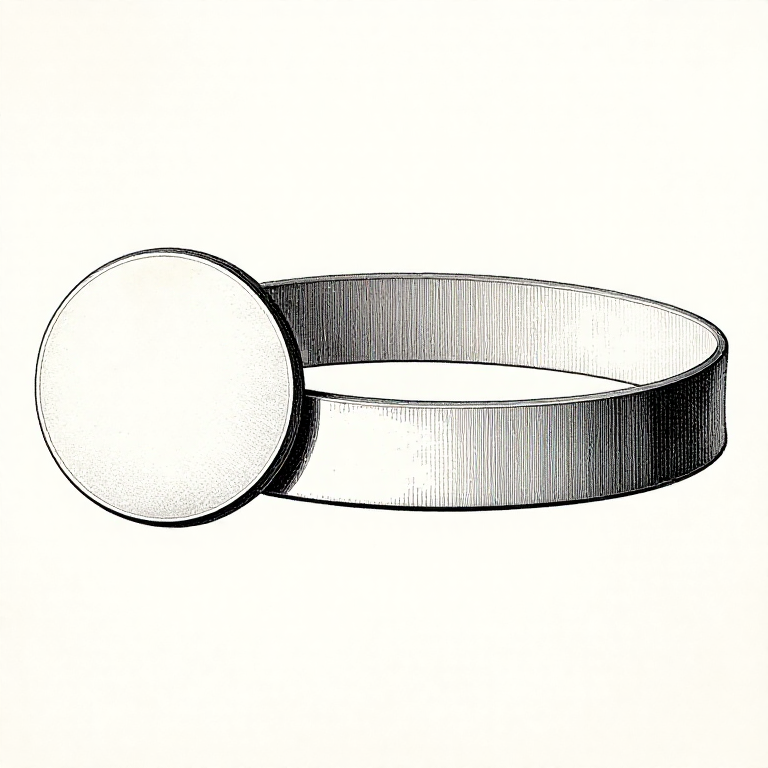


Belts and Chains: Tension, Wrap, and Why Too Tight Kills the Bearings
A slipping belt is obvious and annoying, so people tighten belts. An over-tight belt is not obvious at all, and it destroys the bearings at both ends — slowly, invisibly, and far more expensively than a slipping belt ever would.
The tension a belt needs is the tension that stops it slipping, and that depends on how much of the pulley it wraps around, not on how hard it feels. Grip rises exponentially with wrap angle, which is the whole reason a jockey pulley works.
Chains are the opposite case. A chain does not need tension to grip — the teeth do that — so a chain is deliberately run SLACK, and a tight chain is simply a chain being worn out faster than necessary.
Fortgeschritten
3 hours
Anweisungen
1
1
Why wrap angle decides everything
Why wrap angle decides everything
Jupyter-Notebook wird geladen …
Benötigte Werkzeuge:
 Desktop-Computer
 Rolle
Rolle Lineal
 Zahnriemen
2
2
Setting tension by deflection
Setting tension by deflection
Measure the span between the two pulley centres. Press the belt at the midpoint with a known force and measure how far it moves. The specification is a deflection of roughly 1.6 mm per 100 mm of span, at a force the belt maker states.
That gives a number instead of a feeling, and it is repeatable by somebody else — which is the same argument as weighing salt rather than measuring it in spoons.
Re-tension after the first few hours of running. A new belt seats into the pulley grooves and stretches, so it loses a noticeable fraction of its tension almost immediately. Most belt drives that slip were tensioned once, when new, and never again.
Benötigte Werkzeuge:
Lineal PräzisionswaageZahnriemen
3
3
Chains want slack, and they want oil
Chains want slack, and they want oil
A roller chain transmits force through the engagement of rollers and teeth, so it needs no tension to grip. Leave roughly 2% of the span as sag on the slack side — for a 500 mm span, about 10 mm.
A tight chain loads the bearings exactly as a tight belt does, and it also forces the rollers hard into the sprocket teeth, so both wear faster. A chain that 'stretches' has not stretched: the pins and bushes have worn, and the pitch has grown.
Oil is what prevents that wear, and it has to reach INSIDE the rollers where the pins turn. Oil applied to the outside of a chain lubricates nothing that matters; it goes on the inner edge of the slack run, where the links open slightly and draw it in.
Materialien für diesen Schritt:
 Rollenkette1 Stück
Benötigte Werkzeuge:
Lineal Nitrilhandschuhe
4
4
Alignment matters as much here as at a coupling
Alignment matters as much here as at a coupling
Two pulleys that are not in the same plane make the belt run onto the flange, rub, heat up and wear on one edge. The same misalignment on a chain drive makes it climb the sprocket teeth and eventually jump.
Check with a straightedge across both pulley faces, or a string line. On a V-belt drive the tolerance is about half a degree; on a timing belt or chain it is tighter still.
A belt that wears on one side only, or a chain that is bright on one face of its plates, is reporting misalignment rather than bad luck. That is the diagnostic habit the last rung of this batch is about — the wear pattern names the fault.
Materialien für diesen Schritt:
Rollenkette1 StückBenötigte Werkzeuge:
 HaarlinealLinealZahnriemen
Materialien
1- 1 StückPlatzhalter
Verwandte Blueprints
Diese Blueprints teilen Wissen — Techniken, Materialien oder Prinzipien

CC0 Gemeinfrei
Dieser Blueprint ist unter CC0 veröffentlicht. Sie dürfen dieses Werk für jeden Zweck frei kopieren, ändern, verbreiten und verwenden, ohne um Erlaubnis zu fragen.
Unterstützen Sie den Maker, indem Sie Produkte über seinen Blueprint kaufen, wo er eine Maker-Provision von Anbietern festgelegt, verdient. Oder erstellen Sie eine neue Iteration dieses Blueprints und verbinden Sie ihn in Ihrem eigenen Blueprint, um Einnahmen zu teilen.