KUNST
SCHÖNHEIT & WELLNESS
HANDWERK
KULTUR & GESCHICHTE
UNTERHALTUNG
UMFELD
ESSEN & GETRÄNKE
REVERSE ENGINEERING
WISSENSCHAFTEN
SPORT
TECHNOLOGIE
WEARABLES


Bode: Gain, Phase and What Feedback Costs
Nyquist's criterion answers a yes-or-no question about a loop you have already built. It does not tell you what to change, and at Bell Labs in the 1930s that left designers measuring amplifier after amplifier without a way to steer the next one.
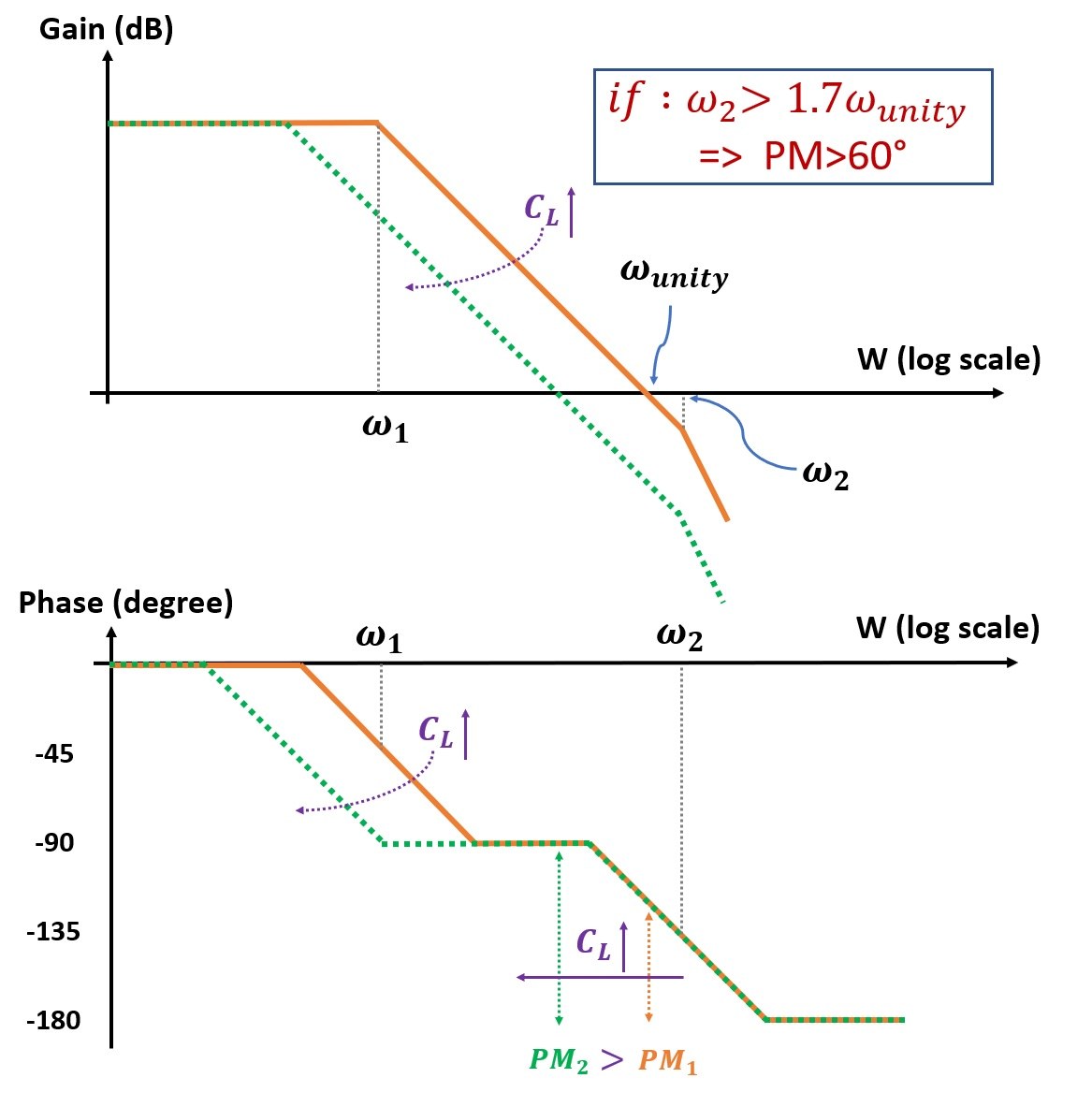
Hendrik Bode's answer, worked out through the 1930s and published as a book in 1945, is that for an ordinary minimum-phase network the phase is not free. It is determined by how fast the gain is falling: a slope of twenty decibels per decade goes with ninety degrees of lag, forty with a hundred and eighty. The stability question therefore becomes a question about a SLOPE, and the design rule that runs all of classical control falls straight out - cross through unity gain at twenty decibels per decade, because forty means a hundred and eighty degrees, and a hundred and eighty degrees at unity gain is an oscillator.
The deeper result is the one that has no workaround. For a stable loop with no right-half-plane poles that falls off faster than one over frequency, the integral of the log of the sensitivity over all frequencies is exactly zero. Sensitivity below one is where feedback is helping you; the integral says every decibel of help at one frequency is paid for by a decibel of harm at another. Engineers call it the waterbed: press it down here and it comes up there.
That is why the design decisions in this blueprint are all about WHERE, never how much. Turning the gain down, adding a dominant pole, adding a lead network and buying a faster plant all reach the same phase margin and cost completely different things - accuracy everywhere, speed, noise at the actuator, or money.
Erfahren
3 hours
Anweisungen
1
1
Measure a slope and a phase together
Measure a slope and a phase together
Build a two-stage RC low-pass with a buffer between the sections - 10k and 10 nF, then 10k and 1 nF - and sweep it with the generator, recording amplitude and phase per decade.
Plot gain in decibels against log frequency and phase underneath. Where the gain falls at 20 dB per decade the phase sits at 90 degrees; where both sections are working it is 40 and 180. The two plots are not independent measurements of the same thing.
Materialien für diesen Schritt:
 Widerstandssortiment 1/4 W1 Set
 Keramikkondensator-Set1 Set
 Millimeterpapier6 Blätter
Benötigte Werkzeuge:
 Steckbrett
 DDS-Signalgenerator
 Digitales Oszilloskop
 TL072 JFET-Operationsverstärker
 Bleistiftsatz (Graphit)
2
2
Buy phase margin two different ways
Buy phase margin two different ways
Close a loop around the network with an op-amp until it rings, then reduce the loop gain until the ringing dies. Note the closed-loop accuracy you have lost.
Put the gain back and instead add a single slow lag - 100k and 1 uF - ahead of it. The ringing goes again, the DC accuracy comes back, and the loop is now visibly slower. Same margin, different bill.
Materialien für diesen Schritt:
Widerstandssortiment 1/4 W1 Set Elektrolytkondensator-Sortiment1 Set
Benötigte Werkzeuge:
TL072 JFET-OperationsverstärkerSteckbrettDigitales OszilloskopDDS-Signalgenerator3
3
Slope against phase, the waterbed, and four compensators
Slope against phase, the waterbed, and four compensators
Jupyter-Notebook wird geladen …
Benötigte Werkzeuge:
 Desktop-Computer
4
4
Compendium: when the slope rule stops being true
Compendium: when the slope rule stops being true
The gain-phase relation holds only for MINIMUM-PHASE systems: no poles or zeros in the right half plane and no pure time delay. Two common things break it. A transport delay - a conveyor, a pipeline, sound crossing a room, a network hop - adds phase without touching the gain at all, so no amount of reshaping the magnitude plot buys it back and the only cure is to cross over below where the delay has eaten the margin. A right-half-plane ZERO does something stranger: it also adds lag while the gain falls, and it makes the output go the WRONG WAY first. A boiler whose drum level drops when you add cold water, or an aircraft that sinks before it climbs when the elevator comes up, are both this, and both impose a hard ceiling on how fast any controller may be allowed to act.
The integral has a sharper version for those cases. With an unstable open-loop pole at p it is no longer zero but pi times p, so an inherently unstable plant does not merely need feedback - it needs a fixed quantity of amplification-somewhere that grows with how unstable it is. That is the mathematics behind a fact every pilot of a relaxed-stability aircraft relies on: the machine can be made to fly beautifully and can never be made insensitive.
Materialien
4- Platzhalter
- Platzhalter
- 6 BlätterPlatzhalter
- Platzhalter
Benötigte Werkzeuge
6- 1 vendor sell this, none ship to you yetPlatzhalter
- Platzhalter
- 1 vendor sell this, none ship to you yetPlatzhalter
- Platzhalter
- Platzhalter
- Platzhalter
Verwandte Blueprints
Diese Blueprints teilen Wissen — Techniken, Materialien oder Prinzipien

CC0 Gemeinfrei
Dieser Blueprint ist unter CC0 veröffentlicht. Sie dürfen dieses Werk für jeden Zweck frei kopieren, ändern, verbreiten und verwenden, ohne um Erlaubnis zu fragen.
Unterstützen Sie den Maker, indem Sie Produkte über seinen Blueprint kaufen, wo er eine Maker-Provision von Anbietern festgelegt, verdient. Oder erstellen Sie eine neue Iteration dieses Blueprints und verbinden Sie ihn in Ihrem eigenen Blueprint, um Einnahmen zu teilen.