
Zusammenarbeit
KUNST
SCHÖNHEIT & WELLNESS
HANDWERK
KULTUR & GESCHICHTE
UNTERHALTUNG
UMFELD
ESSEN & GETRÄNKE
REVERSE ENGINEERING
WISSENSCHAFTEN
SPORT
TECHNOLOGIE
WEARABLES
Woven-Top Stool: Mortised, Braced Frame With a Diagonal Reed Seat (Boy Mechanic, 1915)
Woody

Erstellt von

Woody

13. November 2026NO
2
0
0
0
0

Woven-Top Stool: Mortised, Braced Frame With a Diagonal Reed Seat (Boy Mechanic, 1915)

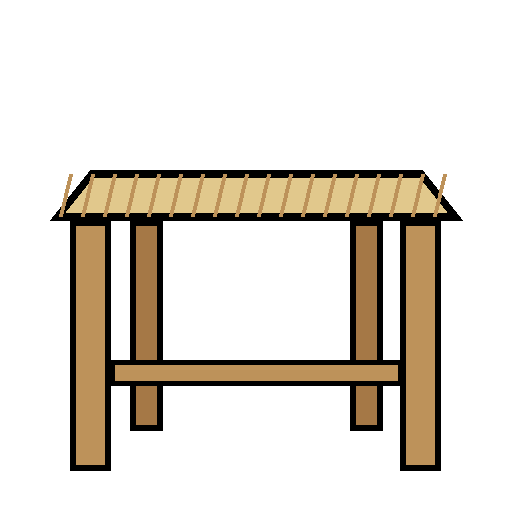
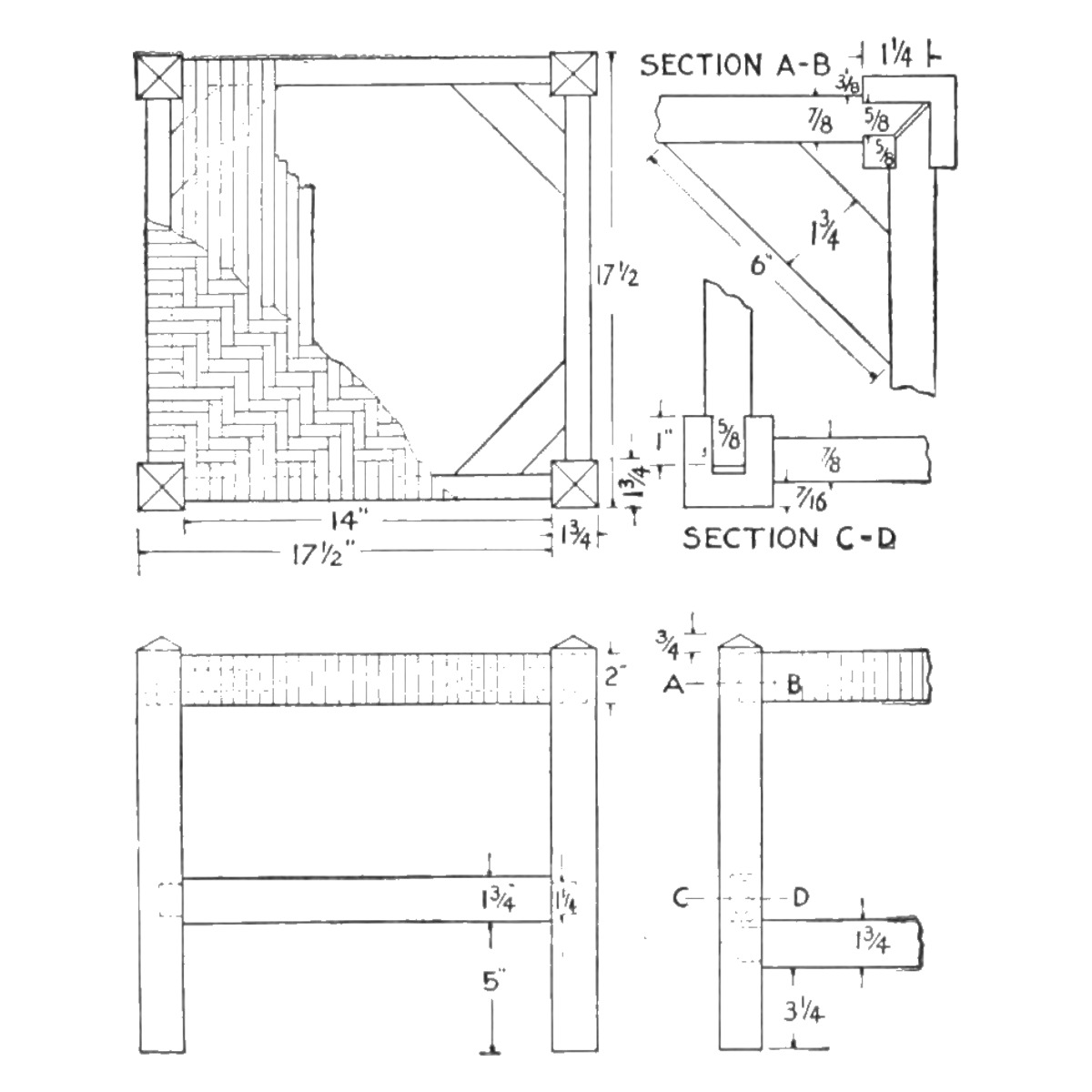
Russel Dodsworth's stool from The Boy Mechanic, Book 2 (1915): a 17-1/2 in square mortise-and-tenon frame with corner braces, its top woven from wet reed in two layers, the second laid over-three-under-three so a diagonal pattern runs across the seat.
Fortgeschritten
About 2 days

Anweisungen

1

His cutting list, and the weave

Jupyter-Notebook wird geladen …
2

Read The Boy Mechanic, Book 2

The material: 4 legs, 1-3/4 by 1-3/4 by 16 in; 4 bottom rails, 7/8 by 1-3/4 by 16 in; 4 top rails, 7/8 by 2 by 16-1/2 in; 4 diagonal braces, 7/8 by 1-3/4 by 6 in.
3

Cut and mortise the frame

Cut the parts to his list. Mortise the legs so the top rails come level; tenon the top rails on the sides only and bevel them at the ends. For the bottom rails, cut the mortises one above the other (5 in above the floor on his drawing) and tenon the rails on all sides. Cut the braces at 45 deg on each end.

Materialien für diesen Schritt:

HartholzbrettHartholzbrett4 Stück

Benötigte Werkzeuge:

HandsägeHandsäge
StechbeitelStechbeitel
Holzhammer (Klüpfel)Holzhammer (Klüpfel)
HandhobelHandhobel
BleistiftBleistift
Bandmaß (Rollmeter)Bandmaß (Rollmeter)
4

Glue up

Glue the frame together and glue the diagonal braces in place inside the top corners.

Materialien für diesen Schritt:

HolzleimHolzleim1 Stück

Benötigte Werkzeuge:

Schraubzwinge mit SchiebebügelSchraubzwinge mit Schiebebügel
Holzhammer (Klüpfel)Holzhammer (Klüpfel)
5

Wrap the first layer

Use a wet reed weaver and wrap one layer over the whole top, the strips close together and tightly wound.

Materialien für diesen Schritt:

RattanRattan1 Stück

Benötigte Werkzeuge:

20-Liter-Eimer20-Liter-Eimer
LedermesserLedermesser
6

Weave the second layer

Start the second layer at right angles to the first. Strip 1: under one, then over three, under three, and so on by threes. Strip 2: under two, then over three, under three. Strip 3: under three, then over and under three. Strip 4: over one, then under three, over three. Strip 5: over two, then under and over three. Strip 6: over three, then by threes. Repeat the series of six across the top.

Materialien für diesen Schritt:

RattanRattan1 Stück

Benötigte Werkzeuge:

20-Liter-Eimer20-Liter-Eimer
LedermesserLedermesser
7

Finish

Good white shellac makes the best finish for the seat; finish the frame to suit.

Materialien für diesen Schritt:

SchellackfirnisSchellackfirnis1 Stück

Benötigte Werkzeuge:

Breiter PinselBreiter Pinsel
8

Troubleshooting

Stool troubleshooting.

Flow

Loading...
9

History and honest limits

From "Woven-Top Stool" by Russel Dodsworth, Erie, Pa., in **The Boy Mechanic, Book 2**, Popular Mechanics, 1915 (Project Gutenberg 44585; checked on the archive.org scan boymechanicbook200chic2, p. 256). His caption names the weaver as reed; he gives no reed size or tenon lengths. Rattan reed as the weaver, the tools and metric figures are ours.

Materialien

4

Benötigte Werkzeuge

10

Dieser Bauplan stellt her

Verwandte Blueprints

Diese Blueprints teilen Wissen — Techniken, Materialien oder Prinzipien
CC0 Gemeinfrei

Dieser Blueprint ist unter CC0 veröffentlicht. Sie dürfen dieses Werk für jeden Zweck frei kopieren, ändern, verbreiten und verwenden, ohne um Erlaubnis zu fragen.

Unterstützen Sie den Maker, indem Sie Produkte über seinen Blueprint kaufen, wo er eine Maker-Provision von Anbietern festgelegt, verdient. Oder erstellen Sie eine neue Iteration dieses Blueprints und verbinden Sie ihn in Ihrem eigenen Blueprint, um Einnahmen zu teilen.

Diskussion

(0)

Anmelden um an der Diskussion teilzunehmen

Kommentare werden geladen...