
Butz Thermostat
A coal furnace burns as hard as its draught allows. Open the damper and it roars; close it and it idles. In 1885 the only thing connecting the temperature upstairs to the damper in the cellar was a person — who had to notice the house was cold, go down, open the damper, remember to come back, and close it again before the place became an oven. At night, nobody did.
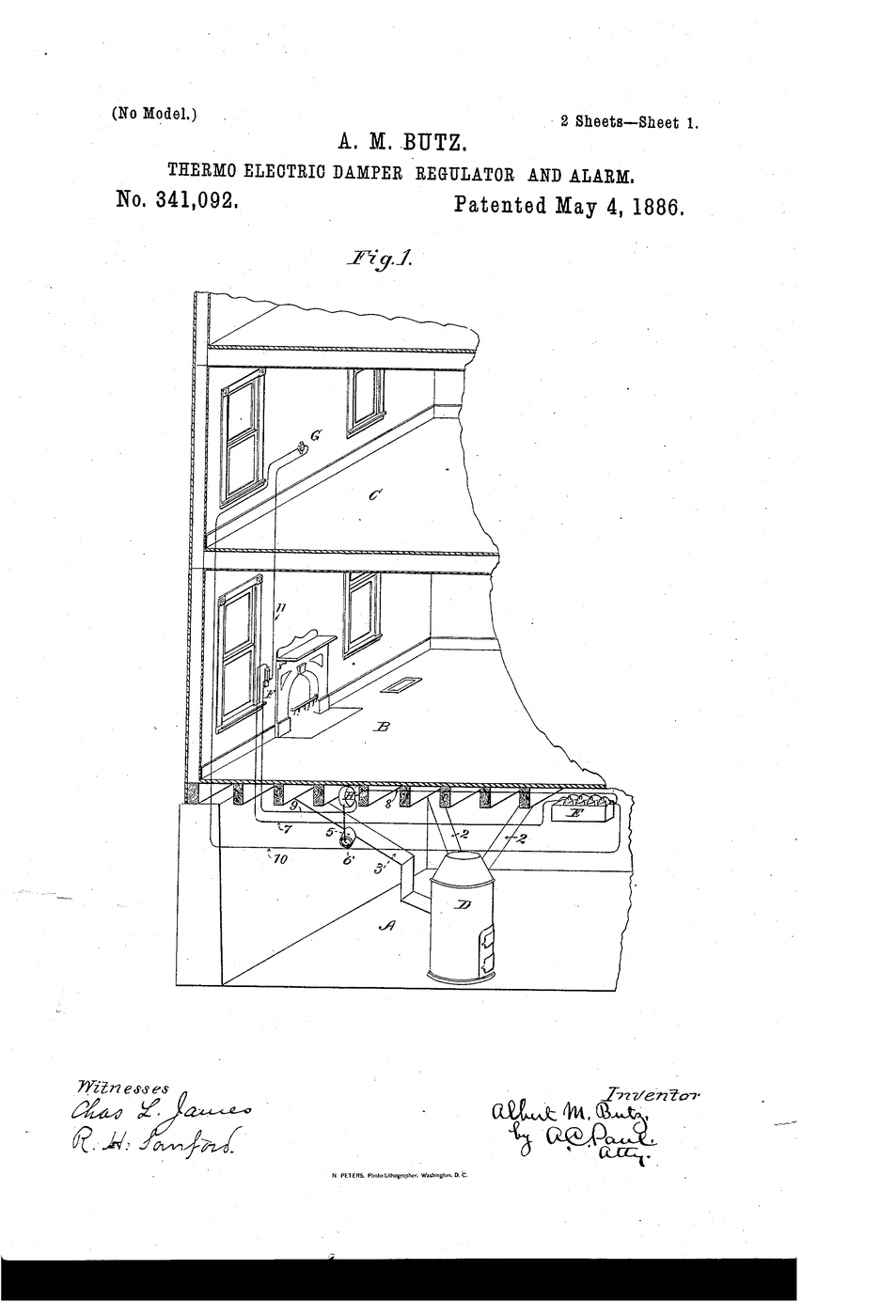
Butz closes the loop. A thermostat in the room senses the temperature and closes an electrical circuit. That energises an electromagnet, which releases a spring motor, which pulls the damper open. The fire responds, the room warms, the contact opens, and the damper shuts again.
Nothing here measures better than what came before. What is new is that the measurement acts back on the cause.
US Patent 341,092, "Thermo-electric damper-regulator and alarm", filed 14 December 1885 and granted 4 May 1886 to Albert M. Butz — the patent the Honeywell company grew out of.
Anweisungen
Low voltage only, and no real furnace
Low voltage only, and no real furnace
Build the whole loop at 12 V or less and use a lamp or small heater as the "fire". Never wire a home-made control to a real furnace, boiler or flue — that is regulated work for good reasons.
Read US 341,092 and count the circuits
Read US 341,092 and count the circuits
Butz claims two circuits: one that works the damper as temperature rises and falls, and one that sounds an alarm when the house gets cold enough to mean the fire needs fuel.
Run the loop by hand first
Run the loop by hand first
Watch a thermometer and switch a lamp on and off by hand to hold a target temperature. Time how long you can keep it steady. You are the controller, and you are the part being replaced.
Benötigte Werkzeuge:
 Infrarot-Thermometer
Make a bimetallic sensor
Make a bimetallic sensor
Bond a strip of steel to a strip of brass along their length. Unequal expansion makes the pair bend when heated — that bend is the measurement.
Materialien für diesen Schritt:
 Verzinkter Stahldraht1 Meter
Benötigte Werkzeuge:
 Flachzange
Calibrate the bend against temperature
Calibrate the bend against temperature
Warm the strip and record deflection against temperature at four points. This curve is what turns a piece of metal into an instrument.
Add an adjustable contact
Add an adjustable contact
Mount a contact screw so the strip touches it at a chosen temperature. Moving the screw moves the set point — this is the thermostat dial.
Verify it switches, and only switches
Verify it switches, and only switches
Put a meter across the contact and warm the strip. It goes from open to closed. It reports nothing about how cold the room is — only whether it is past the line.
Benötigte Werkzeuge:
 Digitalmultimeter — automatische Bereichswahl, True RMS
Drive an electromagnet from the contact
Drive an electromagnet from the contact
Wire the contact to a coil wound on a soft-iron core. The tiny force of a bending strip now commands a much larger force — the strip does not have to move the damper itself.
Materialien für diesen Schritt:
 Lackierter Kupferdraht1 Rolle
Benötigte Werkzeuge:
 Labornetzgerät
Build a spring motor and latch
Build a spring motor and latch
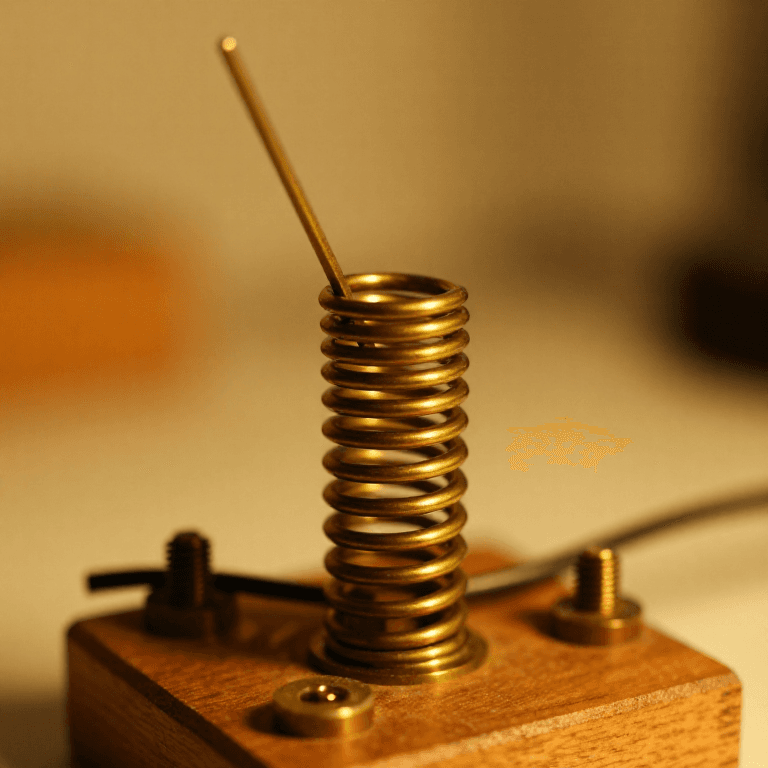
Wind a spring that wants to swing a flap, held by a latch. Let the electromagnet trip the latch. Butz uses stored mechanical energy released electrically, not an electric motor.
Materialien für diesen Schritt:
 Druckfedernsortiment1 Set
Fit the damper flap over the heat source
Fit the damper flap over the heat source
Mount a card or metal flap that restricts airflow to your lamp enclosure. Open flap, more heat; closed flap, less.
Close the loop and let it run
Close the loop and let it run
Connect everything and leave it alone for ten minutes. Temperature rises, contact opens, damper shuts, temperature falls, damper reopens. Nobody is watching it.
Plot the temperature and find the oscillation
Plot the temperature and find the oscillation
Record temperature every 30 seconds. It does not sit at the set point — it swings above and below it. This is normal for on/off control and it never fully goes away.
Move the sensor next to the heat source
Move the sensor next to the heat source
Put the strip close to the lamp and re-run. It now switches off almost immediately and the room stays cold. A controller measures where its sensor is, which is why thermostat placement is not decoration.
Add Butz's second circuit
Add Butz's second circuit
Fit a second contact further along, so a much lower temperature rings a buzzer. That is the alarm: the fire is losing, come and feed it.
History & Context — indicate, regulate, control
History & Context — indicate, regulate, control
The patent. US 341,092, "Thermo-electric damper-regulator and alarm", filed 14 December 1885 and granted 4 May 1886 to Albert M. Butz of Minneapolis. It was known as the damper flapper, and the company Butz founded to sell it became, after a long chain of mergers and renamings, Honeywell.
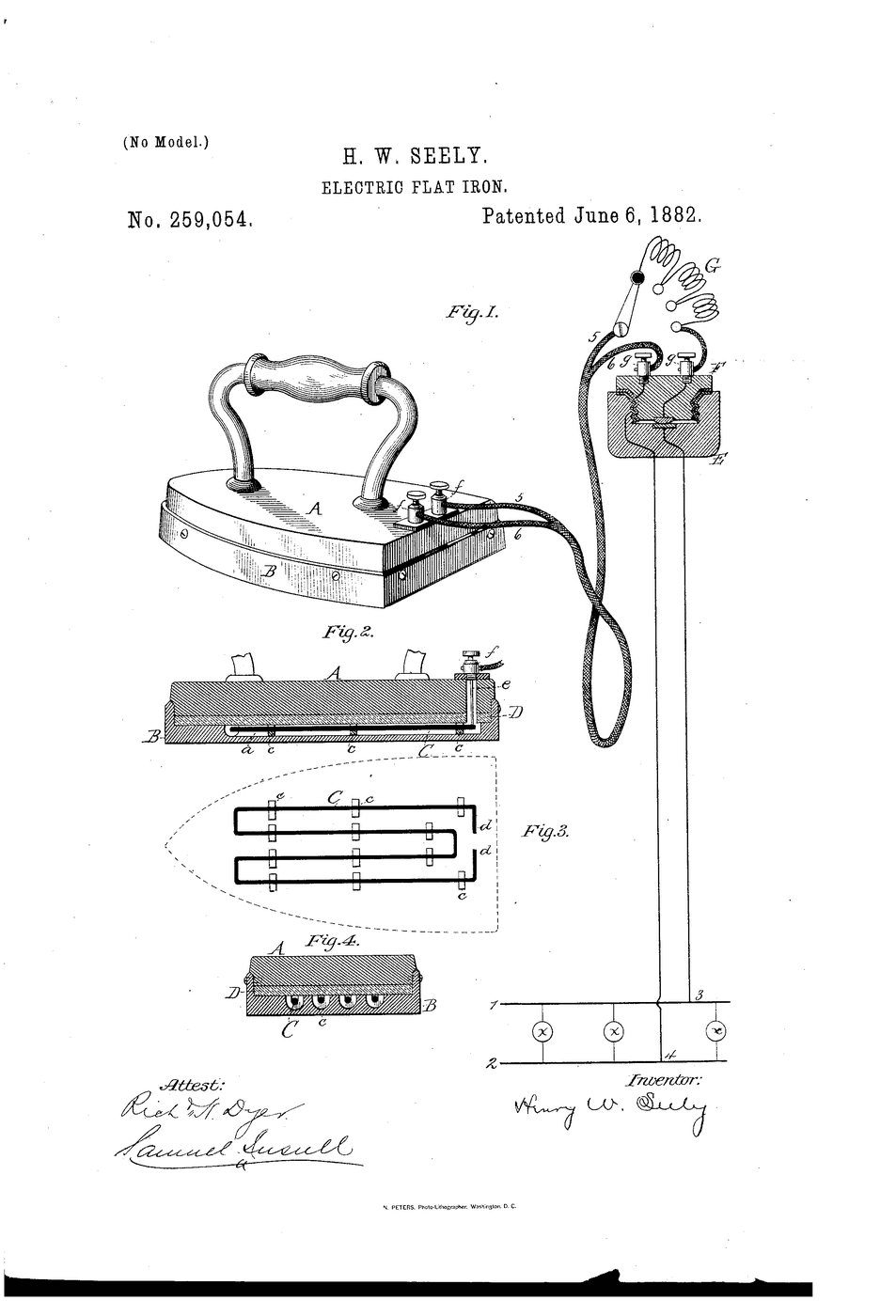
📌 This blueprint completes a three-part arc across this collection, and the distinction is worth holding onto. Warren Johnson's electric tele-thermoscope of 1883 INDICATES: it reports the temperature elsewhere and does nothing about it. Seely's electric flat-iron of 1882 REGULATES: a series resistance sets how much heat is produced, but nothing measures the result, so the temperature it reaches depends on the room. Butz CONTROLS: the measurement acts back on the source, and the loop is closed. Sensing, regulating and controlling are three different problems, and the nineteenth century solved them in that order — the first two are useless on their own for holding a house at a temperature, and the third needs neither better sensors nor better heaters, only a connection between them.
Why a spring motor rather than an electric one. In 1885 there was no domestic electricity worth the name; Butz's circuit runs on a battery, which can supply a brief pulse to an electromagnet but not sustained work. So the energy to move the damper is stored mechanically in a wound spring, and electricity is used only to decide — to trip a latch. This is the standard shape of early control engineering: a weak, cheap signal releasing a strong, stored force. The same division exists in a modern system, where a thermostat switches milliamps and a relay or valve does the work.
Butz sold out early and missed it all. In 1888 he assigned the patent to his own patent attorneys, who formed a company to exploit it; he was out within a few years of inventing it. The business passed through the Consolidated Temperature Controlling Company and the Minneapolis Heat Regulator Company before the 1927 merger that produced Minneapolis-Honeywell, and the corporate name became Honeywell in 1964. It is the same shape as Ingersoll and Langstroth elsewhere in this programme — the invention outlived the inventor's interest in it by about eighty years.
The oscillation in step 12 never got fixed, only managed. Simple on/off control must overshoot, because the heat already in the system keeps arriving after the contact opens. Adding deliberate hysteresis stops the contact chattering; anticipators, and later proportional and PID control, reduce the swing. But a domestic thermostat today still cycles around its set point rather than sitting on it, and the plot you draw in step 12 is recognisably the plot of a modern heating system.
Materialien
3- 1 MeterPlatzhalter
- 1 RollePlatzhalter
- 1 SetPlatzhalter
Benötigte Werkzeuge
4- Platzhalter
- Platzhalter
- Platzhalter
Verwandte Blueprints
Diese Blueprints teilen Wissen — Techniken, Materialien oder Prinzipien

CC0 Gemeinfrei
Dieser Blueprint ist unter CC0 veröffentlicht. Sie dürfen dieses Werk für jeden Zweck frei kopieren, ändern, verbreiten und verwenden, ohne um Erlaubnis zu fragen.
Unterstützen Sie den Maker, indem Sie Produkte über seinen Blueprint kaufen, wo er eine Maker-Provision von Anbietern festgelegt, verdient. Oder erstellen Sie eine neue Iteration dieses Blueprints und verbinden Sie ihn in Ihrem eigenen Blueprint, um Einnahmen zu teilen.