

Caesar Cipher
Anweisungen
Build a shift strip and encrypt
Build a shift strip and encrypt
Two alphabets, one sliding against the other.
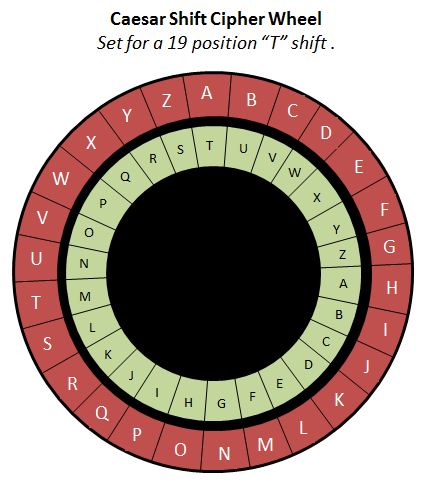
- Write the alphabet along a strip of card.
- Write it twice, end to end, on a second strip.
- Slide the second strip three places and read off the pairs.
Materialien für diesen Schritt:
 Karton1 Packung
 Bleistiftsatz (Graphit)1 Set
Break it by brute force
Break it by brute force
The first attack needs no cleverness at all.
- Take a ciphertext with an unknown shift.
- Write out all 25 possible decryptions.
- One will be English.
Break it by frequency, without trying any key
Break it by frequency, without trying any key
The second attack works even when brute force would not.
- Tally letter frequencies in a long ciphertext and draw a bar chart.
- Compare with English frequencies — E is commonest, then T, A, O, I, N.
- Measure the distance from the ciphertext's tallest bar to E's position.
Materialien für diesen Schritt:
 Millimeterpapier1 pad
Try to fix it, and fail informatively
Try to fix it, and fail informatively
Upgrade to a random alphabet and see what survives.
- Replace the shift with a fully scrambled substitution alphabet.
- Count the key space — 26 factorial, around 4 × 10²⁶.
- Now run the frequency attack again on a long message.
History and context
History and context
Suetonius describes Caesar's use of a shift of three in military correspondence, and Aulus Gellius mentions it too. It was adequate in a world where interception was rare and readers rarer.
Frequency analysis is the important invention, not the cipher. The Arab polymath al-Kindi described it in Baghdad in the ninth century, in a manuscript on deciphering cryptographic messages — the earliest known account. It emerged from scholarship on the Qur'an, where counting letter and word frequencies was already an established method. Cryptanalysis therefore begins as a by-product of textual scholarship, and Europe did not catch up for six hundred years.
ROT13 is a Caesar cipher with a shift of 13, still used online — not for secrecy but to hide spoilers and punchlines from casual view. Because 13 is half of 26, encrypting twice returns the original, which makes it its own inverse. It is honest about being a courtesy rather than a protection.
What this teaches for the rest of cryptography: two independent properties matter, and they are not the same. A cipher must have a key space too large to search, AND it must destroy the statistical structure of the plaintext. Caesar fails both. A random substitution alphabet fixes the first and not the second, which is why it also falls.
Materialien
3- 1 PackungPlatzhalter
- Platzhalter
- 1 padPlatzhalter
Verwandte Blueprints
Diese Blueprints teilen Wissen — Techniken, Materialien oder Prinzipien


CC0 Gemeinfrei
Dieser Blueprint ist unter CC0 veröffentlicht. Sie dürfen dieses Werk für jeden Zweck frei kopieren, ändern, verbreiten und verwenden, ohne um Erlaubnis zu fragen.
Unterstützen Sie den Maker, indem Sie Produkte über seinen Blueprint kaufen, wo er eine Maker-Provision von Anbietern festgelegt, verdient. Oder erstellen Sie eine neue Iteration dieses Blueprints und verbinden Sie ihn in Ihrem eigenen Blueprint, um Einnahmen zu teilen.