Zusammenarbeit
KUNST
SCHÖNHEIT & WELLNESS
HANDWERK
KULTUR & GESCHICHTE
UNTERHALTUNG
UMFELD
ESSEN & GETRÄNKE
REVERSE ENGINEERING
WISSENSCHAFTEN
SPORT
TECHNOLOGIE
WEARABLES
Three-Series Beater Churn: Outer and Inner Loops Turn One Way, the Middle Loops and Centre Blades the Other
Buttercup

Erstellt von

Buttercup

11. November 2026IE
0
0
0
0
0

Three-Series Beater Churn: Outer and Inner Loops Turn One Way, the Middle Loops and Centre Blades the Other

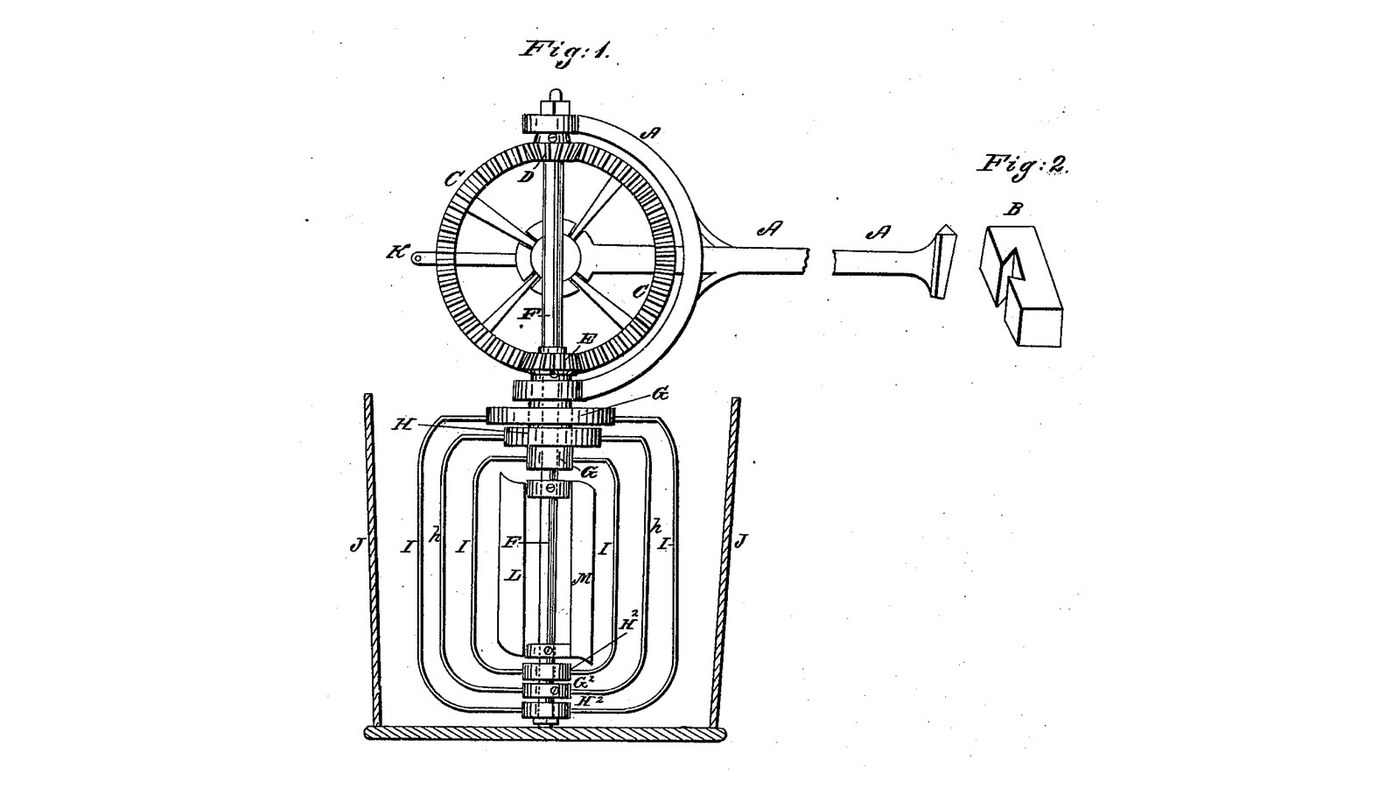
Simon G. Cheever of Boston received US 28,560, dated 5 June 1860, for a machine for mixing paints, oils and powders that "may also be used as a butter mill or churn". Three nested series of loop beaters hang on one shaft: the outer and inner series turn one way and the middle series the other, while curved blades at the centre throw the cream outward into them. One crank drives it all through a wheel with a pinion on each side. This builds it as a churn. The patent gives no sizes; every size here is ours.
Erfahren
About 2 days, plus printing

Anweisungen

1

Three series, two directions

Jupyter-Notebook wird geladen …
2

Nested dashers driven by one wheel and two pinions, seven weeks before

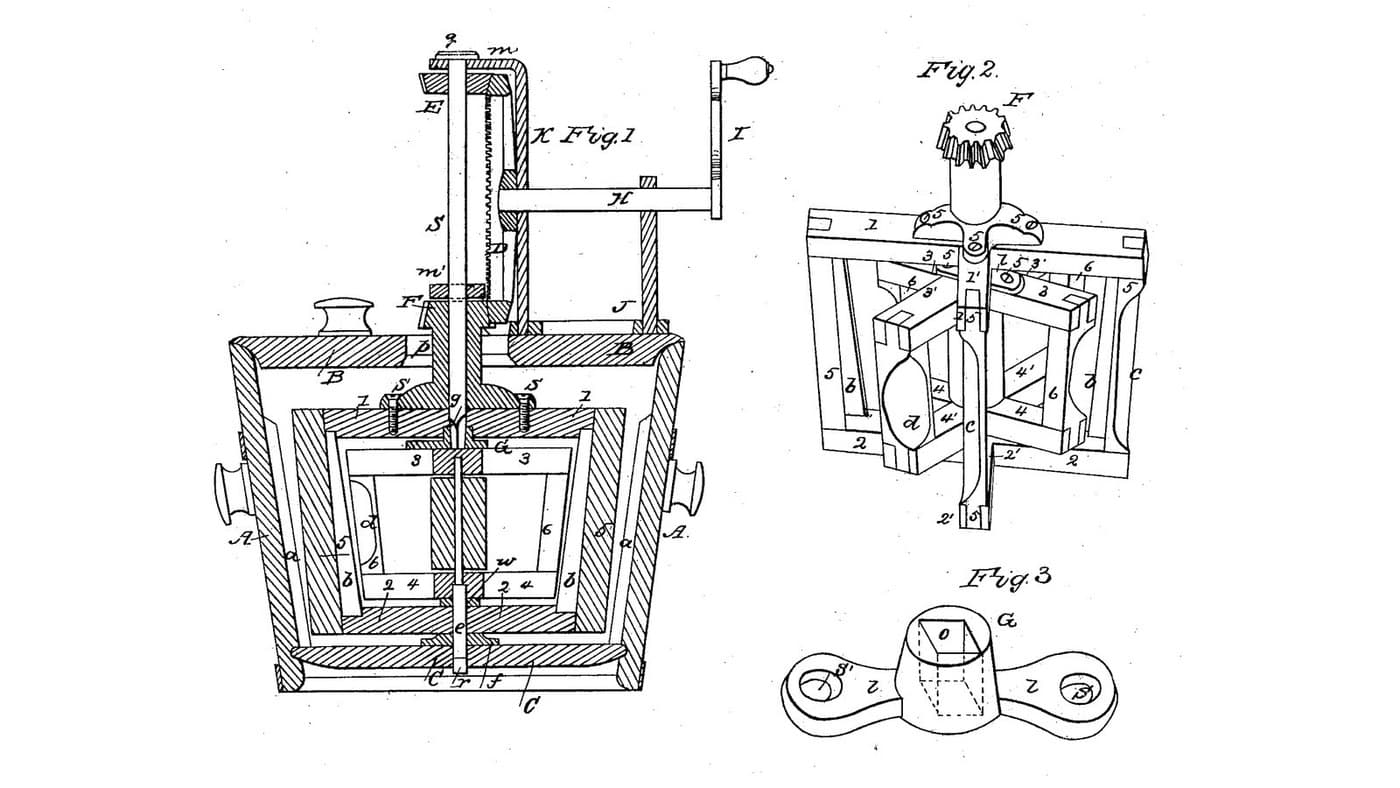
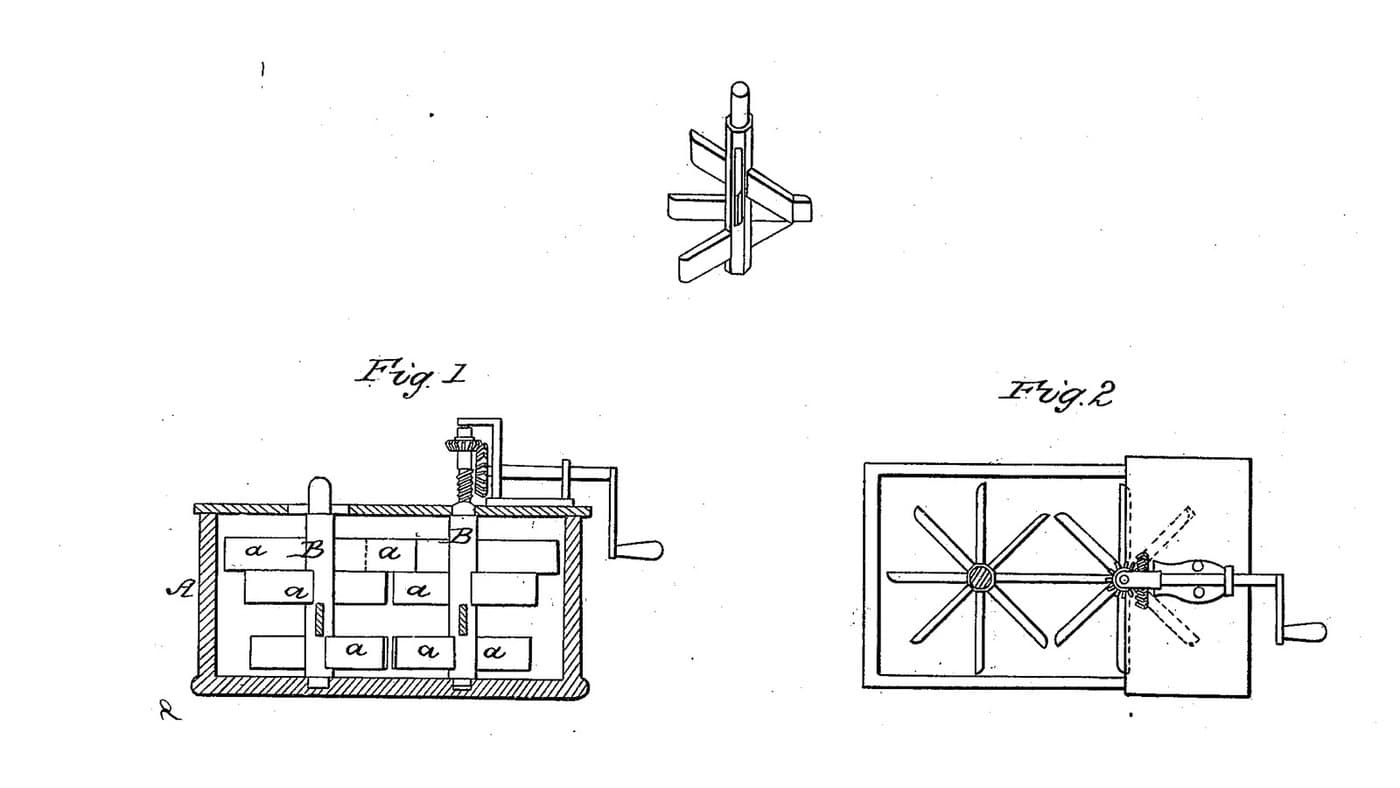
Dunham and Hipple nest two frames. Cheever nests three, the middle one turning against the other two.
3

Read US 28,560

"... the arrangement of the pinions on opposite sides of the driving wheel, and their connections through the collars with the outer and inner series of beaters or mixers, and the action of the central curved blades, is to throw the material constantly from the center to the circumference and there to submit it to the opposing forces of the beaters revolving in opposite directions."
4

Print the driving wheel C

Crown wheel, 36 teeth on its face, module 2, with a hub; bored 12.4 mm. PETG, 0.2 mm layers, 40 % infill, 4 walls.
DesigndateiSTLCC0 - Free
5

Print the pinion D

Spur pinion, 16 teeth, module 2, with a hub; bored 12.4 mm for the shaft F. PETG, 0.2 mm layers, 40 % infill, 4 walls.
DesigndateiSTLCC0 - Free
6

Print the pinion E

Spur pinion, 16 teeth, module 2, with a hub; bored 18.4 mm for the sleeve of collar G. PETG, 0.2 mm layers, 40 % infill, 4 walls.
DesigndateiSTLCC0 - Free
7

Outer and inner series I, I on collars G and H2

Bend 6 mm stainless rod into two outer loops 220 mm across and 300 tall and two inner loops 120 across and 220 tall, open at the middle of top and bottom. Cut 130 mm of 18 mm stainless tube as the sleeve of collar G and fix two printed or hardwood hubs 32 mm across on it, 40 mm apart; screw the outer loops' top ends to the upper hub and the inner loops' to the lower, crossed at right angles. Screw their bottom ends to two hubs H2 bored 12.6 mm, which turn free on the shaft.

Materialien für diesen Schritt:

EdelstahlstabEdelstahlstab4 Stück
EdelstahlrohrEdelstahlrohr1 Stück
HartholzbrettHartholzbrett1 Stück
MaschinenschraubenMaschinenschrauben16 Stück
PETG-FilamentPETG-Filament1 Stück

Benötigte Werkzeuge:

FDM-3D-DruckerFDM-3D-Drucker
SchraubstockSchraubstock
Bügelsäge (Metallsäge)Bügelsäge (Metallsäge)
Feilen (Handfeile)Feilen (Handfeile)
AkkubohrschrauberAkkubohrschrauber
BohrersatzBohrersatz
Schraubendreher-SatzSchraubendreher-Satz
8

Middle series h, collars H and G2, blades L and M

Bend two middle loops 170 mm across and 260 tall. Screw their top ends to a ring H 44 mm across, bored 18.6 mm, that rides on the sleeve between G's two hubs, and their bottom ends to a hub G2 pinned to the shaft F between the two H2 hubs, set 45 degrees from the outer loops. Pin two curved printed blades, 180 tall and reaching 50 mm, on the shaft inside the inner loops.

Materialien für diesen Schritt:

EdelstahlstabEdelstahlstab2 Stück
MaschinenschraubenMaschinenschrauben8 Stück
SplintSplint3 Stück
PETG-FilamentPETG-Filament1 Stück

Benötigte Werkzeuge:
SchraubstockSchraubstock
Bügelsäge (Metallsäge)Bügelsäge (Metallsäge)
Feilen (Handfeile)Feilen (Handfeile)
AkkubohrschrauberAkkubohrschrauber
BohrersatzBohrersatz
Schraubendreher-SatzSchraubendreher-Satz
9

Shaft F, bridge, arm A, wheel C and crank K

Pass a 12 mm stainless shaft F, 500 mm long, up through G2, H2 and the sleeve. Cut a hardwood bridge 350 x 330 x 15 mm to lie on the bucket's rim, bored 24 mm in the middle for the sleeve. Fix the pinion E on the sleeve's top, and the pinion D on the shaft above it. Screw two hardwood arms to the bridge carrying a 12 mm stainless axle with the wheel C meshing E below and D above, and a crank K on its end; a hardwood bracket over D holds the shaft's top.

Materialien für diesen Schritt:

EdelstahlstabEdelstahlstab2 Stück
HartholzbrettHartholzbrett2 Stück
HartholzdübelHartholzdübel1 Stück
HolzleimHolzleim1 Stück
HolzschraubenHolzschrauben10 Stück
Shaft CollarShaft Collar4 Stück
PETG-FilamentPETG-Filament1 Stück

Benötigte Werkzeuge:

TischkreissägeTischkreissäge
Flachfräsbohrer-SatzFlachfräsbohrer-Satz
AkkubohrschrauberAkkubohrschrauber
BohrersatzBohrersatz
Bügelsäge (Metallsäge)Bügelsäge (Metallsäge)
Schraubzwinge mit SchiebebügelSchraubzwinge mit Schiebebügel
Schraubendreher-SatzSchraubendreher-Satz
Bandmaß (Rollmeter)Bandmaß (Rollmeter)
10

The build in 3D

FreeCAD model of this build, the bucket cut open: the outer and inner loops on collar G and the H2 hubs, the middle loops on collar H and G2, the central blades, and on the bridge the wheel C with pinion E below and D above.
DesigndateiBLENDCC0 - Free
11

Churn

Pour about 8 litres of heavy cream at about 15 °C, checked with the thermometer, into the bucket, lower the beaters in and set the bridge on the rim. Turn the crank steadily, timing it. When the butter comes, lift the bridge and beaters out, take out the butter, pour the buttermilk into a bowl, wash the butter in cold water until it runs clear, salt and weigh it.

Materialien für diesen Schritt:

SchlagsahneSchlagsahne8 l
Grobes MeersalzGrobes Meersalz1 Stück
WasserWasser1 Stück

Benötigte Werkzeuge:

Einsteck-FühlerthermometerEinsteck-Fühlerthermometer
StoppuhrStoppuhr
Digitale KüchenwaageDigitale Küchenwaage
Große Rührschüssel aus EdelstahlGroße Rührschüssel aus Edelstahl
12

Troubleshooting

Three-series beater churn troubleshooting.

Flow

Loading...
13

History and honest limits

**Simon G. Cheever** of Boston, US 28,560, 5 June 1860, "Machine for Mixing Paints". He did not claim opposed pinions on one wheel, nor mixers or churn dashers turning oppositely, but the arrangement of the collars so the middle series turns against the outer and inner, with the central curved blades. His arm is metal and clamps into a dovetail socket on any bench; ours is hardwood on a bridge across the bucket. He leaves the number and shape of the beaters open; our loops, counts and every size are ours.

Materialien

13

Benötigte Werkzeuge

15

Designdateien

4

CC0 Gemeinfrei

Dieser Blueprint ist unter CC0 veröffentlicht. Sie dürfen dieses Werk für jeden Zweck frei kopieren, ändern, verbreiten und verwenden, ohne um Erlaubnis zu fragen.

Unterstützen Sie den Maker, indem Sie Produkte über seinen Blueprint kaufen, wo er eine Maker-Provision von Anbietern festgelegt, verdient. Oder erstellen Sie eine neue Iteration dieses Blueprints und verbinden Sie ihn in Ihrem eigenen Blueprint, um Einnahmen zu teilen.

Diskussion

(0)

Anmelden um an der Diskussion teilzunehmen

Kommentare werden geladen...