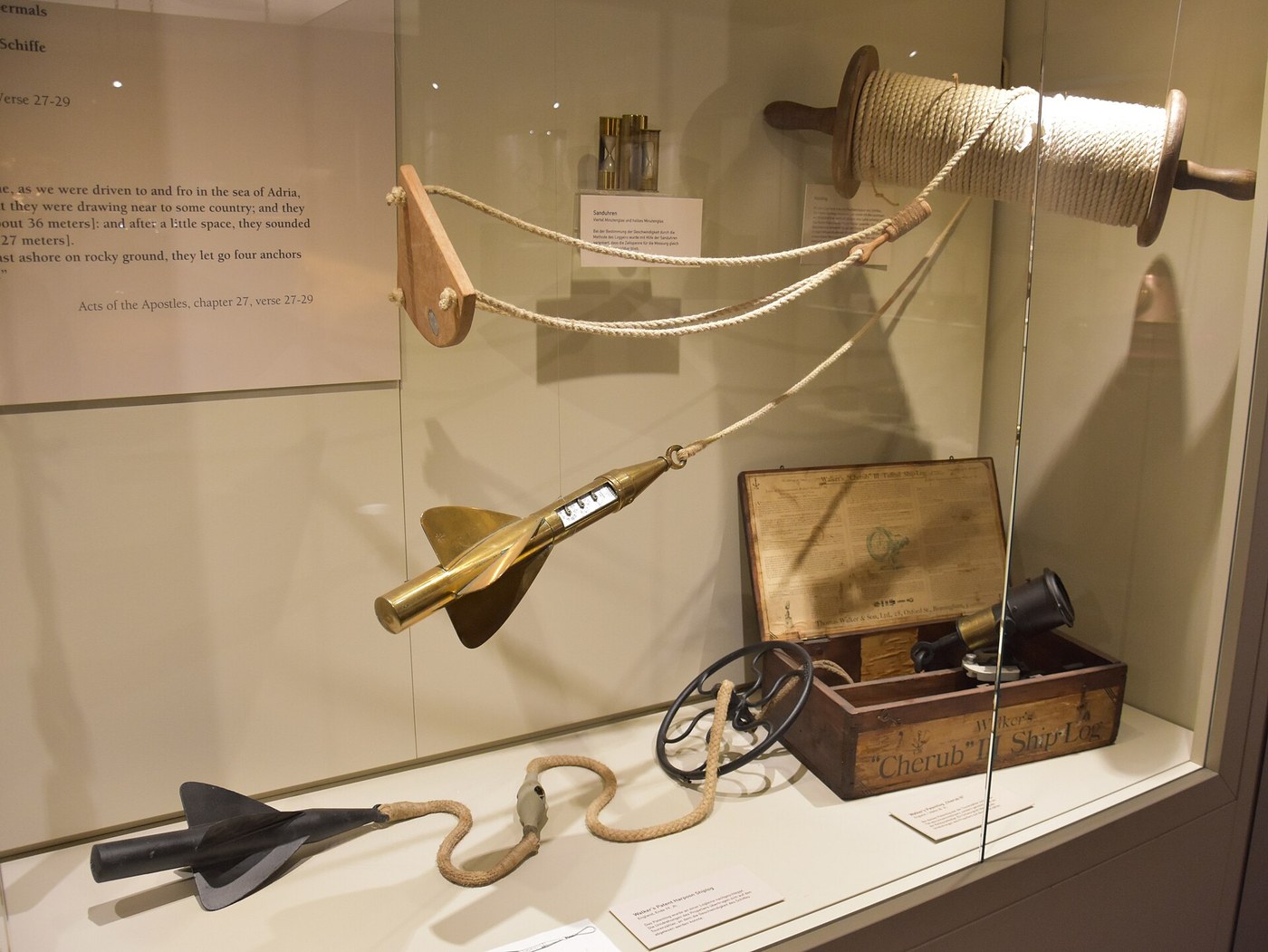


Chip Log
Anweisungen
Make the chip
Make the chip
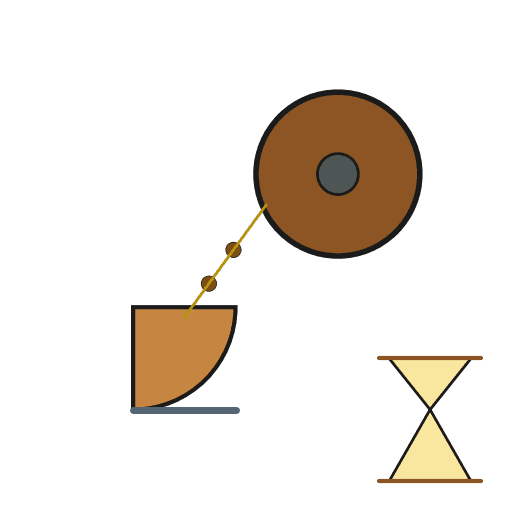
A quarter-circle of board, weighted so it stands upright in the water.
- Cut a quarter-circle roughly 15-20 cm on the straight edges.
- Weight the curved edge with lead or a heavy strip so it floats vertically.
- Attach a three-point bridle so the line pulls the flat face square against the water.
Materialien für diesen Schritt:
 Balsaholz-Plattensortiment1 Packung
 Baumwollschnur1 Rolle
Work out the knot spacing from the maths
Work out the knot spacing from the maths
The clever part is choosing spacing and timing together so no calculation is needed at sea.
- One nautical mile is 1852 m; one hour is 3600 s.
- Pick a glass interval — the classic is 28 seconds.
- Spacing = 1852 × (28 / 3600) = about 14.4 m between knots.
Benötigte Werkzeuge:
 Lineal
Knot the line and add stray line
Knot the line and add stray line
Mark the line so the count can be felt as well as seen.
- Tie knots at your calculated spacing, using different numbers of strands so each is identifiable by touch.
- Before the first knot, leave a length of unmarked stray line.
- Mark the end of the stray line with a piece of cloth.
Materialien für diesen Schritt:
 Angelschnur (monofil)1 Spule
Calibrate against a known speed
Calibrate against a known speed
Test it where you can check the answer.
- Walk a measured distance along a canal bank or pool edge at a steady pace, towing the chip.
- Time yourself over the measured distance for a true speed.
- Now run the log and compare the knot count with the true speed.
Benötigte Werkzeuge:
 Stoppuhr
History and context
History and context
The chip log appears in English sources from the late sixteenth century and was standard equipment for three hundred years. A log was hove regularly — often every hour or every watch — and the readings written on a board and then into the log book. The book is named after the piece of wood, which is why a ship's record, an aircraft's record and a server's record are all called logs.
It was one leg of dead reckoning. Speed from the log, heading from the compass, and time from the glass together give a position estimate by working forward from the last known one. Errors accumulate — a small speed bias compounds over days — which is exactly why a reliable way to fix longitude independently mattered so much, and why the marine chronometer was worth a national prize.
The unit outlived the instrument. A knot is one nautical mile per hour, and the nautical mile is itself defined from the Earth: one minute of latitude, standardised at 1852 metres. That means a speed in knots and a position in degrees and minutes work together arithmetically, which is why aviation and shipping still use it after satellite navigation made the rope obsolete.
What replaced it: the patent log, a towed rotor whose turns are counted mechanically, then the pitot and impeller logs, then GPS. Note that GPS gives speed over the GROUND while a chip log gives speed through the WATER, and the difference between them is the current — so both numbers are still wanted, and ships still measure water speed directly.
Materialien
3- 1 PackungPlatzhalter
- 1 RollePlatzhalter
- 1 SpulePlatzhalter
Dieser Bauplan stellt her
CC0 Gemeinfrei
Dieser Blueprint ist unter CC0 veröffentlicht. Sie dürfen dieses Werk für jeden Zweck frei kopieren, ändern, verbreiten und verwenden, ohne um Erlaubnis zu fragen.
Unterstützen Sie den Maker, indem Sie Produkte über seinen Blueprint kaufen, wo er eine Maker-Provision von Anbietern festgelegt, verdient. Oder erstellen Sie eine neue Iteration dieses Blueprints und verbinden Sie ihn in Ihrem eigenen Blueprint, um Einnahmen zu teilen.