Zusammenarbeit
KUNST
SCHÖNHEIT & WELLNESS
HANDWERK
KULTUR & GESCHICHTE
UNTERHALTUNG
UMFELD
ESSEN & GETRÄNKE
REVERSE ENGINEERING
WISSENSCHAFTEN
SPORT
TECHNOLOGIE
WEARABLES
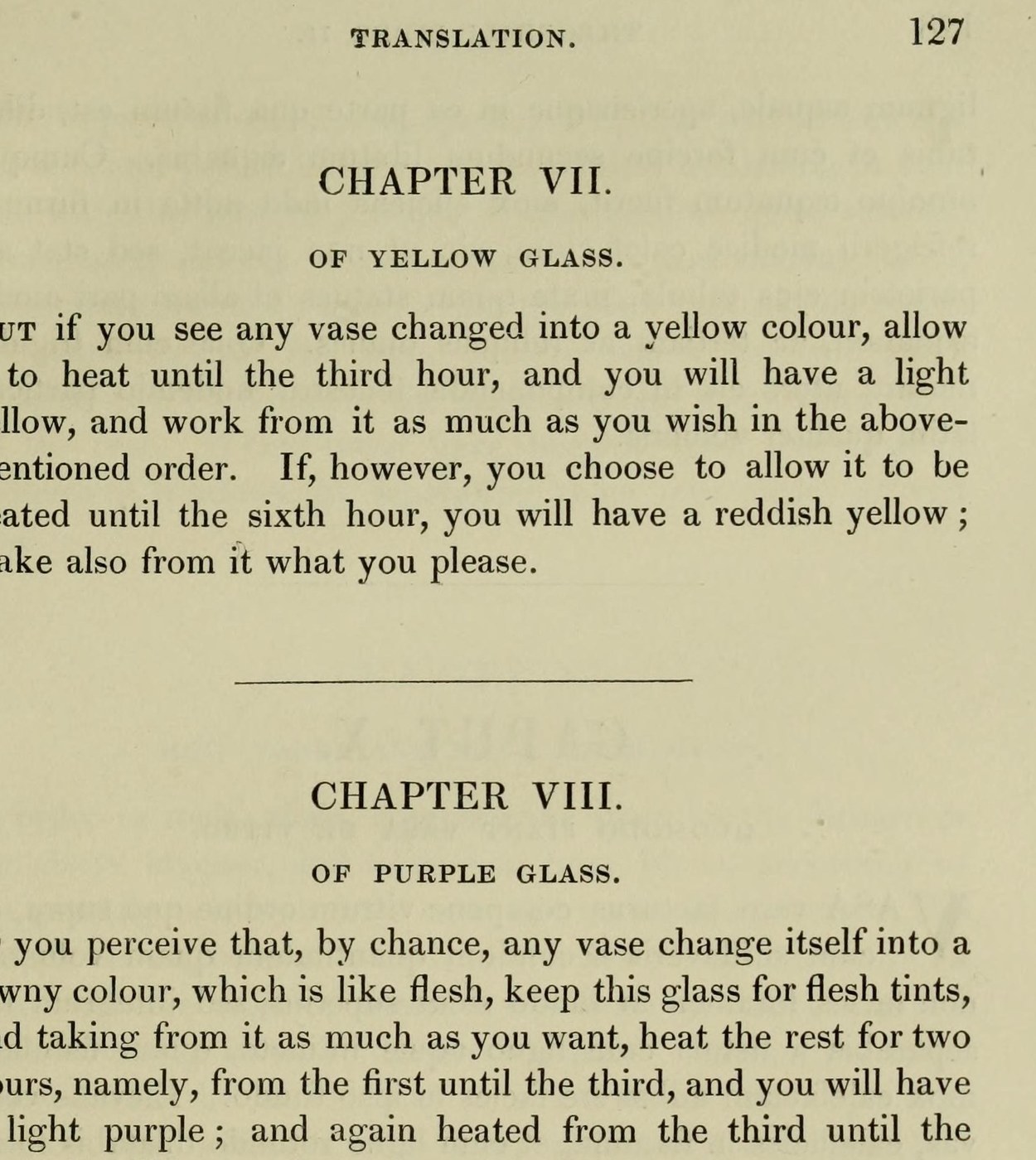


Coloured Glass Sheets: Beech-Ash Glass Blown into Cylinders and Flattened (Theophilus, tr. Hendrie 1847)
Window glass as the monk Theophilus taught it around 1100: two parts beech ash to one of clean sand, fritted for a night and a day, melted overnight in clay pots, blown into long bladders, opened into cylinders, split and flattened in a second oven, and cooled standing upright.
White glass comes first. A pot that turns yellow gives light yellow if heated to the third hour and reddish yellow by the sixth; a pot that turns flesh-coloured gives light purple after two more hours and red purple by the sixth.
Source: Theophilus, De Diversis Artibus, Book II, tr. R. Hendrie (1847), pp. 119-129. Picture: p. 127.
Erfahren
2-3 days
Anweisungen
1
1
Make the beech ash
Make the beech ash
Cut beech-wood logs and dry them. Burn them together in a clean spot and collect the ashes, taking care that no earth gets mixed in.
Materialien für diesen Schritt:
 Laubholzstämme (Eiche, Ahorn, Buche)1 beech
Benötigte Werkzeuge:
 Maurerkelle
2
2
Frit the ash and sand
Frit the ash and sand
Mix two parts of ash with one part of sand washed free of earth and stones. Heat it on the upper hearth of the furnace for a night and a day, stirring it with an iron trowel as it warms so that it does not melt into a lump.
Materialien für diesen Schritt:
 Quarzsand1 1 part to 2 of ash
Benötigte Werkzeuge:
 Glasofen, der 1100 Grad Celsius erreichtMaurerkelle
3
3
Make the pots and melt
Make the pots and melt
Grind dry white clay, wet it, beat it hard with wood and make pots wide at the top and narrow below, with a small lip curved inward. Set the dry pots in the glowing furnace, fill them in the evening with the hot frit and feed dry wood all night until the glass is fully melted.
Benötigte Werkzeuge:
 KaolinpulverGlasofen, der 1100 Grad Celsius erreicht
 SchmiedezangeMaurerkelle
4
4
Blow the cylinders
Blow the cylinders
In the morning gather glass on the iron pipe (two yards long, a thumb thick), blow a little, tap it on a flat stone so it hangs evenly, and blow it into a long bladder. Melt open the far end in the flame and widen it with a piece of wood, break it off the pipe with a wet piece of wood, open the other end the same way, and let a boy carry the cylinder on a stick to the warm cooling oven. This first glass is pure and white.
Benötigte Werkzeuge:
 GlasmacherpfeifeGlasofen, der 1100 Grad Celsius erreicht
 Glühofen
5
5
Bring out the colours
Bring out the colours
If a pot turns yellow, heat it to the third hour for light yellow or to the sixth for reddish yellow. If a pot turns tawny like flesh, keep some for flesh tints; heat the rest from the first to the third hour for light purple, from the third to the sixth for a red purple. Blow cylinders from each as before.
Benötigte Werkzeuge:
Glasofen, der 1100 Grad Celsius erreichtGlasmacherpfeife6
6
Split and flatten
Split and flatten
When all are made and cooled, fire the flattening oven. Split each cylinder along one side with a hot iron, lay it on the glowing hearth, and when it softens open it with the pincers and a smooth piece of wood and flatten it. Stand the sheets upright against the wall of the warm cooling oven, one next to another. When cold, cut them into pieces for windows.
Benötigte Werkzeuge:
Glasofen, der 1100 Grad Celsius erreichtSchmiedezangeGlühofenMaterialien
2- Platzhalter
- 1 1 part to 2 of ashPlatzhalter
Dieser Bauplan stellt her

CC0 Gemeinfrei
Dieser Blueprint ist unter CC0 veröffentlicht. Sie dürfen dieses Werk für jeden Zweck frei kopieren, ändern, verbreiten und verwenden, ohne um Erlaubnis zu fragen.
Unterstützen Sie den Maker, indem Sie Produkte über seinen Blueprint kaufen, wo er eine Maker-Provision von Anbietern festgelegt, verdient. Oder erstellen Sie eine neue Iteration dieses Blueprints und verbinden Sie ihn in Ihrem eigenen Blueprint, um Einnahmen zu teilen.