KUNST
SCHÖNHEIT & WELLNESS
HANDWERK
KULTUR & GESCHICHTE
UNTERHALTUNG
UMFELD
ESSEN & GETRÄNKE
REVERSE ENGINEERING
WISSENSCHAFTEN
SPORT
TECHNOLOGIE
WEARABLES
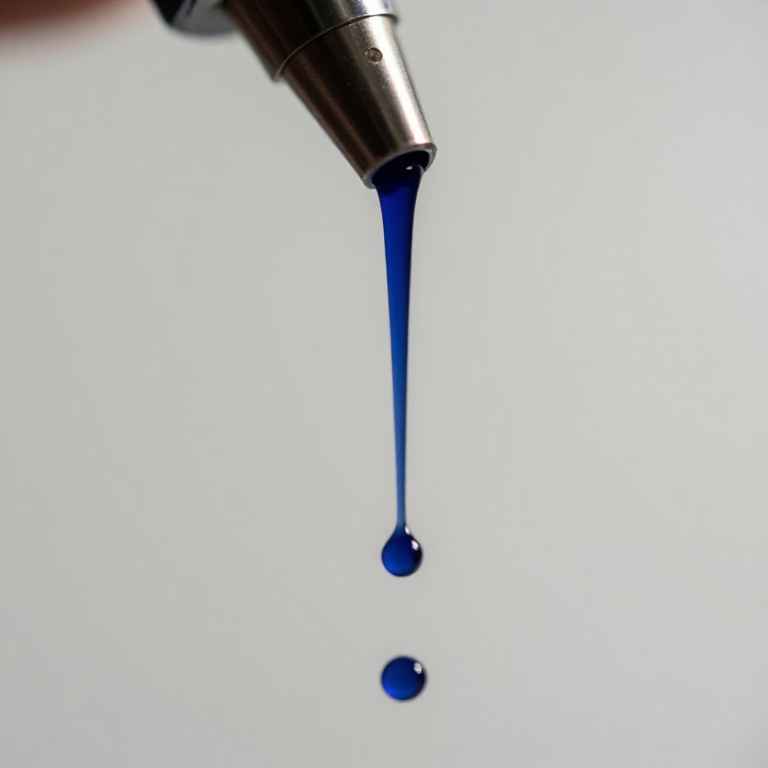


Continuous Inkjet
Rayleigh worked out in 1878 that a liquid jet cannot stay a jet. Surface tension amplifies any disturbance along it until the column pinches into drops, and the wobble that grows fastest has a wavelength of about four and a half times the jet's diameter. A fifty-micrometre nozzle therefore breaks up into drops at tens of kilohertz whether you want it to or not.
Rune Elmqvist at Siemens used that in 1951 to make a chart recorder that wrote with ink instead of a pen. Richard Sweet at Stanford turned it into printing in 1964 by adding the two things that make it controllable: drive the jet with a piezo AT its natural break-up frequency, so every drop is identical and arrives on schedule, then put a charge on each drop at the instant it separates and deflect it electrostatically on its way to the paper.
The consequence is a machine that is always firing. Drops you do not want are simply left uncharged, fly straight on into a gutter, and are pumped back to the reservoir. That sounds wasteful and is the single reason the technology survives: a nozzle with ink permanently flowing through it cannot dry out, so a continuous inkjet can sit in a factory for years and start instantly.
It is why every date code on every can and bottle you have ever bought was printed this way, at conveyor speed, onto a curved and moving surface. It is also why nobody put one on a desk: the gutter, the pump, the filter, the viscosity controller and the evaporating solvent are the price of never clogging.
Fortgeschritten
3 hours
Anweisungen
1
1
Make a jet break up, and photograph it
Make a jet break up, and photograph it
Feed water through a fine nozzle - a syringe needle ground flat - under a metre of head, into a sink.
Strobe an LED from the function generator and sweep the frequency until the drop train freezes. Read that frequency; measure the jet diameter with the loupe. That is Rayleigh's result on a bench.
Materialien für diesen Schritt:
 Laborspritze1 Stück
 Silikonschlauch1 Meter
Benötigte Werkzeuge:
 Funktionsgenerator
 LED-Lichtquelle
 Handlupe 10-fach
 Desktop-Computer
 Digitaler Messschieber 6 Zoll
2
2
Drive it, then deflect it
Drive it, then deflect it
Clamp a piezo disc to the nozzle body and drive it at that frequency. The drop train stops wandering and locks.
Now stand two foil plates 6 mm apart with the stream running between them, touch a charging electrode to the ink upstream, and wind the supply up to 5 kV. The stream bends. Goggles on, one hand behind your back.
Materialien für diesen Schritt:
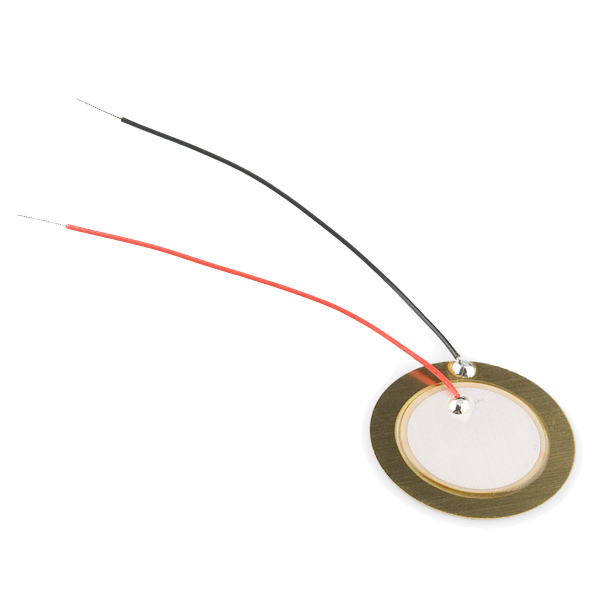 Piezo Element1 Stück
 Aluminiumfolie1 Blatt
Benötigte Werkzeuge:
Funktionsgenerator Hochspannungs-Gleichstromquelle (Labor)
 Vollsichtschutzbrille
 Digitalmultimeter, Laborqualität
 Lineal
3
3
Break-up rate, deflection, and the two inkjets
Break-up rate, deflection, and the two inkjets
Jupyter-Notebook wird geladen …
Benötigte Werkzeuge:
Desktop-Computer4
4
Compendium: charge at one instant, in a solvent
Compendium: charge at one instant, in a solvent
A drop can only be charged while still joined to the conducting jet - once it separates its charge is fixed for ever. So the electrode must switch in the microseconds around break-up, for every drop, at tens of kilohertz, and if the break-up point drifts by one wavelength the charge lands on the wrong drop. Production machines watch break-up optically and servo the piezo amplitude to hold it still. That loop, not the nozzle, is the hard part.
The ink is therefore not water. It must conduct (dissolved salts), dry on glass, foil and polypropylene (methyl ethyl ketone), and survive months of recirculation without settling. Solvent evaporates from the open gutter continuously, so the machine also carries a make-up fluid supply and a viscosity sensor. Compare the aqueous dye ink of blueprint 9, whose only requirement is that it can be boiled.
Materialien
4- 1 StückPlatzhalter
- 1 MeterPlatzhalter
- Piezo Element10% Provision1 Stück€1.99
- 1 BlattPlatzhalter
Benötigte Werkzeuge
9- Platzhalter
- Platzhalter
- Platzhalter
- Platzhalter
- Platzhalter
- Platzhalter
- Platzhalter
- Platzhalter
- Platzhalter
Geschätzte Gesamtkosten
Was der Maker gekauft hat. Materialien ohne Preis besorgst du dort, wo du sie kaufst.
Verwandte Blueprints
Diese Blueprints teilen Wissen — Techniken, Materialien oder Prinzipien


CC0 Gemeinfrei
Dieser Blueprint ist unter CC0 veröffentlicht. Sie dürfen dieses Werk für jeden Zweck frei kopieren, ändern, verbreiten und verwenden, ohne um Erlaubnis zu fragen.
Unterstützen Sie den Maker, indem Sie Produkte über seinen Blueprint kaufen, wo er eine Maker-Provision von Anbietern festgelegt, verdient. Oder erstellen Sie eine neue Iteration dieses Blueprints und verbinden Sie ihn in Ihrem eigenen Blueprint, um Einnahmen zu teilen.