KUNST
SCHÖNHEIT & WELLNESS
HANDWERK
KULTUR & GESCHICHTE
UNTERHALTUNG
UMFELD
ESSEN & GETRÄNKE
REVERSE ENGINEERING
WISSENSCHAFTEN
SPORT
TECHNOLOGIE
WEARABLES
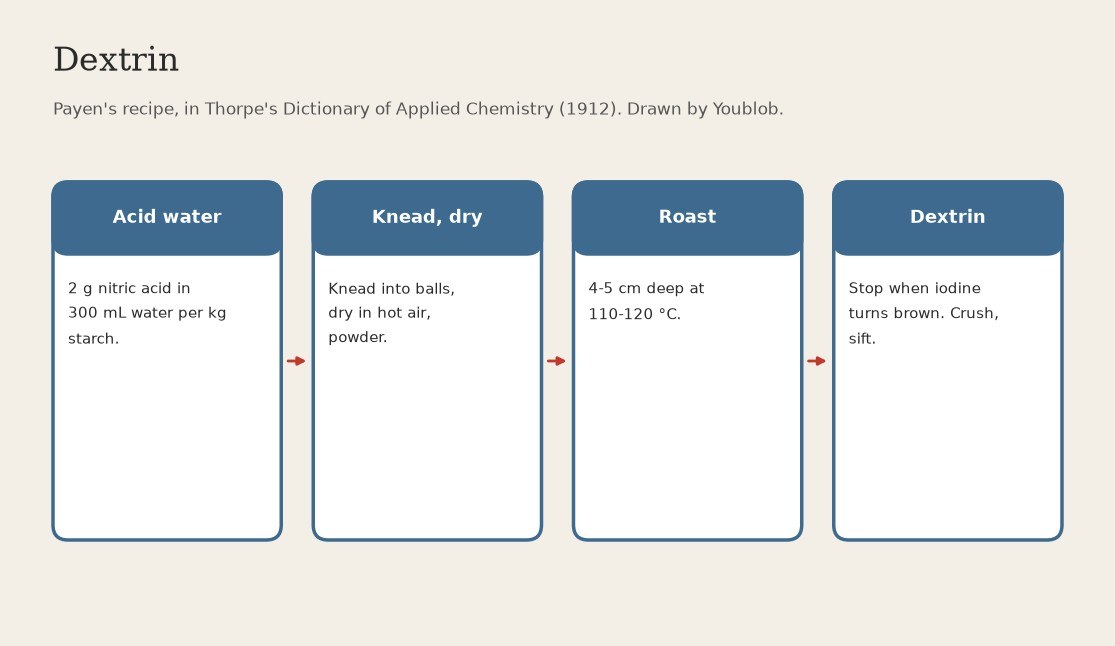


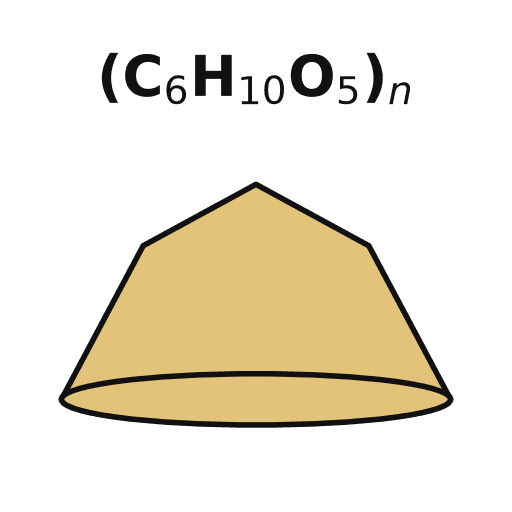
Dextrin: Starch Moistened with Dilute Nitric Acid and Heated at 110-120 °C (Payen, in Thorpe 1912)
Dextrin, also called British gum, is starch broken down by heat into a powder that dissolves in water to a sticky gum. A trace of nitric acid lets it form at a lower heat, 110 to 120 °C, so it comes out paler. The lower the heat and the drier the starch, the whiter the dextrin.
Source: Thorpe, Dictionary of Applied Chemistry, vol. 2 (1912), Dextrins, giving Payen's recipe. Ours: potato starch (Payen names no starch) and the scaling to 1 kg. Not given: how long to dry and to heat. Picture drawn by Youblob.
Anfänger
2 days
Anweisungen
1
1
Mix 2 g nitric acid into 300 mL water
Mix 2 g nitric acid into 300 mL water
Payen: 30 gallons of water holding 2 lb nitric acid (sp. gr. 1.38) for 1000 lb starch. Ours, scaled to 1 kg of starch: weigh 2 g of the acid into about 300 mL water. Add acid to water, not water to acid. Goggles and gloves for the strong acid.
Materialien für diesen Schritt:
 Salpetersäure2 g
 Wasser300 ml
Benötigte Werkzeuge:
 Balkenwaage
 Messkanne
 Chemikalienschutzbrille
 Nitrilhandschuhe
2
2
Knead 1 kg starch with the acid water into balls
Knead 1 kg starch with the acid water into balls
Moisten 1 kg of starch with the acid water, knead it well and make it up into balls. Payen names no starch; ours: potato starch.
Materialien für diesen Schritt:
 Kartoffelstärke1 kg
Benötigte Werkzeuge:
 GlasschaleNitrilhandschuhe
3
3
Dry the balls in hot air, then powder them
Dry the balls in hot air, then powder them
Dry the balls in a hot-air chamber, then powder them. Time and heat for this drying are not given. Ours: a drying oven, and a mortar to powder.
Benötigte Werkzeuge:
 Trockenofen
 Mörser und Pistill
4
4
Heat 4-5 cm deep on trays at 110-120 °C
Heat 4-5 cm deep on trays at 110-120 °C
Spread the powder 1 1/2 to 2 inches (4 to 5 cm) deep on trays (Payen: brass trays) and heat in a hot-air oven at 110 to 120 °C. Time not given.
Benötigte Werkzeuge:
 Flaches TrockentablettTrockenofen
 Backofenthermometer
5
5
Stop as soon as iodine turns a sample brown
Stop as soon as iodine turns a sample brown
Test small samples with iodine. Starch turns iodine blue; commercial dextrin, mostly erythrodextrin, gives a brown colour. When the change is complete, stop the heating at once. Ours: a few iodine crystals shaken in water as the test liquid.
Benötigte Werkzeuge:
 IodkristalleWasserTrockenofen
6
6
Crush, sift and store dry
Crush, sift and store dry
Crush the roasted dextrin and sift it (in works: crushing pans or rollers, then a rotating silk screen as in flour mills). Ours: mortar and a fine sieve. Keep it dry in a closed jar.
Benötigte Werkzeuge:
Mörser und Pistill Sieb mit feinem Drahtgewebe
 Einmachglas
Materialien
3- Platzhalter
- 300 mlPlatzhalter
- 1 kgPlatzhalter
Benötigte Werkzeuge
13- Platzhalter
- Platzhalter
- Platzhalter
- Platzhalter
- Platzhalter
- Platzhalter
- Platzhalter
- Platzhalter
- Platzhalter
- Platzhalter
- Platzhalter
- Platzhalter
- Platzhalter
Dieser Bauplan stellt her
Verwandte Blueprints
Diese Blueprints teilen Wissen — Techniken, Materialien oder Prinzipien

CC0 Gemeinfrei
Dieser Blueprint ist unter CC0 veröffentlicht. Sie dürfen dieses Werk für jeden Zweck frei kopieren, ändern, verbreiten und verwenden, ohne um Erlaubnis zu fragen.
Unterstützen Sie den Maker, indem Sie Produkte über seinen Blueprint kaufen, wo er eine Maker-Provision von Anbietern festgelegt, verdient. Oder erstellen Sie eine neue Iteration dieses Blueprints und verbinden Sie ihn in Ihrem eigenen Blueprint, um Einnahmen zu teilen.