Extracting Zinc from Sphalerite — Roasting and Reduction of the Invisible Metal
Zinc (Zn, element 30) was the last of the ancient metals to be isolated in pure form, despite being used unknowingly for millennia. Roman brass (an alloy of copper and zinc) was produced by heating copper with calamine ore (zinc carbonate, ZnCO₃) in a process called cementation — the zinc vapor reduced from calamine alloyed directly with the copper without ever existing as a separate metal. The difficulty was zinc's low boiling point: at 907 °C, zinc boils before most furnaces reach the temperature needed to reduce its oxide, causing it to escape as vapor. Pure metallic zinc was first produced at Zawar, Rajasthan, India, around 1300 CE using downward-distillation retorts — one of history's most ingenious metallurgical innovations.
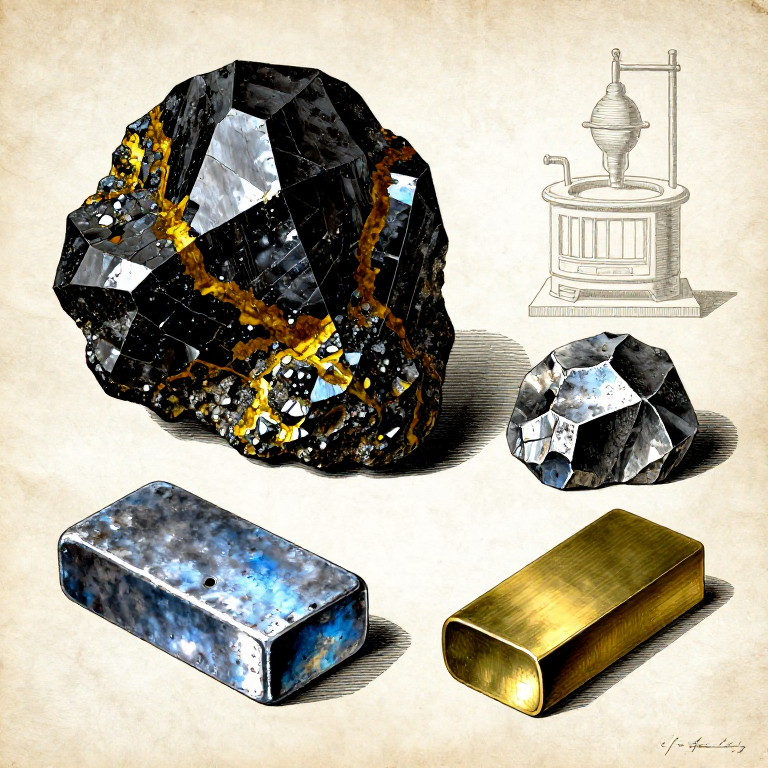
The primary ore of zinc is sphalerite (zinc sulfide, ZnS), which contains 67% zinc by mass. Sphalerite is first roasted in air to convert it to zinc oxide (ZnO), then reduced with carbon at temperatures above 1000 °C. Because zinc immediately boils, the reduction must be performed in a sealed retort with a downward-pointing condenser tube, where zinc vapor collects and solidifies as metallic zinc.
HAZARD: Zinc oxide fumes cause 'metal fume fever' — a flu-like illness with fever, chills, muscle aches, and nausea appearing 4–12 hours after exposure. While not usually life-threatening, repeated exposure may cause chronic respiratory damage. Sulfur dioxide (SO₂) from roasting is a corrosive respiratory irritant. Work outdoors with respiratory protection (P100 minimum) at all stages.
Anweisungen
Understand zinc chemistry and its historical puzzle
Understand zinc chemistry and its historical puzzle
Zinc (Zn, element 30) is a transition metal with atomic mass 65.38, density 7.14 g/cm³, melting point 419.53 °C, and a critical property that defined its metallurgical history: a boiling point of only 907 °C. This is below the temperature required to reduce zinc oxide to metal (approximately 1000–1100 °C), meaning that the moment zinc forms from its oxide, it immediately vaporizes and escapes the furnace as invisible gas.
This created a paradox that baffled European metallurgists for centuries: they could make brass by heating copper with zinc ore (the zinc vapor alloyed with copper before escaping), but they could not isolate the metal itself. Indian metalworkers at Zawar solved this around 1300 CE by inverting the problem — they built downward-pointing retorts so that zinc vapor condensed below the reaction zone rather than escaping upward. European metallurgy did not produce pure zinc until Andreas Sigismund Marggraf demonstrated it in 1746, over 400 years later.
Zinc is moderately reactive: it dissolves in both acids and strong bases (amphoteric behavior), burns in air with a bright blue-green flame producing dense white ZnO fumes, and slowly corrodes in moist air to form a protective patina of basic zinc carbonate.
Identify sphalerite in the field
Identify sphalerite in the field
Sphalerite (ZnS, zinc blende) is the most important zinc ore, containing 67% zinc by mass. It has a resinous to adamantine luster and varies in color from pale yellow (when nearly pure) through brown, red-brown, to nearly black (when iron-rich, called 'marmatite'). The name sphalerite comes from the Greek sphaleros ('treacherous') because it was frequently confused with galena but yielded no useful metal by European methods.
Key identification features: Mohs hardness 3.5–4, perfect cleavage in six directions (producing characteristic angular fragments), specific gravity 3.9–4.1, and a pale yellow to brown streak on unglazed porcelain. Sphalerite occurs in hydrothermal vein deposits, often intimately associated with galena (PbS), chalcopyrite (CuFeS₂), pyrite (FeS₂), and quartz. Major deposits include the Tri-State district (USA), Broken Hill (Australia), and the zinc belt of Belgium–Germany.
Sphalerite fluoresces orange or yellow-orange under long-wave ultraviolet light in many specimens — a useful field identification test. Its streak is always lighter than the specimen's body color, which distinguishes it from similarly colored minerals.
Benötigte Werkzeuge:
 Geologenhammer
 Handlupe 10-fach
 Strichtafel (unglasiertes Porzellan)
Crush and prepare the ore
Crush and prepare the ore
Break sphalerite specimens into small pieces (under 1 cm) using a geological hammer on a steel anvil. The ore should be crushed to roughly uniform grain size to ensure even roasting. Remove any large pieces of gangue (waste rock, typically quartz or calcite) by hand-sorting — the cleaner the ore charge, the higher the zinc yield.
Weigh the crushed ore and record the amount. A charge of 500 grams of reasonably pure sphalerite should yield approximately 200–250 grams of zinc oxide after roasting, and theoretically up to 160–200 grams of metallic zinc after reduction (in practice, significantly less due to losses).
Sphalerite dust is mildly irritating to the lungs. Wear a dust mask during crushing and work in a ventilated area. Collect the crushed ore in a ceramic or steel container — not aluminum, which zinc will alloy with at high temperatures.
Materialien für diesen Schritt:
 Sphaleriterz (Zinksulfid)500 grams
Benötigte Werkzeuge:
Geologenhammer Staubmaske
Roast the sphalerite to zinc oxide
Roast the sphalerite to zinc oxide
PERFORM OUTDOORS ONLY — produces toxic SO₂ gas. Roasting converts zinc sulfide to zinc oxide by heating in air: 2ZnS + 3O₂ → 2ZnO + 2SO₂. The reaction begins at approximately 700 °C and proceeds vigorously at 800–900 °C. Sulfur dioxide (SO₂) is released as a choking, acrid gas — the same compound responsible for acid rain.
Spread the crushed sphalerite in a thin layer (no more than 2 cm deep) on a flat refractory surface — a shallow ceramic dish, a broken kiln shelf, or a sheet of firebrick works well. Place this in an outdoor fire or charcoal furnace and heat to approximately 800–900 °C. The ore must be exposed to air — do not cover it, as oxygen is a reactant. Stir the ore occasionally with a steel rod to expose fresh surfaces.
Roasting is complete when the ore changes from dark (sulfide) to a white-to-yellow powder (zinc oxide, ZnO). This typically takes 1–2 hours. The white powder is called 'calx' or 'calcine' in historical metallurgical terminology. Allow the calcine to cool before handling.
Materialien für diesen Schritt:
 Holzkohle3 kg
Benötigte Werkzeuge:
 Feuerfeste Schale (flache Keramikschale)
 Rührstab aus Stahl
 P100-Atemschutzmaske
 Vollsichtschutzbrille
Construct the reduction retort
Construct the reduction retort
The key innovation of zinc smelting is the sealed retort with downward condenser. Unlike iron or copper smelting (where the metal is liquid at furnace temperatures), zinc at reduction temperature (1000–1100 °C) is a gas that escapes upward in an open furnace. The solution is to perform the reduction in a sealed tube with the open end pointing downward or into a cooled collection vessel.
A suitable retort can be made from a thick-walled ceramic tube (mullite or fireclay, approximately 30–40 cm long, 5–8 cm diameter), sealed at one end. The open end connects to a steel condenser tube angled downward, leading to a water-cooled collection vessel. The Indian metalworkers at Zawar used inverted clay pots; in 18th-century European practice, horizontal retorts of fireclay were used in banks of hundreds.
The retort must withstand 1100 °C without cracking, and the seal between retort and condenser must be tight enough to prevent zinc vapor escaping. Use refractory clay or a mixture of fireclay and sand to seal joints. The condenser tube should extend well below the retort and be cooled by air or wet cloth — zinc solidifies below 419 °C.
Materialien für diesen Schritt:
 Feuerfester Ton (Schamotteton)500 grams
Benötigte Werkzeuge:
 Keramisches Retortenrohr (Schamotte)
 Stahl-Kühlrohr (abgewinkelt)
Mix the charge — zinc oxide with carbon
Mix the charge — zinc oxide with carbon
The reduction reaction is: ZnO + C → Zn(vapor) + CO. Mix the roasted zinc oxide (calcine) thoroughly with crushed charcoal at a ratio of approximately 1:1 by weight. The carbon serves as the reducing agent, stripping oxygen from zinc oxide to produce metallic zinc vapor and carbon monoxide gas.
Crush the charcoal to a grain size similar to the calcine (under 5 mm) for intimate mixing. Larger charcoal pieces leave unreacted pockets of zinc oxide. Some historical recipes add a small amount of ground limestone (calcium carbonate) as a flux to help remove iron impurities as slag, but this is optional for small-scale work.
Pack the mixed charge firmly into the sealed end of the retort, filling approximately two-thirds of the tube length. Leave the remaining third empty — this space allows zinc vapor to travel toward the condenser without carrying calcine dust. Seal the open end of the retort to the condenser tube using refractory clay, leaving only the condenser exit open for zinc vapor to escape and condense.
Materialien für diesen Schritt:
 Holzkohlescheibe500 grams
Benötigte Werkzeuge:
 Mörser und Pistill
Heat the retort to reduction temperature
Heat the retort to reduction temperature
OUTDOORS ONLY — produces carbon monoxide and zinc vapor. Place the loaded retort into a charcoal furnace with the sealed end in the hottest zone and the condenser tube extending out and downward. Heat the furnace steadily to 1000–1100 °C — the retort must glow bright orange. The reduction reaction ZnO + C → Zn + CO begins at approximately 1000 °C and proceeds more rapidly at higher temperatures.
Carbon monoxide (CO) — an odorless, lethal gas — is produced as a byproduct and exits through the condenser tube along with zinc vapor. This is why the process must be performed outdoors with no enclosed spaces downwind. CO is lighter than air and disperses rapidly in open air, but will accumulate fatally under any overhead cover.
Maintain temperature for 2–3 hours. The reaction is endothermic (absorbs heat), so you must continually add charcoal and maintain air supply to the furnace. Use bellows directed at the furnace walls, not at the retort — direct air would oxidize the condenser and condense zinc oxide (white powder) instead of metallic zinc.
Materialien für diesen Schritt:
Holzkohle5 kgBenötigte Werkzeuge:
 Blasebalg
 Holzkohle-TiegelofenP100-Atemschutzmaske
Collect the condensed zinc
Collect the condensed zinc
As the retort reaches operating temperature, zinc vapor travels through the tube to the cooler condenser section, where it solidifies. Zinc condenses as a silvery-grey metallic deposit on the inner walls of the condenser tube and in the collection vessel. Some zinc may also condense as a fine powder (zinc dust) if the condenser is too cool or the vapor contacts air before condensing.
After 2–3 hours of sustained heating, allow the furnace to cool naturally. Do not open the retort while hot — air entering a hot retort will immediately oxidize any remaining zinc vapor to ZnO, losing it as white powder. Once the retort and condenser are cool enough to handle with heavy gloves (below 200 °C), disconnect the condenser tube and extract the condensed zinc.
The zinc may appear as a solid plug or cake inside the condenser, or as irregular metallic droplets and splashes. Collect all metallic zinc by gently tapping and scraping the condenser tube. The total recovery depends on retort seal quality, temperature control, and condenser efficiency — expect 30–50% of theoretical yield for a first attempt.
Benötigte Werkzeuge:
 Verstärkte Arbeitshandschuhe
 Stahlschaber
Remelt and cast the zinc ingot
Remelt and cast the zinc ingot
The collected zinc fragments can be consolidated into a single ingot by remelting. Zinc melts at 419.53 °C — easily achievable over a charcoal fire or with a propane torch. Use a small steel or cast-iron crucible (not ceramic — molten zinc attacks silicate ceramics). Place the zinc fragments in the crucible, heat until fully molten, and pour into a simple ingot mold (a groove carved in dry sand, or a small steel mold).
WARNING: Do not overheat zinc above approximately 500 °C — at higher temperatures, zinc oxidizes rapidly in air, producing dense white fumes of ZnO (zinc oxide). These fumes cause metal fume fever: flu-like symptoms appearing 4–12 hours after exposure, lasting 24–48 hours. Melt zinc at the lowest temperature that maintains fluidity, and avoid breathing any white fumes.
The resulting ingot should be bright silvery-grey on freshly cut surfaces, with a density of 7.14 g/cm³ (heavier than iron at 7.87 g/cm³ — no, lighter; iron is denser). Zinc has a characteristic bluish-white color and a crystalline fracture pattern when broken.
Benötigte Werkzeuge:
 Stahltiegel
 TiegelzangeP100-Atemschutzmaske
Verify the metal and understand its properties
Verify the metal and understand its properties
Confirm the identity of your zinc by testing its properties. Zinc has a distinctive bluish-white color (between the bright white of aluminum and the grey of lead). It is brittle at room temperature — a zinc bar snaps cleanly rather than bending. However, between 100–150 °C, zinc becomes malleable and can be rolled into sheets; above 200 °C it becomes brittle again.
Chemical tests: zinc dissolves vigorously in dilute hydrochloric acid (HCl), producing hydrogen gas bubbles: Zn + 2HCl → ZnCl₂ + H₂↑. This reaction is much more vigorous than lead in acid (lead dissolves slowly) and confirms the metal is zinc, not lead or tin. Zinc also dissolves in sodium hydroxide solution (NaOH), producing hydrogen — this amphoteric behavior distinguishes zinc from most other common metals.
A small piece of zinc held in a propane flame burns with a characteristic bright blue-green flame, producing white ZnO smoke. This flame color is unique to zinc and is an instant identification test. Perform this test outdoors and briefly — the ZnO fumes cause metal fume fever.
Benötigte Werkzeuge:
Handlupe 10-fach Glasprobenfläschchen
Document findings and clean up safely
Document findings and clean up safely
Weigh the final zinc ingot and calculate your yield: (zinc recovered ÷ original sphalerite weight × 0.67) × 100 = recovery percentage. A yield above 30% is good for a first attempt with improvised equipment. The Zawar metalworkers achieved approximately 60–70% recovery with their purpose-built retort batteries — a remarkable feat of medieval engineering.
Record the date, ore source, charge weights, approximate temperatures achieved, and any observations about the process. Note which steps caused the most difficulty — condenser design and seal integrity are typically the main challenges. Photographs of the retort setup and the final zinc product are valuable documentation.
Clean up: zinc oxide dust and spent retort material are mildly toxic if inhaled and should be disposed of responsibly. Wipe down surfaces with damp cloths. Spent charcoal and calcine residue can be allowed to cool completely and disposed of with mineral waste. The retort tube can be reused if it survived the firing without cracking. Store the zinc ingot in a dry place — zinc corrodes slowly in moist air, forming a dull grey patina of basic zinc carbonate.
Materialien
4- 500 gramsPlatzhalter
- 8 kgPlatzhalter
- 500 gramsPlatzhalter
- 500 gramsPlatzhalter
Benötigte Werkzeuge
19- Platzhalter
- Platzhalter
- Platzhalter
- Platzhalter
- Platzhalter
- Platzhalter
- Platzhalter
- Platzhalter
- Platzhalter
- Platzhalter
- Platzhalter
- Platzhalter
- Platzhalter
- Platzhalter
- Platzhalter
- Platzhalter
- Platzhalter
- Platzhalter
- Platzhalter
Materialien verbundener Blueprints

Understanding Cadmium from Zinc Smelting — The Toxic Metal in Rechargeable Batteries
von Peter
Bergbau

Understanding Indium from Zinc Ore — The Soft Metal Behind Every Touchscreen
von Peter
Chemie
Understanding Germanium from Zinc Ore Processing — The Semiconductor That Started the Electronics Age
von Peter
Chemie
Making Cobalt Green (Rinmann's Green) — The Cobalt Zinc Oxide Pigment of Swedish Chemistry
von Charlie
KUNST
Dieser Bauplan stellt her
CC0 Gemeinfrei
Dieser Blueprint ist unter CC0 veröffentlicht. Sie dürfen dieses Werk für jeden Zweck frei kopieren, ändern, verbreiten und verwenden, ohne um Erlaubnis zu fragen.
Unterstützen Sie den Maker, indem Sie Produkte über seinen Blueprint kaufen, wo er eine Maker-Provision von Anbietern festgelegt, verdient. Oder erstellen Sie eine neue Iteration dieses Blueprints und verbinden Sie ihn in Ihrem eigenen Blueprint, um Einnahmen zu teilen.