KUNST
SCHÖNHEIT & WELLNESS
HANDWERK
KULTUR & GESCHICHTE
UNTERHALTUNG
UMFELD
ESSEN & GETRÄNKE
REVERSE ENGINEERING
WISSENSCHAFTEN
SPORT
TECHNOLOGIE
WEARABLES
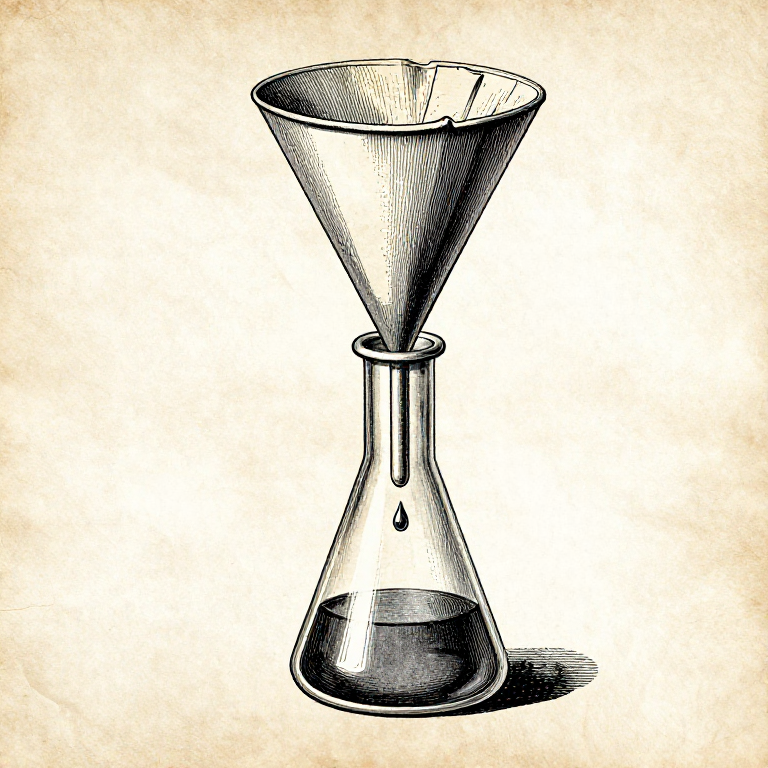


Filtering: Gravity, Vacuum, and Why the Filtrate Came Through Cloudy
Filtering separates a solid from a liquid, and the first question is always WHICH ONE you want. If it is the liquid, you want it clear and you can rinse the solid away. If it is the solid, every rinse has to end up on the paper.
Getting that backwards is the most expensive mistake here, because it is usually discovered after the other half has gone down the sink.
Then the choice of method. GRAVITY filtration is slow, gentle and enough for most things. VACUUM filtration through a Buchner funnel is much faster and gives a drier solid, at the cost of more equipment and a tendency to pull fine particles straight through.
Anfänger
2 hours
Anweisungen
1
1
Decide which phase you want before you set up
Decide which phase you want before you set up
Say it out loud and write it in the notebook: am I keeping the FILTRATE that runs through, or the RESIDUE on the paper? Everything else follows from that.
Keeping the filtrate means a clean receiving vessel, and the solid on the paper can be rinsed to recover any trapped liquid. Keeping the residue means rinsing the solid on the paper with fresh solvent to wash away the mother liquor, and the filtrate is what gets discarded.
When in doubt, keep BOTH until the work is done. A filtrate in a labelled beaker costs nothing to keep for an hour and cannot be recovered once it is in the drain.
Benötigte Werkzeuge:
 Becherglas
 Haftetiketten
2
2
Gravity: fold the paper, wet it, and pour down a rod
Gravity: fold the paper, wet it, and pour down a rod
Fold the circle in half, then in half again, and open it into a cone with three layers on one side. Wet it with the solvent and press it to the funnel so it seals — a paper that is not sealed lets liquid run down the gap between paper and glass, which is most of the way cloudy filtrate gets in.
Pour down a stirring rod held to the paper, and never fill above about three-quarters of the paper's height. Liquid that runs over the top of the paper has not been filtered at all.
For speed, use a FLUTED paper instead: folded into a fan, it presents far more area and does not seal to the glass, which is fine when you want the filtrate fast and the solid is not the product.
Materialien für diesen Schritt:
 Filterpapier1 Stück
 Destilliertes Wasser1 Liter
Benötigte Werkzeuge:
 Glastrichter mit Stiel
 RührstabBecherglas
 Erlenmeyerkolben
3
3
Vacuum: seat the paper wet, and break the vacuum the right way round
Vacuum: seat the paper wet, and break the vacuum the right way round
Put the paper flat in the Buchner funnel — it should cover the holes and not turn up the sides — wet it with solvent, and apply suction briefly to seat it before adding anything. A dry or ill-fitting paper lets the mixture run round the edge and straight through.
Break the vacuum at the flask or the tap BEFORE switching the pump off. A pump switched off while still connected can suck water back up the tubing into the flask, which ruins the filtrate and sometimes the pump.
Do not use vacuum on a very fine precipitate or on anything volatile. The pressure drop drags fine particles through the paper, and it evaporates solvent out of the product while you watch.
Materialien für diesen Schritt:
Filterpapier1 StückBenötigte Werkzeuge:
 Büchnertrichter (Porzellan)
 Filtrierkolben (Saugstutzen / Erlenmeyer)
 Spritzflasche
4
4
Cloudy filtrate, and what each cause looks like
Cloudy filtrate, and what each cause looks like
Cloudy filtrate has three usual causes and they are distinguishable. A LEAK around the paper gives filtrate that is clear at first and goes cloudy, or is cloudy only in bursts. Re-seat the paper and filter it again.
PARTICLES FINER THAN THE PAPER give uniformly cloudy filtrate from the start. Use a finer grade, filter twice, or add a filter aid — and if it is a precipitate, letting it stand and grow before filtering often solves it outright.
A PRECIPITATE STILL FORMING gives filtrate that is clear when collected and goes cloudy in the flask afterwards. That is not a filtration problem at all: the solution was still cooling or still reacting, and it needed to be finished before it was filtered.
Materialien für diesen Schritt:
Filterpapier1 StückBenötigte Werkzeuge:
Glastrichter mit StielBecherglasErlenmeyerkolbenMaterialien
2- 1 StückPlatzhalter
- 1 LiterPlatzhalter
Benötigte Werkzeuge
8- Platzhalter
- Platzhalter
- Platzhalter
- Platzhalter
- Platzhalter
- Platzhalter
- Filtrierkolben (Saugstutzen / Erlenmeyer)10% ProvisionPlatzhalter
- Spritzflasche10% ProvisionPlatzhalter
Verwandte Blueprints
Diese Blueprints teilen Wissen — Techniken, Materialien oder Prinzipien


CC0 Gemeinfrei
Dieser Blueprint ist unter CC0 veröffentlicht. Sie dürfen dieses Werk für jeden Zweck frei kopieren, ändern, verbreiten und verwenden, ohne um Erlaubnis zu fragen.
Unterstützen Sie den Maker, indem Sie Produkte über seinen Blueprint kaufen, wo er eine Maker-Provision von Anbietern festgelegt, verdient. Oder erstellen Sie eine neue Iteration dieses Blueprints und verbinden Sie ihn in Ihrem eigenen Blueprint, um Einnahmen zu teilen.