
KUNST
SCHÖNHEIT & WELLNESS
HANDWERK
KULTUR & GESCHICHTE
UNTERHALTUNG
UMFELD
ESSEN & GETRÄNKE
REVERSE ENGINEERING
WISSENSCHAFTEN
SPORT
TECHNOLOGIE
WEARABLES
Filtering Properly: Which Half Are You Trying to Keep?
Charlie

Erstellt von

Charlie

24. September 2026DE
15
0
0
0
0

Filtering Properly: Which Half Are You Trying to Keep?

Filtration separates a solid from a liquid, and every decision about how to do it follows from one question: **which half do you want?** Keeping the liquid and throwing away the solid is a different operation from keeping the solid and throwing away the liquid — different apparatus, different paper, different technique, and opposite mistakes. It is also where a great deal of material is quietly lost. A filter cake holds solvent, filter paper holds product, and a solution poured too fast goes round the paper instead of through it.
Anfänger
2 hours

Anweisungen

1

Gravity filtration: when the liquid is the product

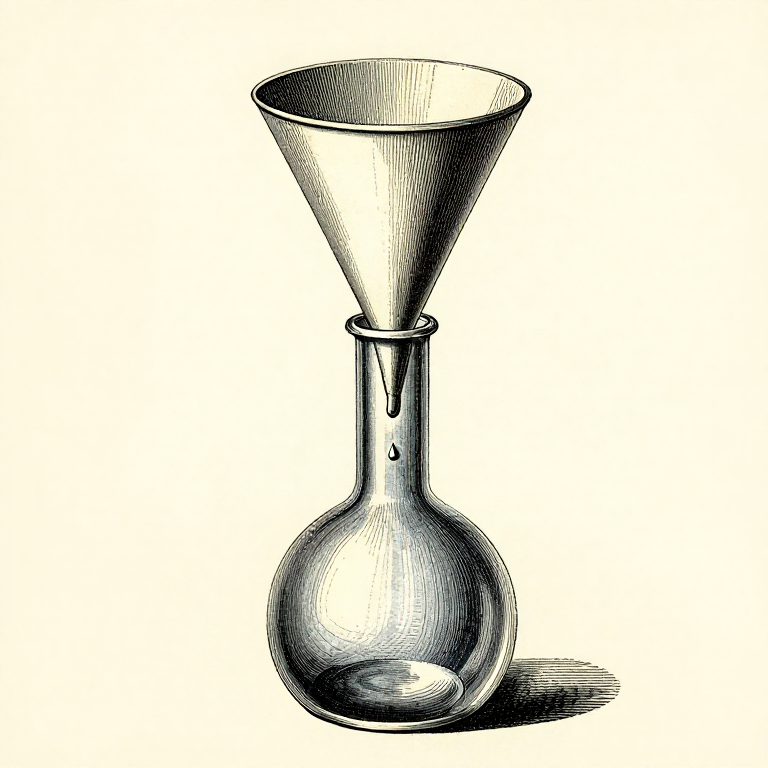
**Gravity filtration** is a cone of paper in a funnel, and the liquid runs through under its own weight. Use it when the solid is unwanted — dust, insoluble impurity, a drying agent. **Flute the paper.** A fan-folded fluted filter has several times the surface area of a plain cone and runs far faster, because the liquid is not sitting against the glass. For anything but a trivial volume this is the difference between a minute and half an hour. **Wet the paper first** with the solvent being used, and seat it against the funnel. A dry paper floats off its seat and lets liquid past. **Do not fill above the paper.** Liquid poured over the top goes straight down the outside, and this is the commonest way an otherwise careful filtration is ruined. **Use a stirring rod** to direct the pour down onto the paper rather than splashing. **For a hot filtration**, warm the funnel first and keep everything moving. Any cooling crystallises product in the paper.

Materialien für diesen Schritt:

FilterpapierFilterpapier1 Stück
Ethanol in Laborqualität, 95 %Ethanol in Laborqualität, 95 %1 Stück

Benötigte Werkzeuge:

ErlenmeyerkolbenErlenmeyerkolben
GlasrührstabGlasrührstab
Becherglas aus BorosilikatBecherglas aus Borosilikat
2

Vacuum filtration: when the solid is the product

A **Buchner funnel** on a filter flask with suction pulls the liquid through and leaves a compact cake. Use it when the solid is what you want. **A flat paper cut to the plate**, not a cone. It must cover every hole and not turn up the sides — a paper that is too large curls and lets solid past its edge. **Wet the paper and apply suction before adding anything.** The paper seats down onto the plate and seals. **Pour with the suction running**, and rinse the last of the crystals out of the flask with a little of the mother liquor, not with fresh solvent — fresh solvent dissolves the crop. **Wash the cake with ice-cold solvent.** Release the vacuum, add just enough solvent to cover, stir the cake gently with a spatula so the wash reaches all of it, then re-apply suction. Pouring wash straight onto a cake under suction channels through one spot and washes nothing. **Pull air through to dry**, then press the cake with a clean stopper to squeeze the last liquid out. **Use a trap** between the flask and the pump. Without one, a pressure change pulls pump oil or water back into the product — an unpleasant and entirely avoidable loss.

Materialien für diesen Schritt:

FilterpapierFilterpapier1 Stück
CrusheisCrusheis1 Stück
Ethanol in Laborqualität, 95 %Ethanol in Laborqualität, 95 %1 Stück

Benötigte Werkzeuge:

Büchnertrichter (Porzellan)Büchnertrichter (Porzellan)
VakuumpumpeVakuumpumpe
ErlenmeyerkolbenErlenmeyerkolben
3

Choosing the paper, and what it costs

Filter papers differ in **pore size** and in **speed**, and the two trade against each other directly. **Coarse and fast** — for bulky precipitates and for removing a drying agent. Fine particles go straight through. **Medium** — the general-purpose choice, and right for most crystallisations. **Fine and slow** — for fine precipitates that pass through anything coarser. It can take a very long time, and it is worth it only when the product actually requires it. **Ashless paper** is made for gravimetric work: it burns to almost nothing, so a precipitate can be ignited in the paper and weighed. Expensive, and pointless for anything else. **Sintered glass** replaces paper entirely where the paper would be attacked — strong acids, strong alkali — or where paper fibres would contaminate. It is reusable and needs cleaning immediately, because a dried cake in a sinter is very difficult to remove. **Every paper holds liquid**, and that liquid contains dissolved product. On a small preparation this is a real fraction of the yield, and it is the argument for using the smallest funnel the job allows.

Materialien für diesen Schritt:

FilterpapierFilterpapier2 Stück

Benötigte Werkzeuge:

Büchnertrichter (Porzellan)Büchnertrichter (Porzellan)
PräzisionswaagePräzisionswaage
4

Decanting, centrifuging and knowing when not to filter

Filtration is not always the right answer. **Decanting** — letting the solid settle and pouring the liquid off — costs nothing, loses nothing to a filter, and is the right first move whenever the solid settles well. Follow it with a filtration of the last portion if needed. **Washing by decantation** is better than washing on a filter for a fine solid: add solvent, stir, settle, pour off, repeat. The solid is properly mixed with each wash rather than channelled through. **Centrifuging** settles what will not settle by itself, and loses nothing to paper. It is the right answer for small volumes and for very fine or gelatinous solids that blind a filter instantly. **A gelatinous precipitate should not be filtered at all** if it can be avoided. It clogs the paper in seconds and then nothing moves. Digest it — stand it warm for a while — and the particles coarsen enough to filter. This genuinely works and it is the standard fix. **Do not filter a hot saturated solution unless you have to.** Every degree it cools in the funnel is product in the paper.

Materialien für diesen Schritt:

Ethanol in Laborqualität, 95 %Ethanol in Laborqualität, 95 %1 Stück

Benötigte Werkzeuge:

Becherglas aus BorosilikatBecherglas aus Borosilikat
GlasrührstabGlasrührstab

Materialien

3

Benötigte Werkzeuge

6

CC0 Gemeinfrei

Dieser Blueprint ist unter CC0 veröffentlicht. Sie dürfen dieses Werk für jeden Zweck frei kopieren, ändern, verbreiten und verwenden, ohne um Erlaubnis zu fragen.

Unterstützen Sie den Maker, indem Sie Produkte über seinen Blueprint kaufen, wo er eine Maker-Provision von Anbietern festgelegt, verdient. Oder erstellen Sie eine neue Iteration dieses Blueprints und verbinden Sie ihn in Ihrem eigenen Blueprint, um Einnahmen zu teilen.

Diskussion

(0)

Anmelden um an der Diskussion teilzunehmen

Kommentare werden geladen...