KUNST
SCHÖNHEIT & WELLNESS
HANDWERK
KULTUR & GESCHICHTE
UNTERHALTUNG
UMFELD
ESSEN & GETRÄNKE
REVERSE ENGINEERING
WISSENSCHAFTEN
SPORT
TECHNOLOGIE
WEARABLES
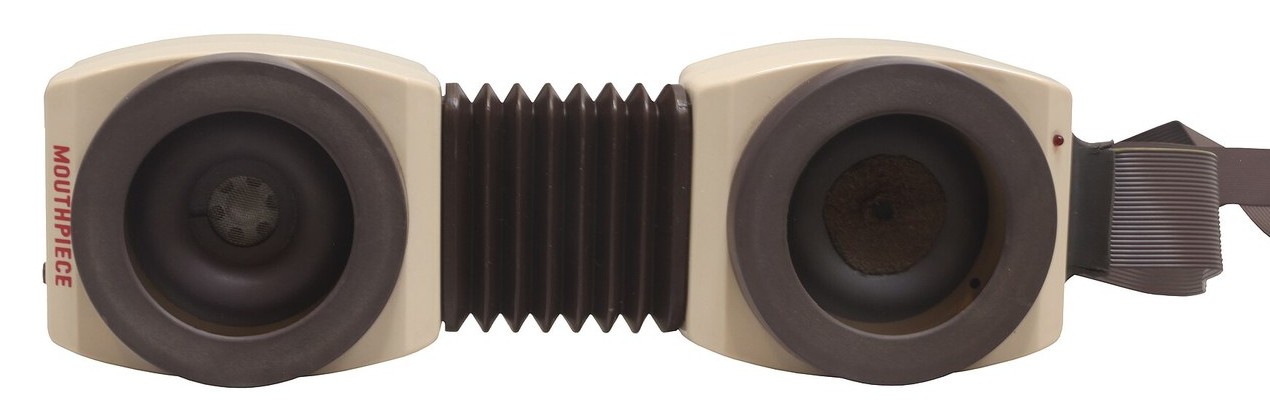


The FSK Modem
There were computers in 1962 and there were telephone lines, and no way at all to connect them. A UART's mark and space are DC levels, and the telephone network is a chain of transformers and filters that passes roughly 300 to 3400 hertz and nothing outside it. A DC level dies at the first transformer.
The Bell 103 dataset put the bits inside the passband. A one is a tone at 1270 hertz, a zero is a tone at 1070, and the receiver simply asks which of the two is louder over each bit period. That is frequency-shift keying, and it is the same idea as the FM broadcast blueprint this one links to, applied to a channel four thousand times narrower.
The detail that makes it useful is the second pair of tones. The answering end uses 2025 and 2225 hertz, far enough above the originating pair that a filter separates them completely, so both ends can talk at once over one pair of wires. Three hundred bits per second in each direction, full duplex, over any line good enough to hold a conversation.
The word modem is what the box does: MOdulate on the way out, DEModulate on the way in. Everything for the next thirty-five years is the same box getting cleverer about how much it can push through three kilohertz — phase keying, then quadrature amplitude modulation, then trellis coding — until V.34 stopped at 33.6 kbit/s because Shannon said so.
FULLY BUILDABLE, and it genuinely works. Generate the tones on a microcontroller, detect them with a pair of Goertzel filters, and send data down an audio cable — or across the room through a loudspeaker and a microphone, which is exactly what an acoustic coupler was.
Fortgeschritten
4 hours
Anweisungen
1
1
Listen to the channel you have to fit inside
Listen to the channel you have to fit inside
Before building anything, measure what a voice channel actually passes. Feed a swept tone from the function generator into any audio path you can borrow — a phone handset, a headset amplifier, a cheap intercom — and read the output amplitude on the scope from 100 Hz to 5 kHz.
Plot it. You will find a passband roughly 300 Hz to 3.4 kHz with steep skirts, and nothing at DC at all. That shape is not an accident or a defect: it is the deliberate result of packing as many conversations as possible onto one trunk, which is the next blueprint.
Now put a square wave at 300 Hz through the same path and look at what comes out. The flat tops are gone and the DC has vanished. That is what happens to a UART frame on a telephone line, and it is the whole reason this blueprint exists.
Benötigte Werkzeuge:
 Funktionsgenerator
 Digitales Oszilloskop
2
2
Modulate and demodulate
Modulate and demodulate
Flash the sketch on two boards. Couple them with an audio cable and a series capacitor at each end, or point a small speaker at an electret microphone across the desk — the second is an acoustic coupler and is exactly how a 1960s modem worked, because you were not allowed to wire anything of your own to the telephone.
Note the two details that matter. Phase is CONTINUOUS across bit boundaries: jumping phase makes a click, and a click is broadband energy that both filters hear. And the framing is blueprint 1's start and stop bits, unchanged — the modem replaces the physical layer and leaves the framing alone, which is the first time in this batch that a layer is swapped without disturbing the one above it.
Watch the printed mark/space ratio while you turn the volume down. It falls smoothly, and then the data stops. That is your margin.
bell103_fsk.inocpp
Materialien für diesen Schritt:
 Mikrofon1 Stück
 Kondensatorsortiment1 Stück
 Widerstandssortiment1 Stück
Benötigte Werkzeuge:
 ESP32-Entwicklungsboard
 Lautsprecher (Labor)Digitales Oszilloskop
 Steckbrett
 Steckbrücken
3
3
Tones, detection and Shannon's ceiling
Tones, detection and Shannon's ceiling
Jupyter-Notebook wird geladen …
Benötigte Werkzeuge:
 Desktop-Computer
4
4
Compendium: what a modem is really negotiating
Compendium: what a modem is really negotiating
WHY FULL DUPLEX NEEDED FOUR TONES. Both ends want to transmit at once on one pair. Bell 103 solves it by frequency division: the originating end lives at 1070/1270 and the answering end at 2025/2225, with 755 Hz of clear space between the bands. Later standards ran out of room for that and switched to echo cancellation — transmit and receive in the SAME band, and subtract a model of your own signal from what comes back. That is the reason V.32 and later needed a digital signal processor and Bell 103 needed four filters.
AGAINST THE BROADCAST FM BLUEPRINT. Wideband FM spends 150 kHz of spectrum to buy noise immunity, because the broadcaster has spectrum and wants quality. A modem has three kilohertz that it cannot widen at any price, so every advance had to come from packing more bits into each symbol instead. Same modulation family, opposite constraint, and it is the constraint that shapes the engineering.
WHAT THIS LAYER ACTUALLY PROMISED. Not reliability — a modem hands up whatever it decoded, errors included, which is why the CRC of the previous blueprint sits above it and why every file-transfer protocol of the era carried its own checksum. The modem's only promise is that bits go in one end and come out the other. Every blueprint after this one is built on how thin that promise is.
Materialien
3- Platzhalter
- 1 StückPlatzhalter
- Platzhalter
Benötigte Werkzeuge
7- Platzhalter
- 1 vendor sell this, none ship to you yetPlatzhalter
- Platzhalter
- Platzhalter
- 1 vendor sell this, none ship to you yetPlatzhalter
- 3 vendors sell this, none ship to you yetPlatzhalter
- Platzhalter
Verwandte Blueprints
Diese Blueprints teilen Wissen — Techniken, Materialien oder Prinzipien

CC0 Gemeinfrei
Dieser Blueprint ist unter CC0 veröffentlicht. Sie dürfen dieses Werk für jeden Zweck frei kopieren, ändern, verbreiten und verwenden, ohne um Erlaubnis zu fragen.
Unterstützen Sie den Maker, indem Sie Produkte über seinen Blueprint kaufen, wo er eine Maker-Provision von Anbietern festgelegt, verdient. Oder erstellen Sie eine neue Iteration dieses Blueprints und verbinden Sie ihn in Ihrem eigenen Blueprint, um Einnahmen zu teilen.