
Iron Saddening — Darkening and Shifting Natural Dye Colours with Iron Water
Iron saddening is one of the most powerful tools in a natural dyer's arsenal. A brief dip in an iron solution can transform bright gold to olive green, sunny yellow to khaki, pink to mauve, and orange to brown. The technique has been used since antiquity — anywhere natural dyeing was practised, iron modification was understood. The term 'saddening' comes from the Middle English sadden, meaning to darken or make sombre — iron literally saddens the colour.
The chemistry is straightforward: ferrous sulfate (FeSO₄, also called green vitriol or copperas) dissociates in water into iron ions and sulfate. The iron ions bond to tannins and dye molecules already in the fibre, forming larger, darker complexes. Tannin-rich dyes (pomegranate, walnut, oak gall) react most dramatically — tannin + iron produces deep olive to near-black, the same reaction that makes iron gall ink. But even non-tannin dyes respond: madder shifts from red to burgundy, weld yellow becomes olive, turmeric gold turns khaki.
Iron saddening is always done as a post-dye treatment, never before dyeing. Iron as a pre-mordant damages wool protein and makes it brittle. As an afterbath on already-dyed wool, the iron reacts with the dye, not the fibre, and the effect is purely chromatic. The key is moderation — too much iron or too long an exposure turns everything grey-black and hardens the wool. Used with a light hand, iron saddening produces some of the most beautiful and historically important colours in the natural dyer's palette.
Anweisungen
Prepare samples of dyed wool for iron modification
Prepare samples of dyed wool for iron modification
Iron saddening works on wool that has already been dyed with a natural dye. For a demonstration of the effect, cut small samples (5-10 g each) from skeins dyed with different dyes — onion skin gold, madder red, turmeric yellow, pomegranate gold, or weld yellow. Each dye reacts differently with iron, and testing samples before committing a full skein teaches you what to expect. Label each sample with the dye source so you can record the colour shift.
Materialien für diesen Schritt:
 Wollstrang50 g
Dissolve ferrous sulfate in warm water
Dissolve ferrous sulfate in warm water
Use 2% WOF of ferrous sulfate — for 50 g of dyed wool samples, dissolve 1 g of ferrous sulfate in 2 litres of warm water (about 40°C). Stir until fully dissolved — the solution will be a pale, clear green. Do not use more iron than 2% WOF — excess iron hardens wool fibres and makes them brittle and scratchy. Iron is a strong modifier; very small quantities produce dramatic colour shifts. A kitchen scale accurate to 1 g is sufficient. Wear gloves — ferrous sulfate stains skin and nails a rusty orange.
Materialien für diesen Schritt:
 Eisensulfat1 g
Benötigte Werkzeuge:
 Digitale Küchenwaage
Pre-wet the dyed wool samples
Pre-wet the dyed wool samples
Soak the dyed wool samples in warm water for 5-10 minutes. Squeeze out the excess. The fibres must be wet for even uptake — dry fibres placed into the iron bath grab iron unevenly, creating blotchy dark spots. Iron modification is fast-acting and mistakes are difficult to reverse, so even uptake matters more here than in most dyeing steps.
Submerge the dyed wool in the iron bath for 5-10 minutes
Submerge the dyed wool in the iron bath for 5-10 minutes
Lower the damp, dyed samples into the iron solution. You will see the colour change begin within seconds — gold turning olive, red darkening to burgundy, yellow shifting to khaki. Turn the wool gently every 2 minutes for even exposure. Five minutes gives a moderate shift; ten minutes gives a strong shift. For most dyes, 5 minutes is enough — you can always dip again if you want a darker result, but you cannot undo over-saddening. Watch the wool, not the clock: when the colour reaches the shade you want, remove it immediately.
Benötigte Werkzeuge:
 Suppentopf
Rinse immediately and thoroughly
Rinse immediately and thoroughly
Remove the wool from the iron bath and rinse immediately in several changes of clean water. The iron continues reacting with the dye as long as it is in contact with the fibre — rinsing stops the reaction at your chosen shade. Use water at the same temperature as the bath (warm, not cold) to avoid felting. Rinse until the water runs clear with no greenish tint from residual ferrous sulfate. Thorough rinsing is critical — iron left in the fibre will continue darkening the colour over time and can eventually damage the wool.
Compare iron-modified samples against unmodified originals
Compare iron-modified samples against unmodified originals
Lay out the iron-modified samples beside the unmodified originals to see the full range of colour shifts. Typical results: onion skin gold → olive green. Madder red → plum or burgundy. Turmeric yellow → khaki or olive. Pomegranate gold → deep olive to near-black. Weld yellow → olive green. The shifts are consistent and reproducible — the same dye with the same iron concentration gives the same result every time. This predictability made iron saddening a standard technique in historical dye workshops: a dyer with three dye plants and an iron pot had access to nine or more distinct colours.
Make a rusty iron water alternative
Make a rusty iron water alternative
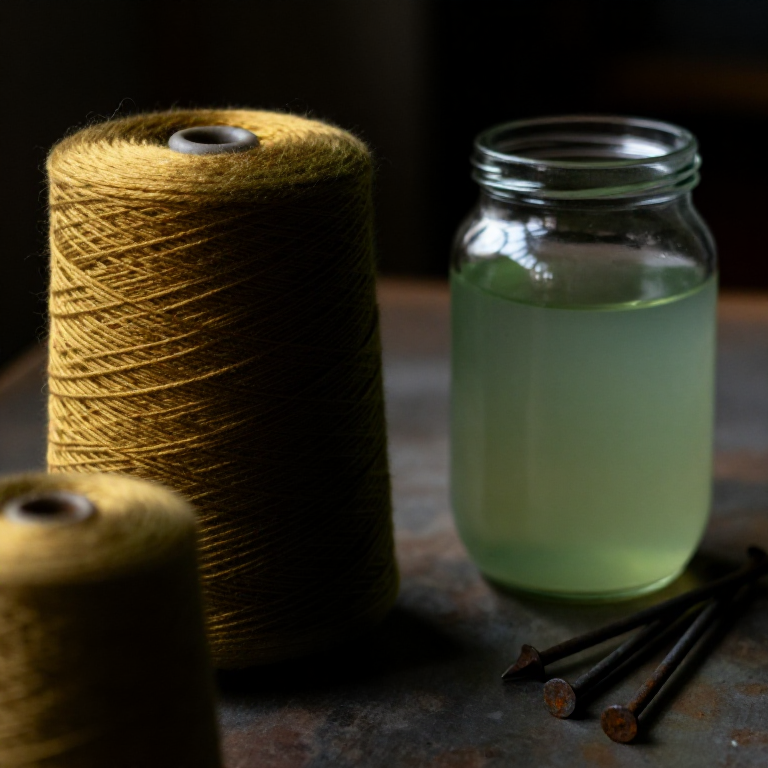
If ferrous sulfate is not available, you can make iron water from rusty iron. Place rusty nails, old iron bolts, or steel wool in a jar with a 1:1 mixture of water and white vinegar. Cover loosely and leave for 1-2 weeks. The acetic acid dissolves the iron oxide, creating a solution of iron acetate — a slower-acting but perfectly functional iron modifier. Strain the liquid before use. This homemade iron water is less concentrated than a ferrous sulfate solution, so longer soaking times (15-30 minutes) are needed. Historical dyers commonly used this method — a jar of rusty nails in vinegar was a standard item in every dye workshop.
Materialien für diesen Schritt:
 Weißer Reinigungsessig500 ml
Dispose of the iron bath safely
Dispose of the iron bath safely
The spent iron bath is very dilute — 1 g of ferrous sulfate in 2 litres of water — and can be poured down the drain or onto the garden (iron is a plant micronutrient in small quantities). Do not pour iron water onto concrete or stone — it leaves permanent rust stains. Do not mix iron bath waste with other dye baths you plan to reuse — even trace amounts of iron contamination will shift colours in future dye sessions. Keep iron tools, jars, and pots completely separate from your alum-mordanting and dyeing equipment.
Materialien
3- 50 gPlatzhalter
- 1 gPlatzhalter
- 500 mlPlatzhalter
Benötigte Werkzeuge
2- Platzhalter
- Platzhalter
Materialien verbundener Blueprints
Mordanting Wool with Alum — The Foundation of Natural Dyeing
von Tex
Textil & Leder

Dyeing with Pomegranate Rinds — Ancient Gold from the Fruit of the Middle East
von Tex
Textil & Leder
Dyeing with Onion Skins — Orange-Gold from the Kitchen
von Charlie
Chemie
Dyeing Yellow-Green with Persian Berries — The Buckthorn Dye of Ancient Manuscript Painters
von Tex
Textil & Leder
Dyeing Brown-Black with Alder Bark — The Northern European Dark Dye
von Tex
Textil & Leder
Dieser Bauplan stellt her
Verwandte Blueprints
Diese Blueprints teilen Wissen — Techniken, Materialien oder Prinzipien
Greek Wool Dyeing — Dyeing Wool with Madder Root
von Tex
Textil & Leder
Extracting Yellow Dye from Weld Plant — The Oldest European Yellow
von Charlie
Chemie
Making Iron Gall Ink from Oak Galls — Medieval Writing Ink
von Charlie
Chemie
Dyeing Yellow-Green with Nettle — The Universal Wild Dye Plant
von Tex
Textil & Leder
Dyeing Brown with Acorns — The Universal Tannin Dye of the Ancient World
von Tex
Textil & Leder
CC0 Gemeinfrei
Dieser Blueprint ist unter CC0 veröffentlicht. Sie dürfen dieses Werk für jeden Zweck frei kopieren, ändern, verbreiten und verwenden, ohne um Erlaubnis zu fragen.
Unterstützen Sie den Maker, indem Sie Produkte über seinen Blueprint kaufen, wo er eine Maker-Provision von Anbietern festgelegt, verdient. Oder erstellen Sie eine neue Iteration dieses Blueprints und verbinden Sie ihn in Ihrem eigenen Blueprint, um Einnahmen zu teilen.