Isolating Phosphorus from Bone Ash — The Element Discovered in Urine
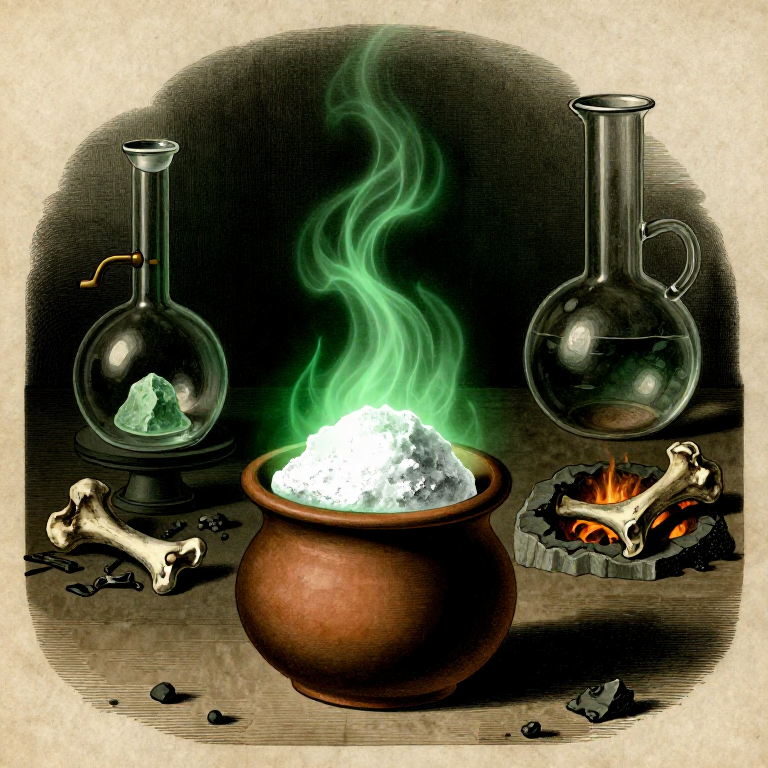
Phosphorus (P, element 15) holds a unique place in chemical history: it was the first element to be discovered by a known individual. In 1669, Hamburg alchemist Hennig Brand was searching for the Philosopher's Stone by boiling and distilling vast quantities of human urine. After evaporating approximately 5,500 liters of urine to a paste, heating the residue to red heat, and condensing the vapors, he obtained a waxy, white substance that glowed in the dark — phosphorus, from the Greek phosphoros ('light-bearer').
Brand's original method is impractical (and unpleasant). By the 1770s, Carl Wilhelm Scheele and Johan Gottlieb Gahn developed the practical bone-ash method that replaced it: animal bones, which are approximately 58% calcium phosphate (Ca₃(PO₄)₂), are calcined, treated with sulfuric acid to produce phosphoric acid, then heated with charcoal to reduce the phosphorus. This blueprint follows the historical bone-ash method — the same basic chemistry used in early phosphorus match factories.
EXTREME HAZARD: White phosphorus is spontaneously flammable in air, igniting at approximately 30 °C. It causes severe, deep chemical burns that are extraordinarily painful and heal very slowly. Phosphorus burns cannot be extinguished with water — they must be smothered. Phosphorus vapor is toxic. This process produces small quantities and must be performed outdoors with full protective equipment. White phosphorus must be stored under water at all times to prevent ignition.
Dieser Bauplan stellt her
CC0 Gemeinfrei
Dieser Blueprint ist unter CC0 veröffentlicht. Sie dürfen dieses Werk für jeden Zweck frei kopieren, ändern, verbreiten und verwenden, ohne um Erlaubnis zu fragen.
Unterstützen Sie den Maker, indem Sie Produkte über seinen Blueprint kaufen, wo er eine Maker-Provision von Anbietern festgelegt, verdient. Oder erstellen Sie eine neue Iteration dieses Blueprints und verbinden Sie ihn in Ihrem eigenen Blueprint, um Einnahmen zu teilen.