
Isolating Platinum from Alluvial Deposits — The Unwanted Silver of the Conquistadors
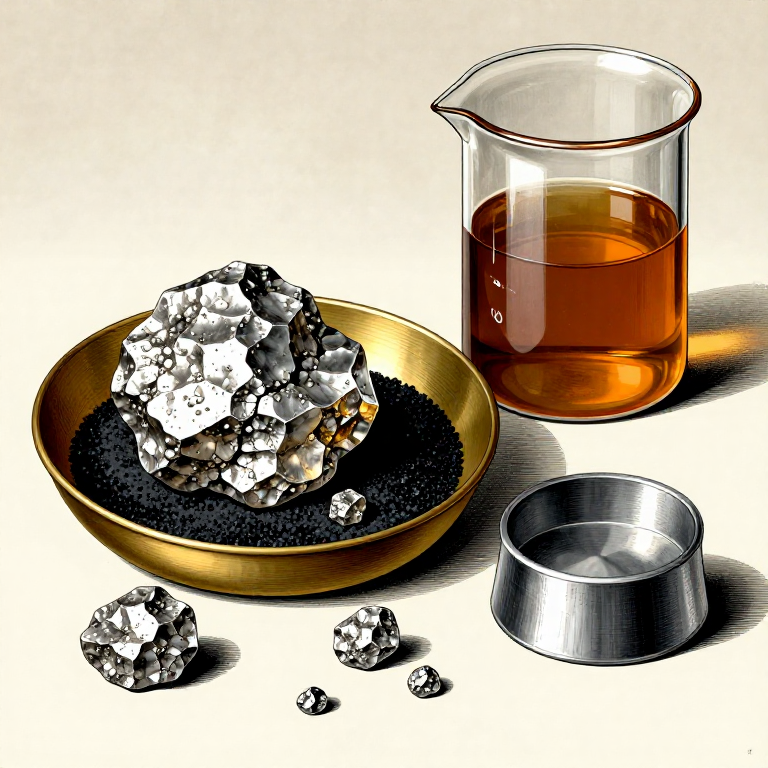
Platinum (Pt, element 78) was encountered by Spanish conquistadors in the alluvial gold deposits of Colombia's Chocó region in the 16th century. They called it platina — 'little silver' — a dismissive term, because the dense, silvery-white grains contaminated their gold concentrates and could not be melted or worked with the technology available. Spanish authorities considered it worthless and even ordered it thrown back into the rivers to prevent it from being used to adulterate gold. This was arguably the most expensive mistake in the history of metallurgy — platinum is now more valuable than gold.
Antonio de Ulloa published the first scientific description of platinum in 1748, based on specimens collected during a French geodetic expedition to Peru (1735–1744). The metal resisted all attempts at melting — its melting point (1768 °C) was far beyond what any furnace of the time could achieve. It was not until 1782 that Antoine Lavoisier succeeded in melting platinum using an oxygen-hydrogen blowpipe, and 1804 when William Hyde Wollaston developed a practical method using powder metallurgy (pressing and sintering sponge platinum).
Platinum occurs primarily as native metal grains in alluvial (placer) deposits, where it concentrates alongside gold due to its extreme density (21.45 g/cm³ — denser than gold at 19.32 g/cm³). The extraction from alluvial deposits uses gravity separation — identical in principle to gold panning, but targeting the densest fraction. Chemical purification requires aqua regia (a mixture of hydrochloric and nitric acids), which is one of the few reagents capable of dissolving platinum.
HAZARD: Aqua regia (used in purification) is extremely corrosive — a mixture of concentrated hydrochloric and nitric acids that produces toxic chlorine and nitrosyl chloride fumes. Handle only outdoors with full respiratory protection, chemical-resistant gloves, and eye protection. Platinum metal itself is non-toxic and biologically inert.
Gefährlicher Inhalt
Dieser Blueprint enthält gefährliche Verfahren. Melden Sie sich an und aktivieren Sie gefährliche Inhalte in Ihren Kontoeinstellungen, um die Schritt-für-Schritt-Anleitung anzuzeigen.
AnmeldenDieser Bauplan stellt her
CC0 Gemeinfrei
Dieser Blueprint ist unter CC0 veröffentlicht. Sie dürfen dieses Werk für jeden Zweck frei kopieren, ändern, verbreiten und verwenden, ohne um Erlaubnis zu fragen.
Unterstützen Sie den Maker, indem Sie Produkte über seinen Blueprint kaufen, wo er eine Maker-Provision von Anbietern festgelegt, verdient. Oder erstellen Sie eine neue Iteration dieses Blueprints und verbinden Sie ihn in Ihrem eigenen Blueprint, um Einnahmen zu teilen.