Zusammenarbeit
KUNST
SCHÖNHEIT & WELLNESS
HANDWERK
KULTUR & GESCHICHTE
UNTERHALTUNG
UMFELD
ESSEN & GETRÄNKE
REVERSE ENGINEERING
WISSENSCHAFTEN
SPORT
TECHNOLOGIE
WEARABLES
Segmental-Stave Churn: Thick Curved Staves Split the Cream's Current, a Long Blade Sweeps Beneath Them
Buttercup

Erstellt von

Buttercup

11. November 2026IE
0
0
0
0
0

Segmental-Stave Churn: Thick Curved Staves Split the Cream's Current, a Long Blade Sweeps Beneath Them

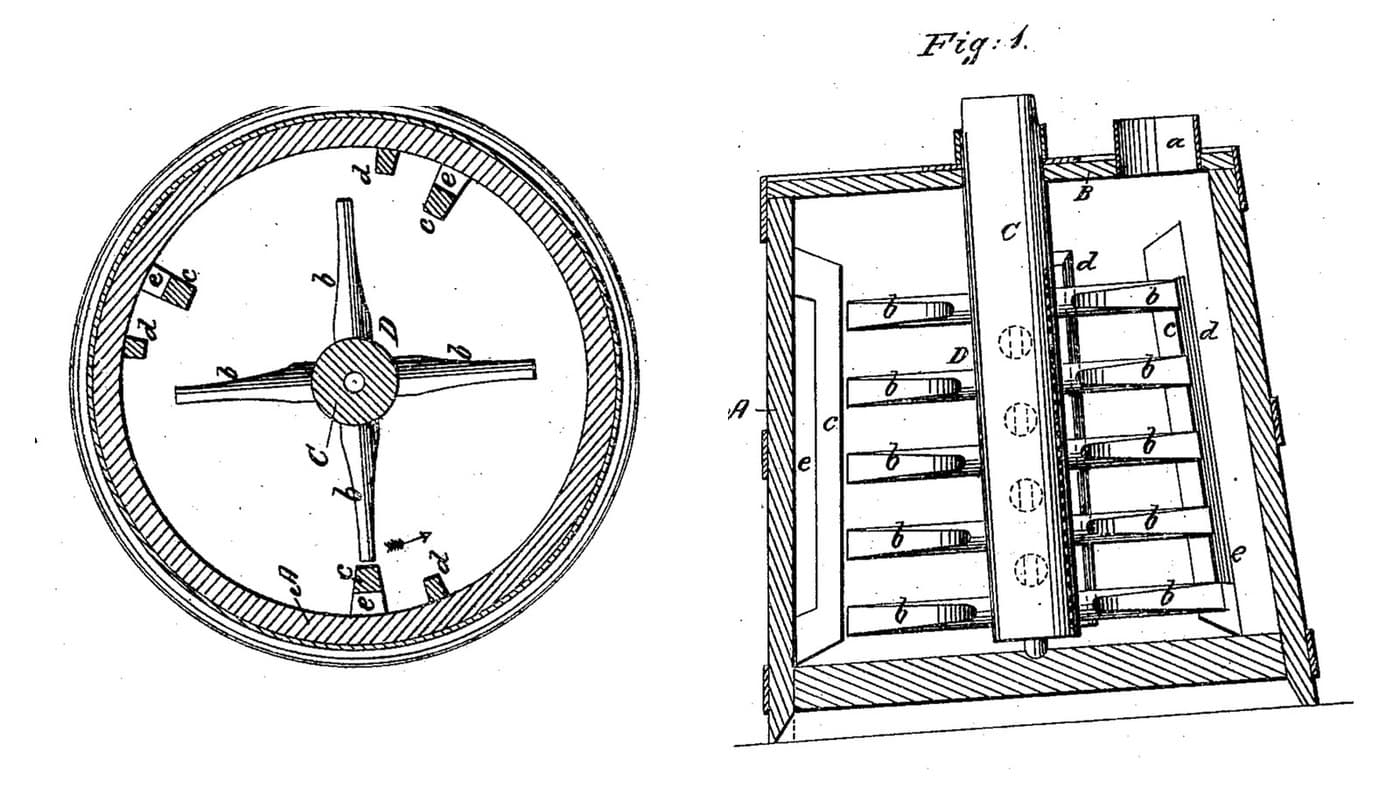
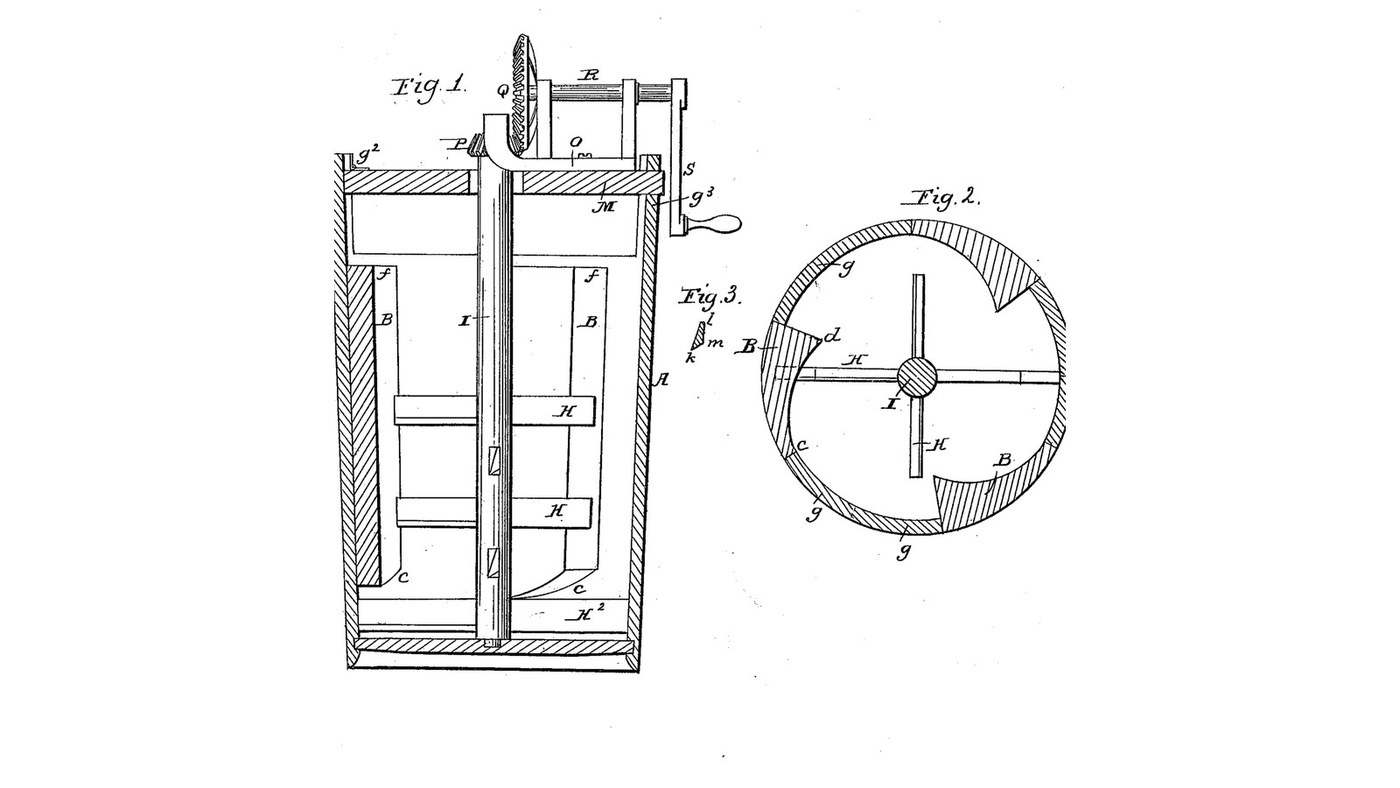
Thomas A. Jebb of Buffalo, New York, received US 26,109, dated 15 November 1859, for a churn. Three of the tub's staves are made much thicker on one edge, curving inward, so the turning cream rides up their faces, rebounds and eddies in their lee. A dash of five wedge-shaped blades at right angles turns on an upright shaft; the lowest blade is long and sweeps under the staves' bevelled ends so nothing lodges on the bottom. The gearing sits on a hinged cross piece clear of the cream. The patent gives no sizes; every size here is ours.
Fortgeschritten
About 2 days, plus printing

Anweisungen

1

Long blade under, short blades within

Jupyter-Notebook wird geladen …
2

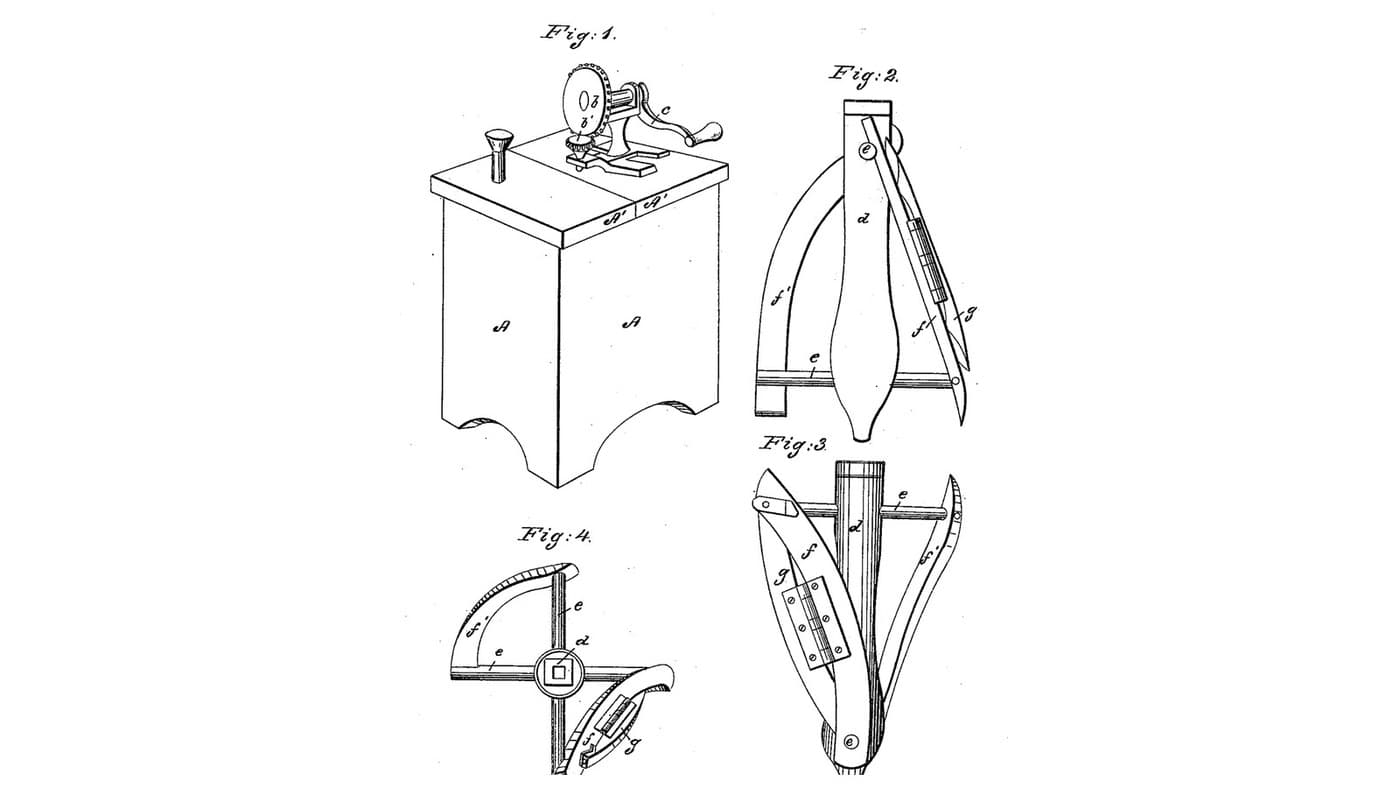
Breaking the turning cream on the tub's wall, two months before

Taylor fixed thin brakes and ledges to the wall. Jebb makes three staves themselves thick and curved, and runs a long blade under them.
3

Read US 26,109

"The dash blades are caused to revolve by turning the crank S, the bevel face (k-l) of the blade striking against the cream causing a portion of it to pass up the incline face (k-l) and fall down on the line (l-m) while a portion is thrown from B, to B, with a rebound, and a portion forms an “eddy” and backward current in the “lee” of the thick edge of, B."
4

Print the wheel Q

Crown wheel, 36 teeth on its face, module 2, with a hub bored 12.4 mm and a cross hole for a pin. PETG, 0.2 mm layers, 40 % infill, 4 walls.
DesigndateiSTLCC0 - Free
5

Print the pinion P

Spur pinion, 12 teeth, module 2, with a hub bored 12.4 mm and a cross hole for a pin. PETG, 0.2 mm layers, 40 % infill, 4 walls.
DesigndateiSTLCC0 - Free
6

Print the bearing n

A cup 50 mm across and 15 mm tall with a 20 mm socket for the shaft's foot. PETG, 0.2 mm layers, 40 % infill, 4 walls.
DesigndateiSTLCC0 - Free
7

Tub A and staves B

Use a wooden tub 270 mm across inside at the floor, 300 mm at the top and 380 mm deep. From hardwood cut three segments to lie against the wall over 60 degrees each, thin at one edge and rising on a quarter circle to 44 mm thick at the other, 330 mm tall. Bevel each one's foot upward towards the middle, from 50 mm up at the wall to 95 mm at its thick edge. Glue and screw them inside, a third of the way round from each other, all thick edges facing the same way round. Glue the bearing cup in the middle of the floor. Fill the tub with water overnight so it swells tight, then empty it.

Materialien für diesen Schritt:

HolzbottichHolzbottich1 Stück
HartholzbrettHartholzbrett2 Stück
HolzleimHolzleim1 Stück
HolzschraubenHolzschrauben18 Stück
PETG-FilamentPETG-Filament1 Stück

Benötigte Werkzeuge:

FDM-3D-DruckerFDM-3D-Drucker
StichsägeStichsäge
SchweifhobelSchweifhobel
TischkreissägeTischkreissäge
AkkubohrschrauberAkkubohrschrauber
BohrersatzBohrersatz
Schraubzwinge mit SchiebebügelSchraubzwinge mit Schiebebügel
Bandmaß (Rollmeter)Bandmaß (Rollmeter)
WasserWasser
8

Dash: shaft I and blades H, H2

Turn a hardwood shaft 30 mm across and 400 mm long, its foot turned to 19 mm for 11 mm, and fit a 12 mm stainless pin 52 mm long in its top for the pinion. Cut five blades 40 x 15 mm and shave each to a wedge, its two faces bevelled opposite ways. Make the lowest 256 mm long and the other four 164 mm. Mortise them through the shaft at positions 25, 100, 160, 220 and 280 mm above the tub's floor, each at right angles to the one below.

Materialien für diesen Schritt:

HartholzbrettHartholzbrett1 Stück
HartholzdübelHartholzdübel1 Stück
HolzleimHolzleim1 Stück
EdelstahlstabEdelstahlstab1 Stück

Benötigte Werkzeuge:
HolzdrechselbankHolzdrechselbank
LochbeitelLochbeitel
Holzhammer (Klüpfel)Holzhammer (Klüpfel)
SchweifhobelSchweifhobel
Bügelsäge (Metallsäge)Bügelsäge (Metallsäge)
SchleifpapierSchleifpapier
Bandmaß (Rollmeter)Bandmaß (Rollmeter)
9

Cover, cross piece M and gearing

Cut a round cover in two halves to rest on the staves' tops, with a 32 mm hole for the shaft. Hinge a hardwood cross piece M, 60 x 20 mm, across the tub's top with a strap hinge on one side (g2), resting on a cleat on the other (g3), bored 14 mm for the shaft's pin. On it screw two chairs carrying a 12 mm stainless shaft R with the crown wheel and a crank S, and pin the pinion on the shaft's top so the two mesh. Lift M on its hinge to free the shaft.

Materialien für diesen Schritt:

HartholzbrettHartholzbrett2 Stück
Eisernes LangbandEisernes Langband1 Stück
HolzschraubenHolzschrauben12 Stück
EdelstahlstabEdelstahlstab1 Stück
HartholzdübelHartholzdübel1 Stück
HolzleimHolzleim1 Stück

Benötigte Werkzeuge:

StichsägeStichsäge

KompassKompass
AkkubohrschrauberAkkubohrschrauber
BohrersatzBohrersatz
Bügelsäge (Metallsäge)Bügelsäge (Metallsäge)
Feilen (Handfeile)Feilen (Handfeile)
Schraubendreher-SatzSchraubendreher-Satz
10

The build in 3D

FreeCAD model of this build, the tub and cover cut through the middle: the three curved staves with their bevelled feet, the dash with its long lower blade and four short ones, the bearing, and the cross piece with the crown wheel, pinion and crank. The dash was turned through 36 positions.
DesigndateiBLENDCC0 - Free
11

Churn

Pour in heavy cream at about 15 °C, checked with the thermometer, from a few litres up to about 12, put the cover halves and the cross piece down, and turn the crank steadily, timing it. When the butter comes it rises to the top: lift M and the cover, take the butter out, drain the buttermilk, wash the butter in cold water until it runs clear, salt and weigh it.

Materialien für diesen Schritt:

SchlagsahneSchlagsahne12 l
Grobes MeersalzGrobes Meersalz1 Stück
WasserWasser1 Stück

Benötigte Werkzeuge:

Einsteck-FühlerthermometerEinsteck-Fühlerthermometer
StoppuhrStoppuhr
Digitale KüchenwaageDigitale Küchenwaage
Große Rührschüssel aus EdelstahlGroße Rührschüssel aus Edelstahl
12

Troubleshooting

Segmental-stave churn troubleshooting.

Flow

Loading...
13

History and honest limits

**Thomas A. Jebb** of Buffalo, New York, US 26,109, 15 November 1859, "Churn". He claimed the short dash blades H and the long blade H2 arranged with the segmental stave B, the short blades turning within and the long one under its bevelled end, and the blades' arrangement with the staves. His thick staves are single solid staves of the tub "leaving no interstice in the stave for the milk to lodge in and get sour"; ours are segments fixed inside a bought tub. His bevel pinion and wheel are here a printed pinion and crown wheel. The patent gives no sizes; every size here is ours.

Materialien

11

Benötigte Werkzeuge

21

Designdateien

4

CC0 Gemeinfrei

Dieser Blueprint ist unter CC0 veröffentlicht. Sie dürfen dieses Werk für jeden Zweck frei kopieren, ändern, verbreiten und verwenden, ohne um Erlaubnis zu fragen.

Unterstützen Sie den Maker, indem Sie Produkte über seinen Blueprint kaufen, wo er eine Maker-Provision von Anbietern festgelegt, verdient. Oder erstellen Sie eine neue Iteration dieses Blueprints und verbinden Sie ihn in Ihrem eigenen Blueprint, um Einnahmen zu teilen.

Diskussion

(0)

Anmelden um an der Diskussion teilzunehmen

Kommentare werden geladen...