

Knitting in the Round on Double-Pointed Needles — Seamless Tubes for Socks, Hats and Mittens
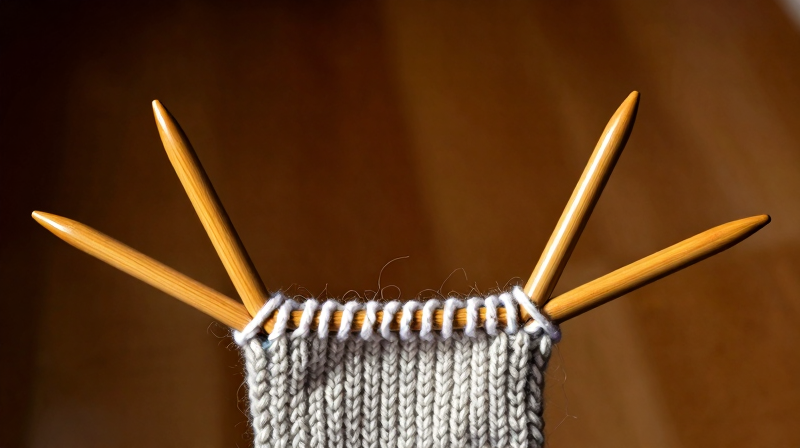
Knitting in the round — working in a continuous spiral instead of back-and-forth rows — is how socks, hats, mittens, and sleeves have been made since the earliest days of knitting. The technique uses a set of four or five double-pointed needles (DPNs): short needles with points at both ends, arranged in a triangle or square with the stitches distributed evenly among them. You knit continuously around the triangle, never turning the work. Because you always face the right side of the fabric, every round is a knit round — and knitting every round produces stockinette automatically, without ever purling.
This is almost certainly how knitting was first practiced. The earliest known knitted objects — 13th-century Egyptian socks found in Fustat (Old Cairo) — were knitted in the round on DPNs at an astonishing gauge: 36 stitches per inch in fine cotton, with intricate colorwork patterns. European knitting guilds of the 15th-16th century required apprentices to knit stockings, berets, and gloves in the round as part of their masterpiece examination. The flat knitting that most beginners learn today (back and forth on two needles) is actually the later development — circular knitting came first.
Double-pointed needles remain the standard tool for small-circumference knitting: sock cuffs, hat crowns, mitten thumbs, and sleeve cuffs where a circular needle is too large to fit. A typical sock uses a set of five DPNs in 2.25-2.75 mm diameter, with stitches divided across four needles and the fifth needle used as the working needle.
Anweisungen
Gather double-pointed needles and yarn
Gather double-pointed needles and yarn
You need a set of five double-pointed needles (DPNs) — short needles (15-20 cm long) with a point at each end. For a practice tube, use 4 mm DPNs with medium-weight wool yarn (worsted or aran weight). DPNs come in sets of four or five; five is standard for socks because it divides the stitches into quarters, but four (forming a triangle) works equally well for practice. Choose wooden or bamboo needles over metal for your first attempt — they grip the yarn better and stitches are less likely to slide off accidentally.
Materialien für diesen Schritt:
 Wollstrang1 Stück
Benötigte Werkzeuge:
 Stricknadeln
Cast on to a single needle
Cast on to a single needle
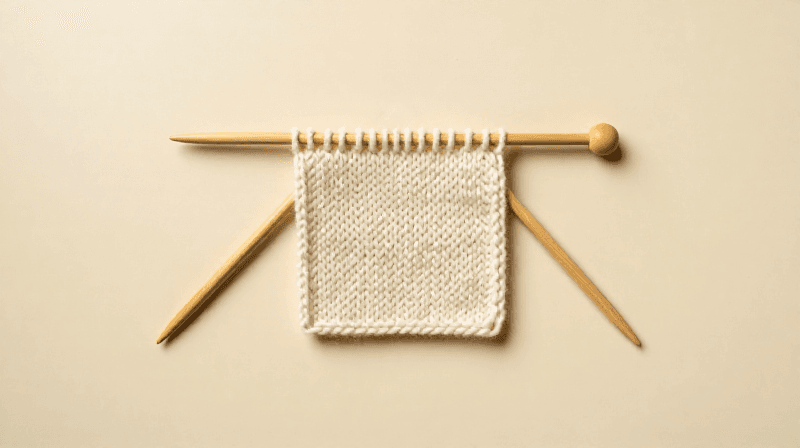
Cast on 32 stitches onto one DPN using the long-tail cast-on. Cast onto a single needle first — do not try to cast onto multiple needles simultaneously. 32 stitches at 4 mm gives a tube about 15 cm in circumference, roughly the size of a wrist warmer. Keep the cast-on edge loose enough that you can comfortably distribute the stitches later — a tight cast-on makes it difficult to slide stitches between needles.
Distribute stitches across four needles
Distribute stitches across four needles
Slip 8 stitches purlwise (without twisting them) onto each of three additional DPNs, leaving 8 on the original needle. You now have 8 stitches on each of four needles. Arrange the four needles into a square on your work surface, with the cast-on edge running along the inside. The working yarn hangs from the last stitch on the fourth needle. The needle with the first cast-on stitch is needle 1; the needle with the working yarn is needle 4.
Join for working in the round
Join for working in the round
This is the critical step. Pick up the needles so they form a square with the cast-on edge on the inside (not twisted). Check carefully that the cast-on edge runs straight along the bottom of all four needles without spiraling around — if it spirals, the tube will be permanently twisted (a Möbius strip, not a cylinder). Hold needle 1 in your left hand and needle 4 in your right hand. Using the fifth DPN as the working needle, knit the first stitch on needle 1, pulling the yarn firmly from needle 4 to close the gap. You have joined the round.
Knit the first round
Knit the first round
Continue knitting across all 8 stitches on needle 1. When needle 1 is empty, it becomes the new working needle. Rotate the work slightly and knit across needle 2, then needle 3, then needle 4. When you finish needle 4, you have completed one round and are back at the start. The join point — where needle 4 meets needle 1 — often has a loose stitch or visible gap. Pull the yarn extra tight on the first and last stitch of each round for the first few rounds until the join tightens up.
Place a stitch marker at the beginning of the round
Place a stitch marker at the beginning of the round
Slip a stitch marker or a short loop of contrasting yarn onto the needle between the last stitch of needle 4 and the first stitch of needle 1. This marks the beginning of each round. Without a marker, you will quickly lose track of where rounds begin and end — the continuous spiral has no natural break point. When you reach the marker, slip it from the left needle to the right needle and continue knitting. Count rounds by counting how many times you pass the marker.
Continue knitting — stockinette appears automatically
Continue knitting — stockinette appears automatically
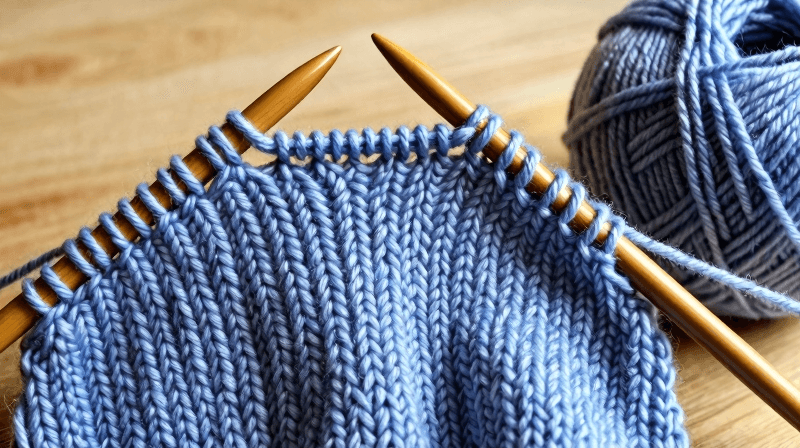
Knit every stitch on every round. After 10-15 rounds, look at the fabric: it is stockinette — smooth Vs on the outside, bumpy purl faces on the inside. Because you never turn the work, you always face the knit (right) side. In flat knitting, stockinette requires alternating knit and purl rows; in the round, knitting every round produces stockinette automatically. This is one of circular knitting's great advantages and the reason most historical knitting was done in the round.
Manage the ladders at needle transitions
Manage the ladders at needle transitions
Look at the columns of stitches where one needle ends and the next begins. You may see slightly looser stitches forming visible vertical lines — these are called ladders. They happen because the yarn travels a slightly longer distance between the last stitch on one needle and the first stitch on the next. To minimize ladders: pull the first stitch on each needle tight, knit the first two stitches of each needle before relaxing tension, and periodically rotate your stitch distribution by knitting one or two extra stitches onto the next needle. Experienced sock knitters shift stitches regularly to prevent ladders.
Practice ribbing in the round
Practice ribbing in the round
To knit 2x2 ribbing in the round (standard sock cuff): knit 2, purl 2, repeat around. Because 32 divides evenly by 4, the ribbing aligns perfectly. Remember to move the yarn to the front before each pair of purls and to the back before each pair of knits. Ribbing in the round is easier than ribbing flat because you always read the stitches from the right side — knit the Vs, purl the bumps. Continue for 10-15 rounds to form a stretchy cuff. This is exactly how a sock cuff is started.
Understand why socks are knitted in the round
Understand why socks are knitted in the round
A sock is a shaped tube: a ribbed cuff, a turned heel, a foot tube, and a tapered toe. Each section is worked in the round — there are no seams. A seamed sock (knitted flat and sewn together) would have a ridge running along the sole, uncomfortable under the foot and prone to wearing through at the seam. Circular knitting eliminates all seams. The heel is worked back and forth on half the stitches (a short section of flat knitting within the circular tube), then rejoined into the round for the foot. The toe is decreased by knitting two stitches together at four evenly spaced points every other round until the opening closes.
Bind off in the round
Bind off in the round
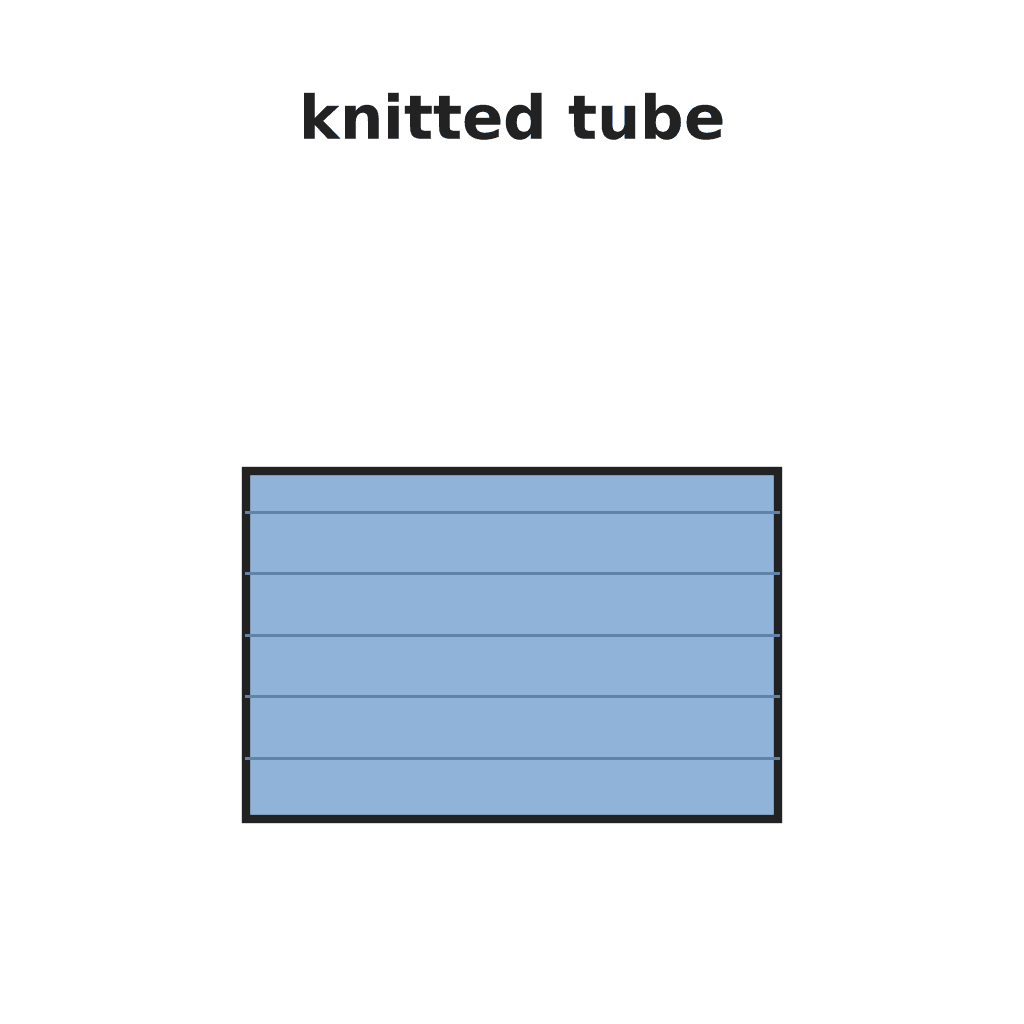
To finish the practice tube: knit 2 stitches, pass the first stitch over the second (standard bind-off). Knit 1 more, pass again. Continue around until 1 stitch remains, cut the yarn leaving a 15 cm tail, and pull it through the last loop. Weave the tail through the inside of the tube with a tapestry needle. You have made a seamless knitted tube — the same construction used for every sock, hat, and mitten in the hand-knitting tradition.
Materialien
1- 1 StückPlatzhalter
Benötigte Werkzeuge
1- Platzhalter
Materialien verbundener Blueprints
Dieser Bauplan stellt her
Verwandte Blueprints
Diese Blueprints teilen Wissen — Techniken, Materialien oder Prinzipien
CC0 Gemeinfrei
Dieser Blueprint ist unter CC0 veröffentlicht. Sie dürfen dieses Werk für jeden Zweck frei kopieren, ändern, verbreiten und verwenden, ohne um Erlaubnis zu fragen.
Unterstützen Sie den Maker, indem Sie Produkte über seinen Blueprint kaufen, wo er eine Maker-Provision von Anbietern festgelegt, verdient. Oder erstellen Sie eine neue Iteration dieses Blueprints und verbinden Sie ihn in Ihrem eigenen Blueprint, um Einnahmen zu teilen.