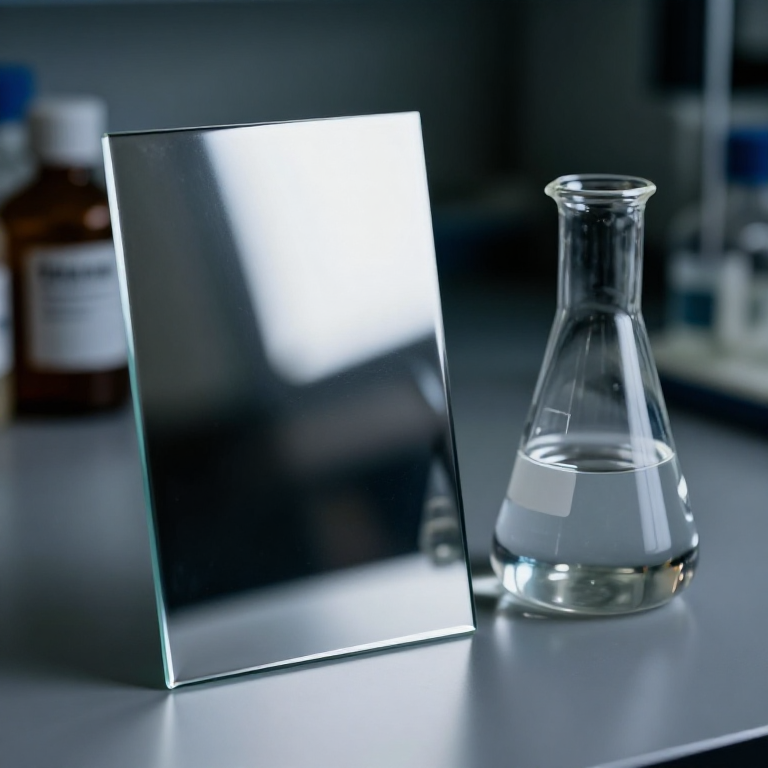


Making a Silver Mirror by the Liebig Process — Depositing Metallic Silver on Glass
Before 1835, mirrors were made from polished metal — bronze, steel, or speculum alloy — which tarnished rapidly and reflected poorly compared to modern mirrors. The revolution came when Justus von Liebig developed a chemical process to deposit a thin, uniform layer of metallic silver directly onto a glass surface. The Liebig process uses the silver mirror reaction: silver nitrate is dissolved in ammonia to form diamminesilver(I) complex (Tollens' reagent), then a reducing sugar (glucose or formaldehyde) is added. The reducing agent donates electrons to the silver ions, which precipitate as metallic silver atoms that bond to the clean glass surface, building up an atomically smooth, highly reflective coating. The process works at room temperature and requires only simple chemicals. By the 1850s, Liebig's silvered glass mirrors had replaced speculum metal in telescopes — Léon Foucault used a silver-on-glass mirror in 1857 to build a reflecting telescope superior to anything made with speculum. Every household mirror, telescope mirror, and optical instrument mirror made between 1856 and the mid-20th century (when aluminium vacuum coating took over) used this process. This blueprint makes a silvered glass mirror using the Tollens' reagent method.
Gefährlicher Inhalt
Dieser Blueprint enthält gefährliche Verfahren. Melden Sie sich an und aktivieren Sie gefährliche Inhalte in Ihren Kontoeinstellungen, um die Schritt-für-Schritt-Anleitung anzuzeigen.
AnmeldenDieser Bauplan stellt her


Verwandte Blueprints
Diese Blueprints teilen Wissen — Techniken, Materialien oder Prinzipien




CC0 Gemeinfrei
Dieser Blueprint ist unter CC0 veröffentlicht. Sie dürfen dieses Werk für jeden Zweck frei kopieren, ändern, verbreiten und verwenden, ohne um Erlaubnis zu fragen.
Unterstützen Sie den Maker, indem Sie Produkte über seinen Blueprint kaufen, wo er eine Maker-Provision von Anbietern festgelegt, verdient. Oder erstellen Sie eine neue Iteration dieses Blueprints und verbinden Sie ihn in Ihrem eigenen Blueprint, um Einnahmen zu teilen.