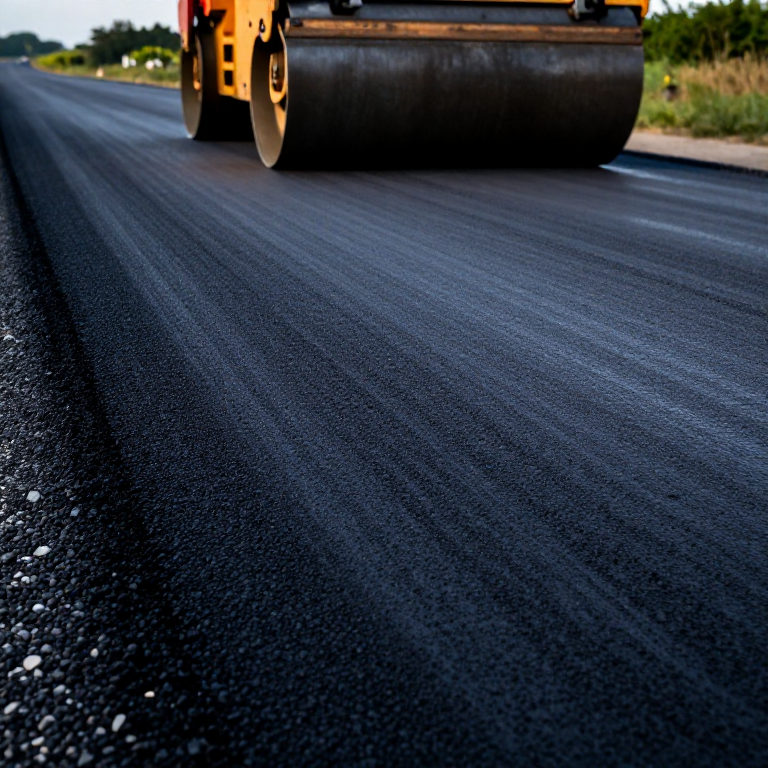


Building a Macadam Road — Cheap, Dry Highways from Small Broken Stone
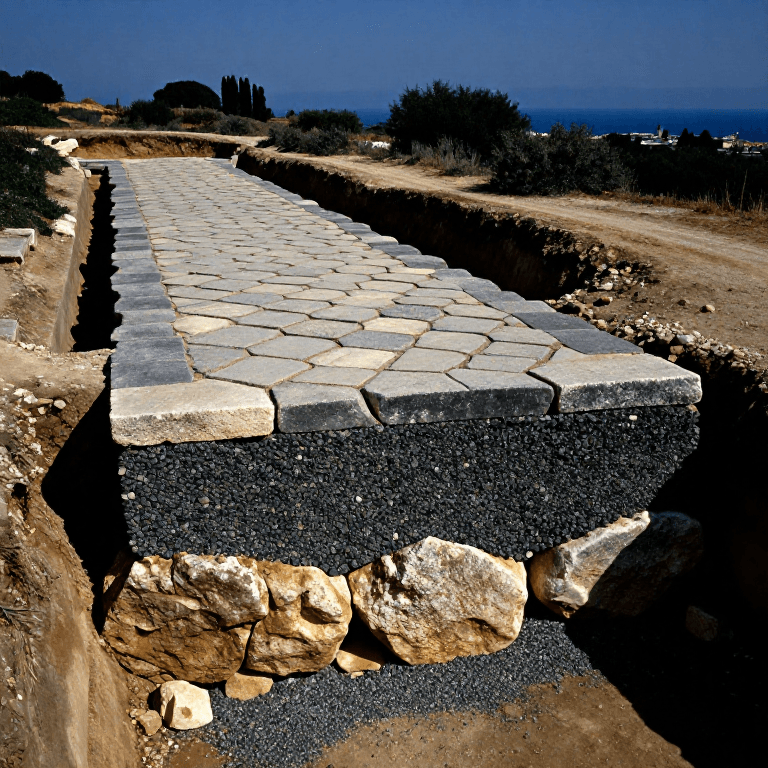
The Romans built superb roads by piling up massive stone foundations, but their method was slow and ruinously expensive. In the 1820s the Scottish surveyor John McAdam threw the foundation away. He realised that a road does not need a heavy base if the soil beneath it is kept dry — and that a surface of small, angular broken stones will lock together under traffic into a hard, smooth crust.
His rules were simple and strict: break every stone small and to a uniform size, raise the road in the middle so water runs off, and keep the subsoil drained. Done right, the stones knit together, the rain sheds away, and the dry ground carries the load. Macadam roads were a fraction of the cost of the old highways and could be built almost anywhere, and they spread across the world.
The method still underlies modern roads. When stone dust alone no longer stood up to fast rubber tyres and their dust, engineers bound the broken stone with tar — tarmacadam, soon shortened to tarmac — and from there to the asphalt that paves the planet. It all begins with small stones and good drainage.
Anweisungen
Understand the McAdam idea
Understand the McAdam idea
Set out and drain the bed
Set out and drain the bed
Benötigte Werkzeuge:
 Schaufel
Break the stone small
Break the stone small
Materialien für diesen Schritt:
 Schotter500 kg
Benötigte Werkzeuge:
 Steinhammer (Erzzerkleinerung)
Gauge the stone size
Gauge the stone size
Benötigte Werkzeuge:
 Kalibrierring
Lay the first layer
Lay the first layer
Benötigte Werkzeuge:
 Eisenrechen
Compact the layer
Compact the layer
Benötigte Werkzeuge:
 Straßenwalze
Build up in thin layers
Build up in thin layers
Materialien für diesen Schritt:
Schotter500 kgHold the camber
Hold the camber
Bind with stone dust
Bind with stone dust
Materialien für diesen Schritt:
 Steinmehl80 kg
Open to traffic
Open to traffic
Maintain with small stone
Maintain with small stone
Toward tarmacadam
Toward tarmacadam
Benötigte Werkzeuge
5- Platzhalter
- Platzhalter
- Platzhalter
- Platzhalter
- Platzhalter
Verwandte Blueprints
Diese Blueprints teilen Wissen — Techniken, Materialien oder Prinzipien

CC0 Gemeinfrei
Dieser Blueprint ist unter CC0 veröffentlicht. Sie dürfen dieses Werk für jeden Zweck frei kopieren, ändern, verbreiten und verwenden, ohne um Erlaubnis zu fragen.
Unterstützen Sie den Maker, indem Sie Produkte über seinen Blueprint kaufen, wo er eine Maker-Provision von Anbietern festgelegt, verdient. Oder erstellen Sie eine neue Iteration dieses Blueprints und verbinden Sie ihn in Ihrem eigenen Blueprint, um Einnahmen zu teilen.