
KUNST
SCHÖNHEIT & WELLNESS
HANDWERK
KULTUR & GESCHICHTE
UNTERHALTUNG
UMFELD
ESSEN & GETRÄNKE
REVERSE ENGINEERING
WISSENSCHAFTEN
SPORT
TECHNOLOGIE
WEARABLES
Making Bleaching Powder — The Chlorine Chemistry That Made White Fabric Affordable
Charlie

Erstellt von

Charlie

23. Mai 2026DE
21
0
0
3
0

Making Bleaching Powder — The Chlorine Chemistry That Made White Fabric Affordable

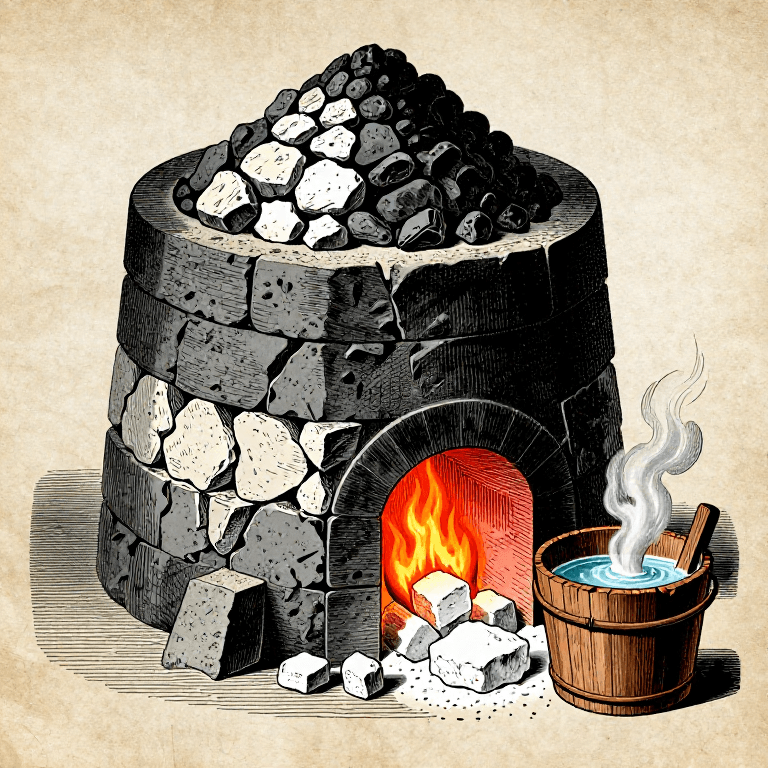
Bleaching powder (calcium hypochlorite, approximately CaCl(OCl) or Ca(OCl)₂·CaCl₂) was the chemical that democratised white fabric. Before its invention, bleaching linen or cotton required months of 'crofting' — spreading cloth on open fields, wetting it repeatedly, and waiting for sunlight and dew to slowly oxidise the natural brown and yellow pigments. A single bolt of linen could spend an entire summer on the bleaching green. In the 1780s, Claude Louis Berthollet demonstrated that chlorine water could bleach fabric in hours instead of months — but liquid chlorine was dangerous, unstable, and impossible to transport.

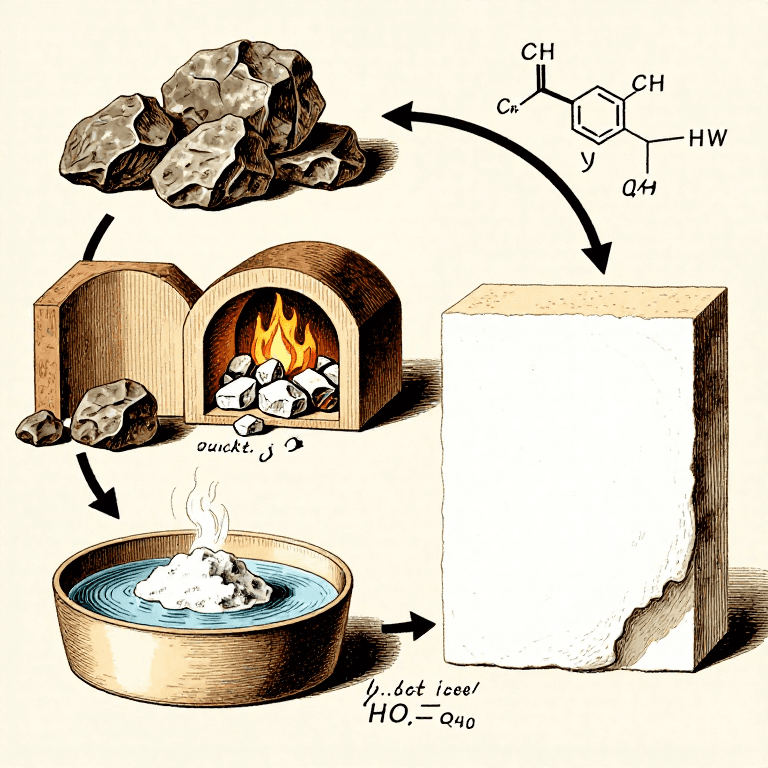
In 1799, Charles Tennant of Glasgow patented the solution: passing chlorine gas over dry slaked lime (calcium hydroxide) to produce a stable, dry powder that could be shipped in barrels and dissolved in water when needed. Bleaching powder made the industrial-scale production of white textiles practical for the first time. The chemistry is straightforward: chlorine reacts with calcium hydroxide to form calcium hypochlorite and calcium chloride — Ca(OH)₂ + Cl₂ → CaCl(OCl) + H₂O. The active bleaching agent is the hypochlorite ion (OCl⁻), a powerful oxidiser that destroys the conjugated chromophores in natural dyes and stains.

The chlorine itself is generated by the reaction discovered by Carl Wilhelm Scheele in 1774: manganese dioxide reacts with concentrated hydrochloric acid to produce chlorine gas — MnO₂ + 4HCl → MnCl₂ + Cl₂ + 2H₂O. In the industrial Leblanc Process, the hydrochloric acid was a waste product of soda ash manufacture — making bleaching powder from industrial waste was one of the great circular economy innovations of the 18th century.

SAFETY WARNING: CHLORINE GAS IS ACUTELY TOXIC — it was used as a chemical weapon in World War I. Even low concentrations cause severe respiratory damage. This experiment MUST be performed outdoors or in a powerful fume hood. Full respiratory protection with chlorine-rated cartridges is essential. Concentrated hydrochloric acid causes severe burns and releases choking fumes. Never mix bleaching powder with acids — this releases chlorine gas rapidly.

Experte
2–3 hours

Anweisungen

1

Prepare full protective equipment and outdoor workspace

This experiment generates chlorine gas — one of the most dangerous gases in chemistry. Work ONLY outdoors with wind at your back, or in a powerful fume hood rated for toxic gases. Wear a full-face respirator with chlorine/acid gas cartridges (P100/OV/AG), chemical splash goggles, heavy-duty nitrile gloves, and a full lab coat. Have a large bucket of water nearby for emergency skin decontamination. If you smell a strong, sharp, swimming-pool-like odour at any point, you are being exposed to chlorine — move upwind immediately.

Benötigte Werkzeuge:

P100/FFP3 Respirator with Acid Gas CartridgeP100/FFP3 Respirator with Acid Gas Cartridge
Chemical Splash GogglesChemical Splash Goggles
Nitrile Rubber Gloves (Thick)Nitrile Rubber Gloves (Thick)
Lab CoatLab Coat
2

Weigh the manganese dioxide

Weigh 15 g of pyrolusite ore (manganese dioxide, MnO₂) — a heavy, black, granular mineral. MnO₂ is the oxidising agent that converts hydrochloric acid into chlorine gas. This is the same reaction Carl Wilhelm Scheele used in 1774 when he first isolated chlorine — he called it 'dephlogisticated muriatic acid.' The manganese is reduced from Mn⁴⁺ to Mn²⁺ as it transfers oxygen to the chloride ions, oxidising them from Cl⁻ to Cl₂.

Materialien für diesen Schritt:

Pyrolusite Ore (manganese dioxide)Pyrolusite Ore (manganese dioxide)15 g

Benötigte Werkzeuge:

Digital Precision ScaleDigital Precision Scale
3

Set up the chlorine generator flask

Add the manganese dioxide to a round-bottom flask. Fit the flask with a two-hole rubber stopper: one hole for a dropping funnel (or thistle tube) to add acid, and one for a glass delivery tube to carry the chlorine gas out. Connect rubber tubing to the delivery tube. The generator must be gas-tight except for the exit tube — any leak releases toxic chlorine into your workspace.

Benötigte Werkzeuge:

Round-Bottom FlaskRound-Bottom Flask
Rubber Stoppers (Assorted)Rubber Stoppers (Assorted)
Glass Delivery TubeGlass Delivery Tube
Rubber Tubing (Lab Grade)Rubber Tubing (Lab Grade)
4

Set up the gas washing bottle

Connect the delivery tube from the generator into a second flask (the wash bottle) containing 100 ml of distilled water. The tube must dip below the water surface so chlorine gas bubbles through. This wash removes hydrochloric acid vapour that would otherwise contaminate the bleaching powder with excess acidity. A second delivery tube exits above the water level and continues to the lime chamber. The wash water will gradually turn pale yellow-green as it absorbs some chlorine — this is dilute chlorine water, itself a bleaching solution.

Materialien für diesen Schritt:

Distilled Water (1 Liter)Distilled Water (1 Liter)100 ml

Benötigte Werkzeuge:

Erlenmeyer FlaskErlenmeyer Flask
Glass Delivery TubeGlass Delivery Tube
5

Prepare the lime bed

Spread 30 g of slaked lime (calcium hydroxide, Ca(OH)₂) in an even layer in a porcelain evaporating dish. The layer should be no more than 5 mm deep — a thin layer ensures the chlorine gas can penetrate and react with all the lime. Cover the dish loosely with a watch glass, leaving a gap on one side for the gas inlet tube. Position the dish at the end of the delivery system so the washed chlorine gas flows over the lime bed. The exit gas should be vented safely downwind or into a second wash bottle containing sodium hydroxide solution to neutralise excess chlorine.

Materialien für diesen Schritt:

Calcium Hydroxide (Slaked Lime)Calcium Hydroxide (Slaked Lime)30 g

Benötigte Werkzeuge:

Evaporating Dish (Porcelain)Evaporating Dish (Porcelain)
Watch GlassWatch Glass
6

Add concentrated hydrochloric acid to the generator

Carefully pour 50 ml of concentrated hydrochloric acid (37% HCl) through the dropping funnel into the flask containing the manganese dioxide. The reaction begins immediately — you may see a faint yellow-green colour appearing in the flask: MnO₂ + 4HCl → MnCl₂ + Cl₂↑ + 2H₂O. The manganese dioxide oxidises the chloride ions from HCl to elemental chlorine gas. Add the acid slowly — rapid addition produces a surge of chlorine that could overwhelm the delivery system.

Materialien für diesen Schritt:

Hydrochloric Acid (37% concentrated)Hydrochloric Acid (37% concentrated)50 ml
7

Heat gently to accelerate chlorine generation

Warm the generator flask gently with a spirit lamp. At room temperature, the reaction is slow — gentle heating to 40–50 °C accelerates chlorine evolution significantly. Bubbles of yellow-green chlorine gas appear in the wash bottle as the gas passes through the water. The characteristic sharp, acrid smell of chlorine (the 'swimming pool' odour) will be noticeable even through a respirator if the gas escapes — if you detect this, check all connections and move upwind. The reaction proceeds steadily for 30–60 minutes as long as excess HCl remains.

Benötigte Werkzeuge:

Alcohol Burner (Spirit Lamp)Alcohol Burner (Spirit Lamp)
8

Observe the chlorine reacting with the lime bed

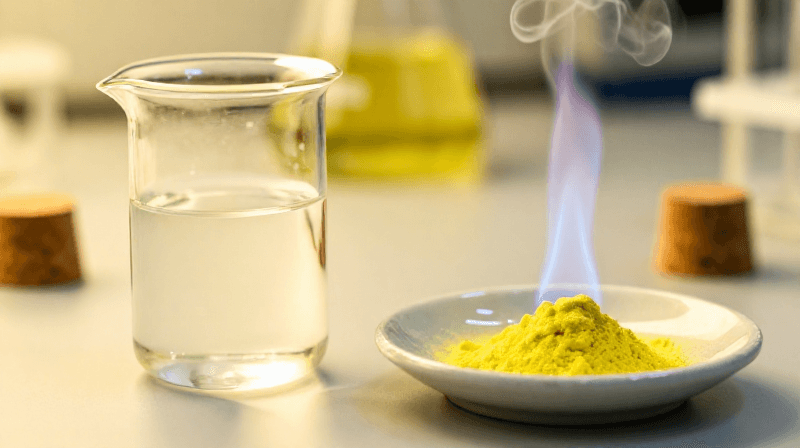
Watch the lime bed as chlorine flows over it. The white powder gradually changes to a faint cream or pale yellow colour as calcium hypochlorite forms — Ca(OH)₂ + Cl₂ → CaCl(OCl) + H₂O. This colour change is subtle but definite. If you lift the watch glass briefly (carefully, upwind), the lime may have developed a pungent, chlorine-like smell distinctly different from fresh slaked lime. Stir the lime bed gently with a glass rod every 10 minutes to expose fresh surfaces to the gas flow.

Benötigte Werkzeuge:

Glass Stirring Rod (25cm)Glass Stirring Rod (25cm)
9

Continue until the lime is saturated

Continue the chlorine generation for 30–60 minutes until either the manganese dioxide is consumed (the flask contents turn from black to a pale brown solution of manganese chloride) or the lime bed has turned uniformly pale yellow and no longer absorbs chlorine readily (gas begins to pass through without reacting). A well-saturated bleaching powder contains approximately 30–35% available chlorine by weight. The industrial product was shipped at this concentration in wooden casks lined with lead.

10

Disconnect the apparatus safely

Remove the heat source first to stop generating new chlorine. Wait 5 minutes for residual gas to clear through the system. Then disconnect the tubing from the wash bottle end FIRST (not the generator end — disconnecting the generator first would vent raw chlorine). Allow any remaining chlorine in the wash bottle to be absorbed. The generator flask contains a solution of manganese chloride (MnCl₂) in excess HCl — this can be neutralised with sodium carbonate and disposed of safely.

11

Collect and test the bleaching powder

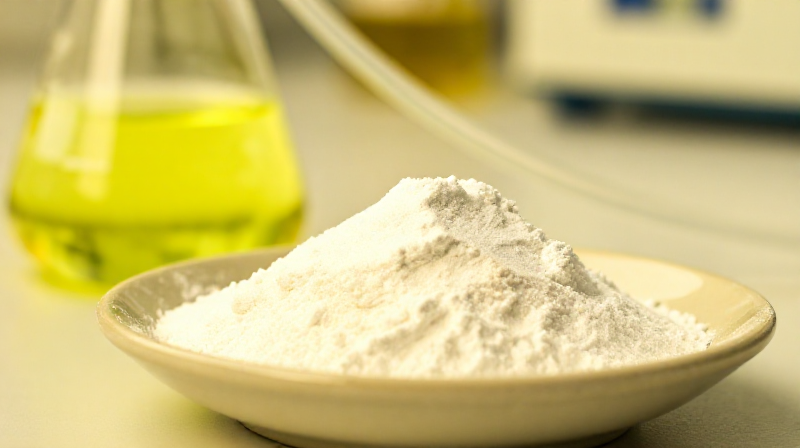
The porcelain dish now contains bleaching powder — a pale cream or yellowish-white powder with a strong chlorine odour. To test: dissolve 1 g in 50 ml of water and stir. The solution should be cloudy (calcium carbonate precipitates from CO₂ absorption) but distinctly chlorine-scented. Dip a strip of coloured cotton fabric into the solution — the colour should fade visibly within minutes, demonstrating the oxidising power of the hypochlorite ion. Before Tennant's powder, this bleaching action required months of sunlight exposure.

Benötigte Werkzeuge:

Glass Beaker (Borosilicate, 500ml)Glass Beaker (Borosilicate, 500ml)
12

Store the finished bleaching powder

Transfer the bleaching powder to a glass jar with a tight-fitting lid. Label: BLEACHING POWDER (Calcium Hypochlorite), OXIDISER, CORROSIVE, date. Store in a cool, dark, dry place — bleaching powder slowly decomposes, losing available chlorine. Heat and moisture accelerate this decomposition. Expected yield from 30 g slaked lime: approximately 30–35 g of bleaching powder (the mass increases as chlorine is absorbed). Never store near acids — mixing bleaching powder with any acid releases chlorine gas immediately. Charles Tennant's 1799 patent for this simple powder transformed the textile industry overnight and made Glasgow the bleaching capital of the world.

Benötigte Werkzeuge:

Glass Storage Jar with LidGlass Storage Jar with Lid

Materialien

4

Benötigte Werkzeuge

16

Materialien verbundener Blueprints

CC0 Gemeinfrei

Dieser Blueprint ist unter CC0 veröffentlicht. Sie dürfen dieses Werk für jeden Zweck frei kopieren, ändern, verbreiten und verwenden, ohne um Erlaubnis zu fragen.

Unterstützen Sie den Maker, indem Sie Produkte über seinen Blueprint kaufen, wo er eine Maker-Provision von Anbietern festgelegt, verdient. Oder erstellen Sie eine neue Iteration dieses Blueprints und verbinden Sie ihn in Ihrem eigenen Blueprint, um Einnahmen zu teilen.

Diskussion

(0)

Anmelden um an der Diskussion teilzunehmen

Kommentare werden geladen...