
Margarine
Anweisungen
See why fat and water will not mix
See why fat and water will not mix
The problem the product solves is on the bench in ten seconds.
- Put oil and water in a jar and shake hard.
- Watch it separate.
- Time how long the mixture holds before two clear layers return.
Materialien für diesen Schritt:
 Becherglas aus Borosilikat2 Stück
Add an emulsifier
Add an emulsifier
An emulsifier has one end that likes water and one that likes fat.
- Repeat the shake with a little milk or a trace of egg yolk added.
- Compare how long it stays mixed.
Materialien für diesen Schritt:
 Vollmilch100 ml
Blend and chill
Blend and chill
Emulsify warm, then set the structure by cooling fast.
- Warm a solid-at-room-temperature fat until just melted.
- Beat in the milk a little at a time until uniform.
- Chill rapidly while continuing to stir.
Materialien für diesen Schritt:
 Kakaobutter100 g
Benötigte Werkzeuge:
 Einstichthermometer
Test it against butter
Test it against butter
Compare the two on the properties that actually matter.
- Spread straight from the fridge.
- Melt a piece on the tongue and note the temperature at which it goes.
- Water release — press a piece and see if liquid weeps out.
History and context
History and context
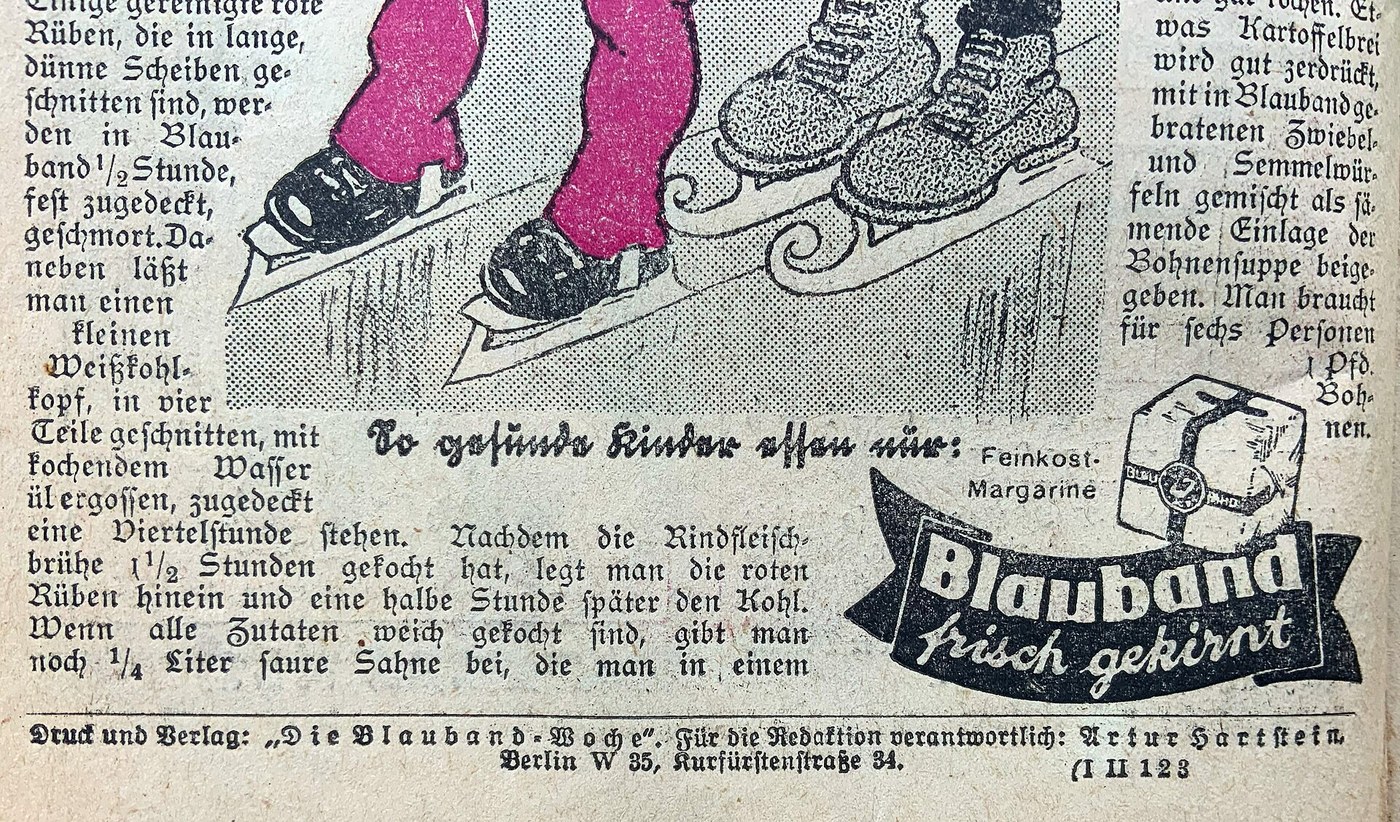
Hippolyte Mège-Mouriès patented his process in 1869, in response to a prize offered under Napoleon III for a butter substitute for the navy and the poor. The name comes from margaric acid, a substance Michel Eugène Chevreul had described earlier and named from the Greek margarites, pearl. Chevreul's margaric acid later turned out not to be a distinct acid at all but a mixture — so margarine is named after a compound that does not exist.
Vegetable oils came later. The original product was animal fat. Wilhelm Normann patented the hydrogenation of liquid oils in 1902, which let cheap vegetable oils be hardened into spreadable fats and moved margarine off beef entirely. That process also produced trans fats, whose serious cardiovascular harms were established much later and which have since been restricted or banned in many countries. Modern margarine is made by interesterification and blending instead.
The colour wars were real legislation. American dairy states taxed margarine, required humiliating labels, and banned it from being coloured yellow; several states at various points required or permitted requiring that it be dyed pink to make it unappetising. Manufacturers responded by selling white margarine with a capsule of dye for the customer to knead in at home. Wisconsin did not repeal its colouring ban until 1967.
What this build is: a demonstration of emulsion and crystallisation using food-safe fats. It is not a recipe for a shelf-stable product — commercial margarine is pasteurised, has preservatives and controlled water content, and is made under conditions a kitchen cannot match.
Materialien
3- 2 StückPlatzhalter
- 100 mlPlatzhalter
- 100 gPlatzhalter
Benötigte Werkzeuge
1- Platzhalter
Dieser Bauplan stellt her
CC0 Gemeinfrei
Dieser Blueprint ist unter CC0 veröffentlicht. Sie dürfen dieses Werk für jeden Zweck frei kopieren, ändern, verbreiten und verwenden, ohne um Erlaubnis zu fragen.
Unterstützen Sie den Maker, indem Sie Produkte über seinen Blueprint kaufen, wo er eine Maker-Provision von Anbietern festgelegt, verdient. Oder erstellen Sie eine neue Iteration dieses Blueprints und verbinden Sie ihn in Ihrem eigenen Blueprint, um Einnahmen zu teilen.