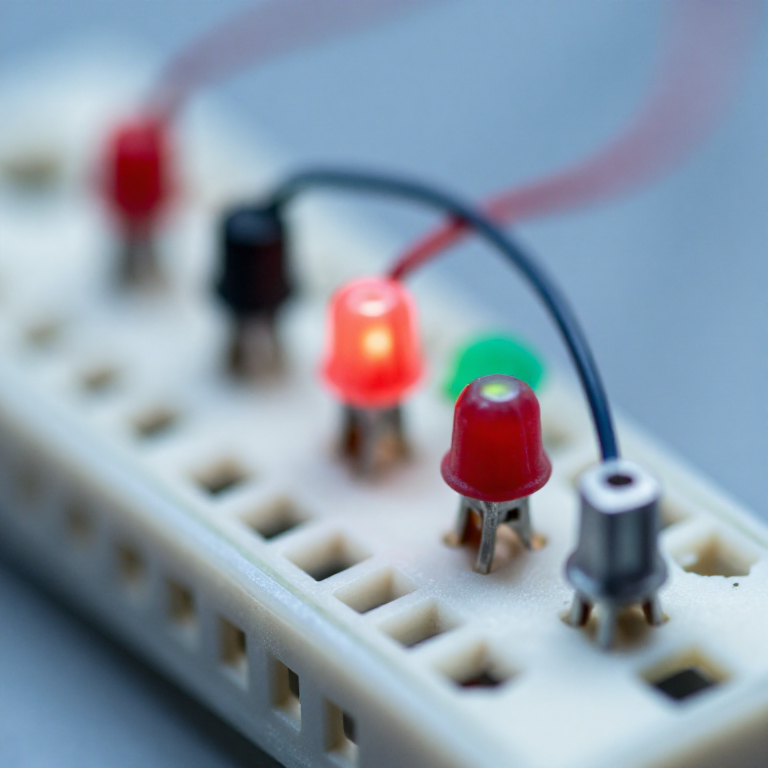


Measuring Planck's Constant with LEDs
Planck's constant is the number that says energy comes in lumps. It appears in the definition of the kilogram, in every quantum calculation ever done, and in the fact that a hot object does not radiate infinite energy at short wavelengths. It is about 6.63 x 10⁻³⁴ joule-seconds, and you can get within striking distance of it on a breadboard for the price of a bag of LEDs.
The reasoning is short. In an LED, an electron drops across the semiconductor's band gap and the energy released comes out as one photon. A photon's energy is hf, or hc/λ. The voltage at which the LED just begins to conduct and glow is the voltage needed to push an electron across that same gap, so eV ≈ hc/λ.
Rearranged, that says the turn-on voltage should be proportional to 1/λ. Measure the turn-on voltage of several LEDs of different colours, plot V against 1/λ, and the slope is hc/e. Multiply by e and divide by c and you have h.
⚠ It will not be exact, and the reasons why are the interesting part. Turn-on voltage is not identical to the band gap, the quoted wavelength is a manufacturer's average rather than a peak, and there are contact potentials and series resistance in the way. Expect to land in the right decade with a real systematic offset — and then go and find it.
Anweisungen
Collect LEDs across the widest colour range you can
Collect LEDs across the widest colour range you can
Gather at least five LEDs of clearly different colours — infrared through red, amber, green, blue and violet if possible — and write down each one's quoted peak wavelength from its datasheet.
Do not guess a wavelength from the colour of the plastic.
The lens colour is a diffuser, not the emission. Clear-lens LEDs are common and a water-clear blue looks identical to a water-clear green when unpowered.
Materialien für diesen Schritt:
 LED-Set1 Set
Benötigte Werkzeuge:
 Allwetter-Feldbuch
Wire the test circuit
Wire the test circuit
Put each LED in series with a resistor across a variable supply, with a voltmeter directly across the LED alone — not across the pair.
Keep the resistor in at all times.
Measuring across LED plus resistor is the classic ruinous error, because you then include an IR drop that grows with current and the slope you extract is meaningless.
Materialien für diesen Schritt:
 Widerstandssortiment 1/4 W1 Set
 Steckbrett1 Stück
Benötigte Werkzeuge:
 Digitalmultimeter — automatische Bereichswahl, True RMS
Find each turn-on voltage the same way every time
Find each turn-on voltage the same way every time
In a dark room, raise the voltage slowly from zero until the LED is just visibly glowing, and record the voltage across it.
Repeat three times per LED and average.
Define your threshold once and apply it identically — "just visible in the dark" is a repeatable criterion; "looks on" is not, and the difference between two observers' criteria is larger than most of the other errors combined.
Do it again with a current criterion
Do it again with a current criterion
Now repeat, but instead of judging by eye, record the voltage at a fixed small current — say 0.1 mA — read from the multimeter in series.
Compare the two sets.
Expect the current-based figures to be more consistent and slightly different from the visual ones.
You have just replaced a human threshold with an instrumental one, which is what most of experimental physics consists of.
Plot V against 1/λ and take the slope
Plot V against 1/λ and take the slope
Plot turn-on voltage on the y axis against 1/λ on the x axis. Draw the best straight line.
The slope is hc/e. Multiply by the electron charge and divide by the speed of light to get h.
Compare with 6.63 x 10⁻³⁴ J s.
Expect the right order of magnitude and an error of some tens of per cent. Also note the intercept — a good fit should pass near the origin, and yours will not.
Benötigte Werkzeuge:
 Rechner
 Millimeterpapier
Hunt the systematic error
Hunt the systematic error
Test the suspects one at a time. Warm an LED in your hand and re-measure. Try two LEDs of the same nominal colour from different batches. Try the same LED at two different threshold currents.
Expect temperature to shift the turn-on voltage measurably, nominally identical LEDs to disagree, and the threshold current to move every reading in the same direction.
A systematic error moves all your points the same way and therefore survives averaging. That is exactly why the intercept is not zero.
Work out h from your readings
Work out h from your readings
Compendium — what the number means and why the method limps
Compendium — what the number means and why the method limps
Where h came from. Max Planck introduced it in 1900 as a mathematical device to fix black-body radiation theory, which otherwise predicted infinite energy at short wavelengths. He regarded the quantisation as a formal trick. Einstein took it literally in 1905, proposing that light itself comes in quanta, and explained the photoelectric effect with it — the work that won him the Nobel Prize. The LED runs that logic backwards: instead of light knocking electrons out, an electron falling across a gap makes light.
Why an LED emits one colour at all. A semiconductor has a forbidden energy range — the band gap — between its valence and conduction bands. An electron injected into the conduction band can drop back across that gap, and the energy difference has to go somewhere; in a direct-band-gap material it goes out as a photon of that energy. The colour is a property of the material, not of the plastic, which is why blue LEDs took decades longer than red ones and why that work earned the 2014 Nobel Prize in Physics.
⚠ The honest accounting of why your answer is off. Turn-on voltage is not the band gap: conduction begins somewhat below it, and the emitted photon energy is usually a little less than eV at any practical current. Manufacturers quote a nominal peak wavelength that varies batch to batch. There are contact and junction potentials in series with the diode. Series resistance adds voltage at any non-zero current. And the band gap itself falls as temperature rises. Together these produce a consistent offset, which is why the fitted line misses the origin — and why the slope is the trustworthy part and the intercept is the diagnostic.
What the constant now anchors. Since the 2019 redefinition of SI units, Planck's constant is fixed by definition at exactly 6.62607015 x 10⁻³⁴ J s, and the kilogram is defined from it. It is no longer something to be measured; it is a defined value that the kilogram is derived from, via the Kibble balance. Your breadboard is measuring a quantity that, at the highest level of metrology, is no longer measurable — because it is now the ruler.
Safe practice. Nothing here is dangerous, with two exceptions: never run an LED without a current-limiting resistor, and do not look directly into a blue, violet or ultraviolet LED at close range. Short-wavelength LEDs put out enough energy per photon to matter, there is no blink reflex for UV, and a bright blue LED viewed head-on is genuinely uncomfortable for a reason.
Materialien
3- 1 SetPlatzhalter
- Platzhalter
- Platzhalter
Benötigte Werkzeuge
4- Platzhalter
- Platzhalter
- Platzhalter
Materialien verbundener Blueprints
Verwandte Blueprints
Diese Blueprints teilen Wissen — Techniken, Materialien oder Prinzipien

CC0 Gemeinfrei
Dieser Blueprint ist unter CC0 veröffentlicht. Sie dürfen dieses Werk für jeden Zweck frei kopieren, ändern, verbreiten und verwenden, ohne um Erlaubnis zu fragen.
Unterstützen Sie den Maker, indem Sie Produkte über seinen Blueprint kaufen, wo er eine Maker-Provision von Anbietern festgelegt, verdient. Oder erstellen Sie eine neue Iteration dieses Blueprints und verbinden Sie ihn in Ihrem eigenen Blueprint, um Einnahmen zu teilen.