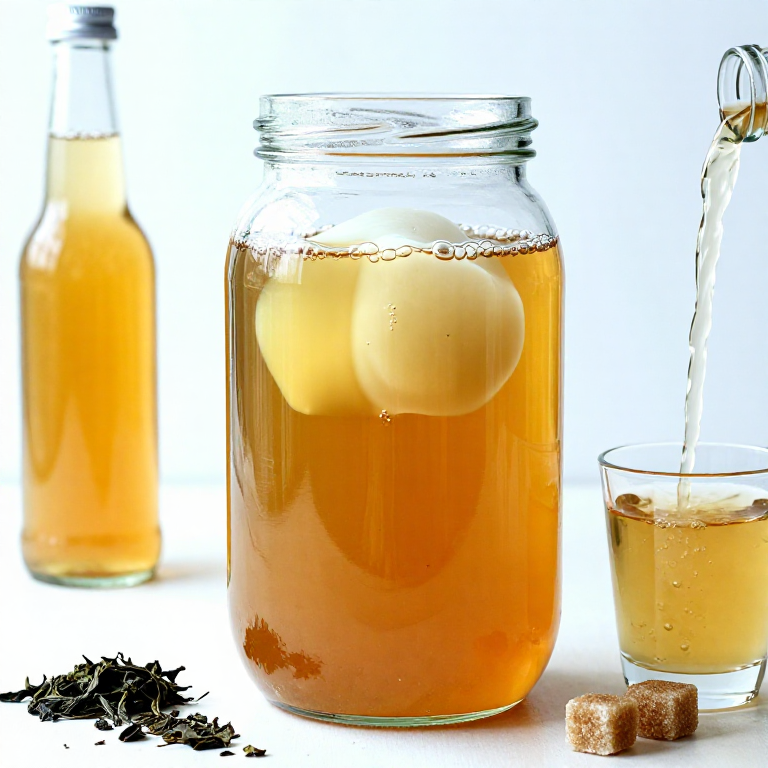


Brewing Kombucha from a SCOBY Culture — Fermented Tea
Anweisungen
Brew and Cool the Sweet Tea
Brew and Cool the Sweet Tea
Boil 500ml of water and steep the tea for 5-10 minutes (longer steeping produces more tannins, which the SCOBY organisms feed on). Remove the tea bags or strain the leaves. Dissolve 100g of white sugar into the hot tea — the sugar is food for the SCOBY, not for you, so do not reduce it. Most of the sugar will be consumed during fermentation. Add 500ml of cool water to bring the total to approximately 1 litre and cool the sweetened tea to room temperature (below 30 degrees C). Never add a SCOBY to hot liquid — temperatures above 35 degrees C will kill the culture organisms. Use only plain tea — flavoured teas contain oils that can harm the SCOBY.
Materialien für diesen Schritt:
 Schwarzer Tee4-6 tea bags Stück
 Weißer Zucker100g g
 Wasser1 litre Liter
Benötigte Werkzeuge:
 Großer Kochtopf
Add the SCOBY and Starter
Add the SCOBY and Starter
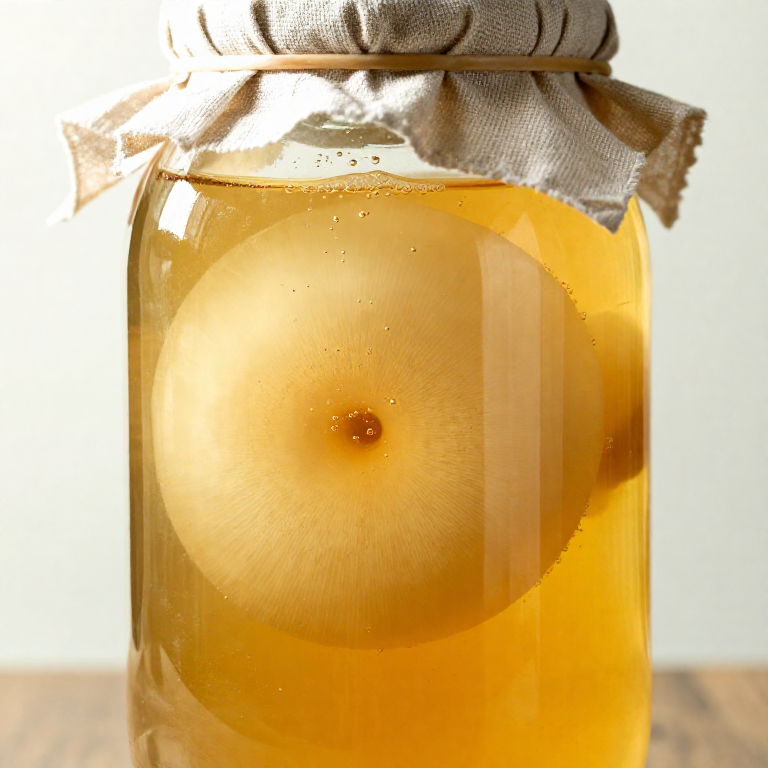
Pour the cooled sweet tea into a clean glass jar. Add 100-200ml of mature kombucha (starter liquid) — this acidifies the tea immediately (target pH below 4.5), creating an environment that inhibits mould and pathogenic bacteria while favouring the SCOBY organisms. Place the SCOBY disc on top of the tea (it may float or sink — both are normal). Cover the jar with a tightly woven cloth or coffee filter secured with a rubber band. The cover must be breathable (the fermentation is aerobic and needs air exchange) but fine enough to exclude fruit flies, which are strongly attracted to fermenting beverages. Do not use a sealed lid — pressure buildup could shatter the jar.
Materialien für diesen Schritt:
 Kombucha-SCOBY1 disc Stück
Benötigte Werkzeuge:
 Ansatzglas
 Tuch (zum Abseihen)
 pH-Meter in Lebensmittelqualität
First Fermentation (F1)
First Fermentation (F1)
Place the jar in a warm location (22-28 degrees C) away from direct sunlight and leave undisturbed for 7-14 days. The SCOBY organisms — primarily Acetobacter bacteria and various yeasts (Brettanomyces, Saccharomyces, Zygosaccharomyces) — consume the sugar and produce acetic acid, gluconic acid, and CO2. A new SCOBY layer will form on the surface as a thin film that gradually thickens. Warmer temperatures speed fermentation; cooler temperatures slow it. Taste the kombucha starting at day 7 by inserting a straw beneath the SCOBY. It should be tangy and slightly sweet — not vinegar-sour and not candy-sweet. The pH should be 2.5-3.5 when ready. Shorter fermentation leaves more residual sugar; longer fermentation produces more acid.
Bottle and Second Fermentation (F2)
Bottle and Second Fermentation (F2)
When the F1 kombucha reaches your desired balance of sweet and tangy, remove the SCOBY with clean hands and reserve 100-200ml of the liquid as starter for the next batch. Pour the remaining kombucha into flip-top glass bottles, leaving 3-4cm of headspace. For flavouring, add fruit juice, ginger, or fruit pieces to the bottles before sealing (approximately 10-15% juice by volume). Seal the bottles tightly and leave at room temperature for 2-5 days. The residual yeast continues fermenting the added sugars in the sealed bottle, producing CO2 that carbonates the drink. Burp the bottles daily by briefly opening the cap to release excess pressure — over-carbonation can cause glass bottles to explode.
Benötigte Werkzeuge:
 Bernsteinfarbene Bierflaschen
 Feinmaschiges Teesieb
Refrigerate and Serve
Refrigerate and Serve
After 2-5 days of F2 (or when the desired carbonation level is reached), move all bottles to the refrigerator. Cold temperature dramatically slows fermentation and prevents further pressure buildup. Refrigerated kombucha keeps for several months. When opening, point the bottle away from your face — well-carbonated kombucha can foam vigorously. The SCOBY can be reused indefinitely: start a new batch of sweet tea, add the SCOBY and reserved starter liquid, and the cycle continues. SCOBYs grow a new layer with each batch and can be peeled apart to share with others or composted. Healthy kombucha has a clean tangy taste, light effervescence, and a pH between 2.5 and 3.5.
Materialien
5- 4-6 tea bags StückPlatzhalter
- 100g gPlatzhalter
- 1 litre LiterPlatzhalter
- 1 disc StückPlatzhalter
- 100-200ml StückPlatzhalter
Benötigte Werkzeuge
8- Platzhalter
- Platzhalter
- Platzhalter
- Platzhalter
- Platzhalter
- Platzhalter
- Platzhalter
- Platzhalter
Dieser Bauplan stellt her

CC0 Gemeinfrei
Dieser Blueprint ist unter CC0 veröffentlicht. Sie dürfen dieses Werk für jeden Zweck frei kopieren, ändern, verbreiten und verwenden, ohne um Erlaubnis zu fragen.
Unterstützen Sie den Maker, indem Sie Produkte über seinen Blueprint kaufen, wo er eine Maker-Provision von Anbietern festgelegt, verdient. Oder erstellen Sie eine neue Iteration dieses Blueprints und verbinden Sie ihn in Ihrem eigenen Blueprint, um Einnahmen zu teilen.