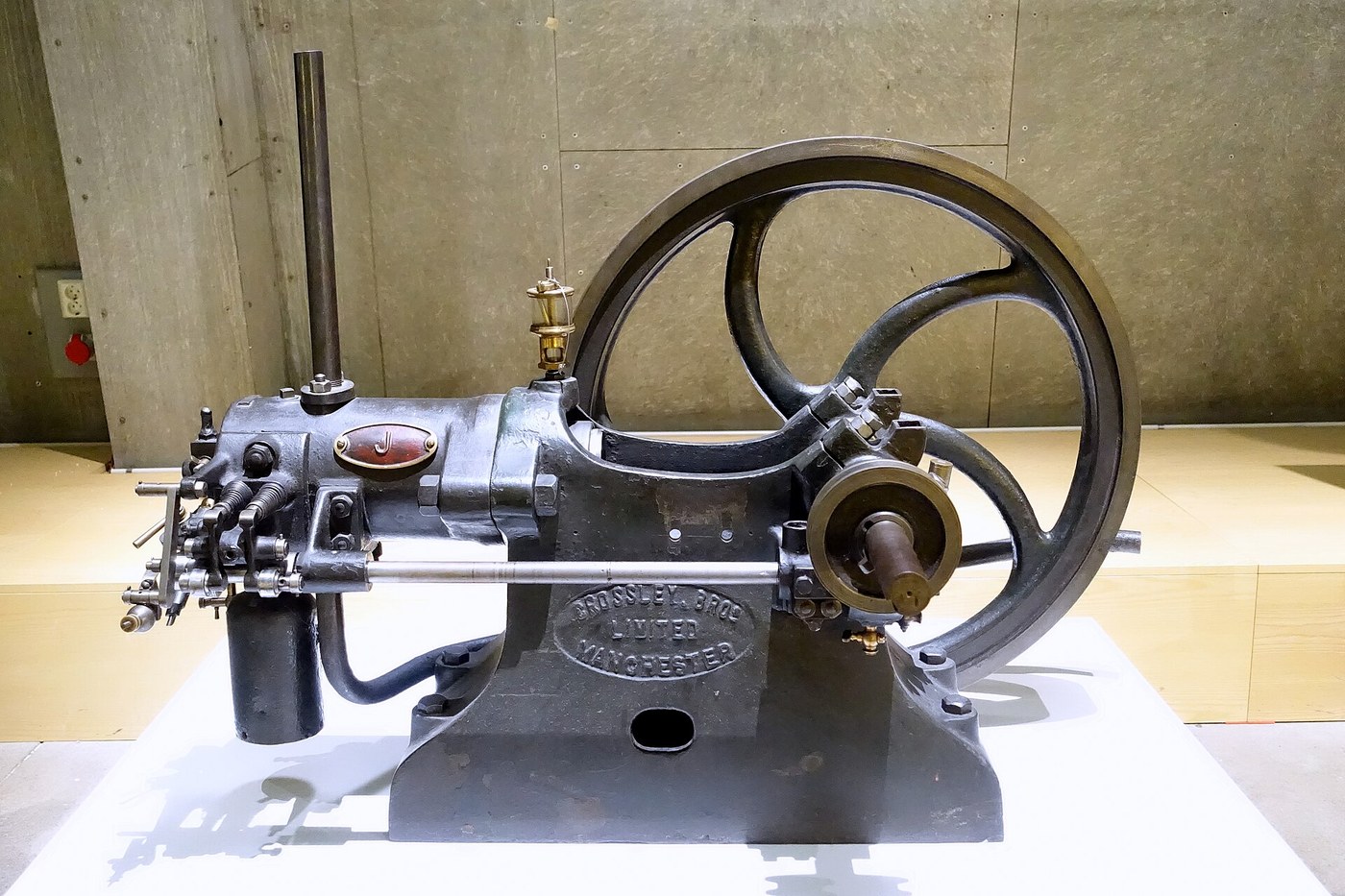


Otto Four-Stroke Engine
Anweisungen
Model the cylinder
Model the cylinder
A large syringe is a piston in a cylinder and shows compression honestly.
- Take a syringe of 50 ml or more with the needle removed.
- Seal the outlet with a fingertip.
- Push the plunger in and feel the resistance rise, then release and watch it spring back.
Benötigte Werkzeuge:
 Lineal
Measure a compression ratio
Measure a compression ratio
Compression ratio is a number you can measure, not just quote.
- Note the volume with the plunger fully out — call it V₁.
- Push in as far as it will comfortably go and note the remaining volume, V₂.
- Compression ratio = V₁ / V₂
Walk the four strokes
Walk the four strokes
Turn a real engine over by hand and watch the valves. A lawnmower or model engine with the head accessible is ideal.
- Intake — piston down, inlet valve open, charge drawn in.
- Compression — piston up, both valves shut.
- Power — ignition at the top, piston driven down, both valves still shut.
- Exhaust — piston up, exhaust valve open, burnt gas pushed out.
Time it against the crank
Time it against the crank
Prove the 2:1 relationship rather than asserting it.
- Mark the crank pulley and the cam or valve cover with chalk.
- Turn the crank slowly through two full revolutions.
- Count how many times each valve opens.
Benötigte Werkzeuge:
 Stoppuhr
History and context
History and context
Nikolaus August Otto, a travelling grocery salesman by trade, built gas engines with Eugen Langen in Cologne from 1864. Their 1867 atmospheric engine won a gold medal in Paris but was tall, noisy and weak. The 1876 engine was different: it compressed the mixture before igniting it, and it ran quietly enough to be called the Silent Otto. US patent 194,047, Improvement in Gas-Motor Engines, was granted on 14 August 1877.
The priority dispute is real and worth stating plainly. Alphonse Beau de Rochas, a French engineer, described the four-stroke compressed-charge cycle in an 1862 publication and never built an engine from it. In 1886 a German court invalidated Otto's German patent on the grounds of that prior description. So Otto did not originate the cycle on paper; he was the first to make it work, sell it, and put it into general use. Both statements are true and the popular version usually keeps only one of them.
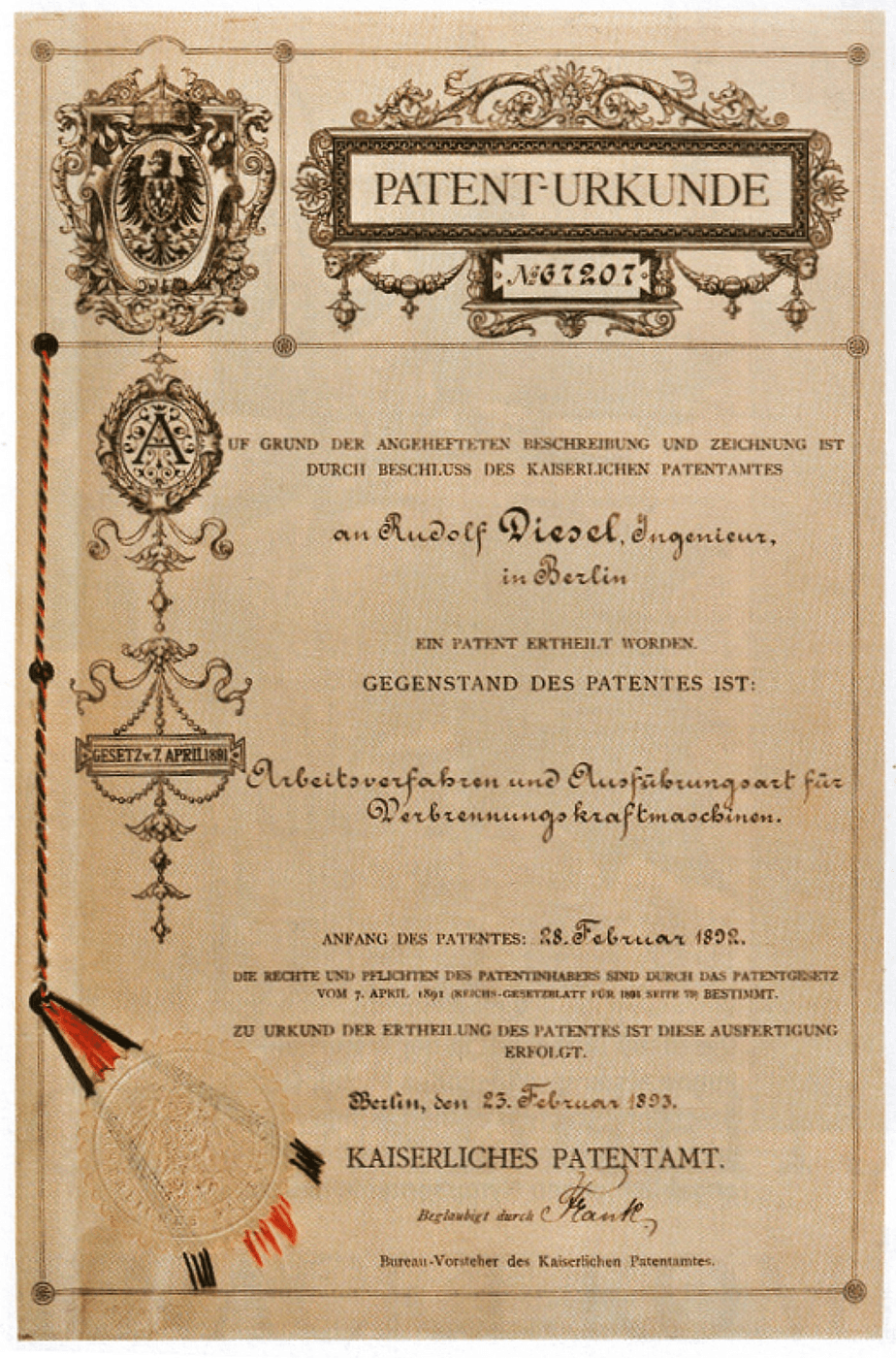
What followed: Gottlieb Daimler and Wilhelm Maybach, who both worked for Otto's company, left and built high-speed petrol versions light enough for vehicles. Rudolf Diesel took the compression idea further, raising it until the fuel ignites from heat alone with no spark.
Built under licence, which is why so few engines say Otto on them. Otto's company sold manufacturing rights abroad, and Crossley Brothers of Manchester held the British rights from 1869, first for the Otto and Langen atmospheric engine and later for the four-stroke. Thousands of engines to Otto's design therefore carry another maker's name cast into the frame — the engine pictured here is one of them, a Crossley. Judging these machines by the badge rather than the cycle they run is a common mistake.
What this exercise does not do: it does not build a running engine. It measures the compression ratio and demonstrates the valve timing on real hardware, which is the part a bench can genuinely show.
Verwandte Blueprints
Diese Blueprints teilen Wissen — Techniken, Materialien oder Prinzipien
CC0 Gemeinfrei
Dieser Blueprint ist unter CC0 veröffentlicht. Sie dürfen dieses Werk für jeden Zweck frei kopieren, ändern, verbreiten und verwenden, ohne um Erlaubnis zu fragen.
Unterstützen Sie den Maker, indem Sie Produkte über seinen Blueprint kaufen, wo er eine Maker-Provision von Anbietern festgelegt, verdient. Oder erstellen Sie eine neue Iteration dieses Blueprints und verbinden Sie ihn in Ihrem eigenen Blueprint, um Einnahmen zu teilen.