Zusammenarbeit
KUNST
SCHÖNHEIT & WELLNESS
HANDWERK
KULTUR & GESCHICHTE
UNTERHALTUNG
UMFELD
ESSEN & GETRÄNKE
REVERSE ENGINEERING
WISSENSCHAFTEN
SPORT
TECHNOLOGIE
WEARABLES
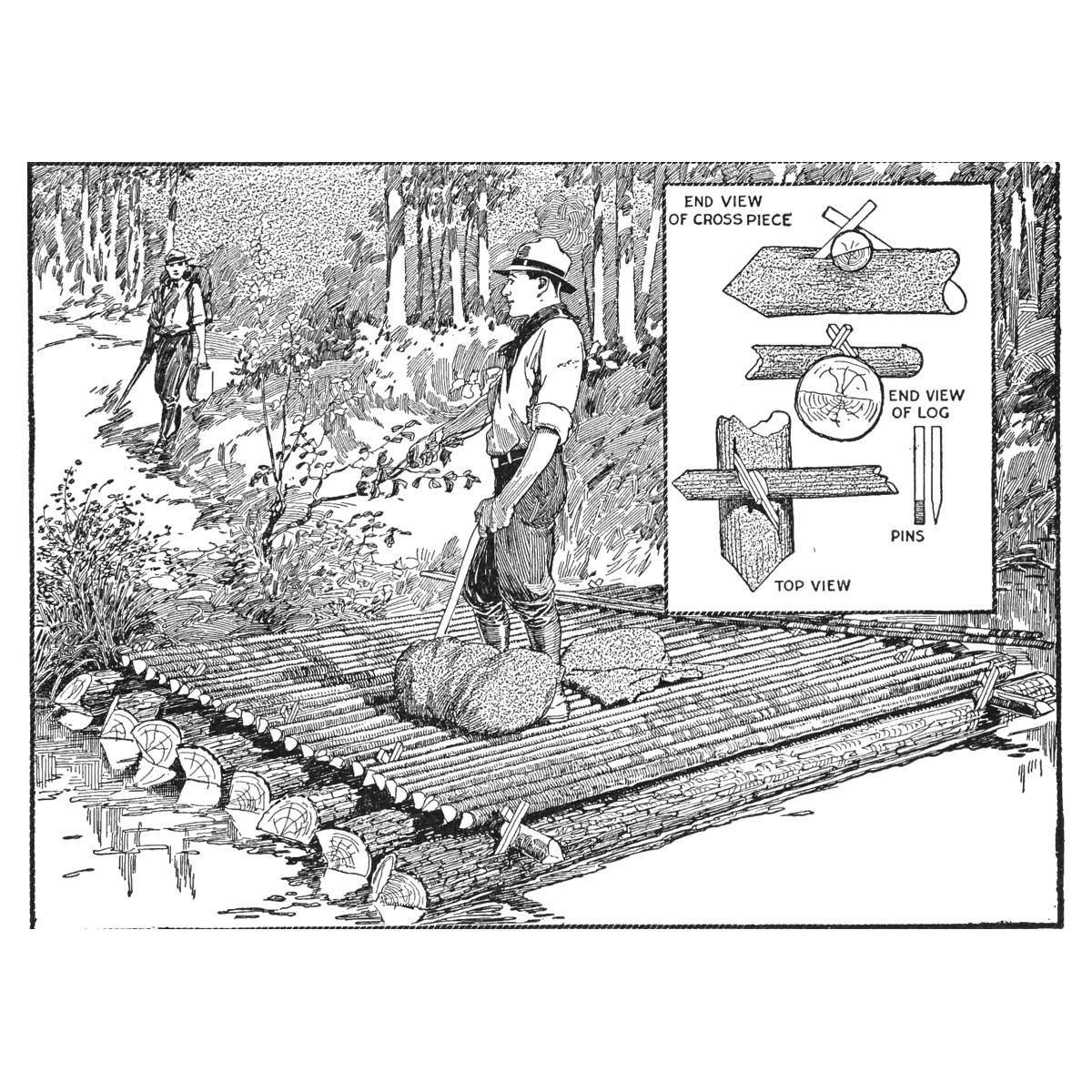


Woodsman's Log Raft: Logs Pinned to Notched Cross Poles With Wooden Spikes, Built With a Hand Ax (Boy Mechanic, 1919)
A. M. Parker's woodsman's raft from The Boy Mechanic, Book 3 (1919), for crossing a stream with only a hand ax: logs rolled into the shallows, cross poles notched into them and held by pairs of hardwood pins driven diagonally so they clamp the poles. For one passenger he uses three logs 9 to 12 in thick and 12 to 16 ft long, spaced to 5 ft.
Fortgeschritten
About half a day
Anweisungen
1
1
His sizes, and a rough buoyancy check
His sizes, and a rough buoyancy check
Jupyter-Notebook wird geladen …
2
2
Read The Boy Mechanic, Book 3
Read The Boy Mechanic, Book 3
The woodsman "has only a hand ax as his tool equipment"; the raft is "pinned together firmly with poles and pointed wooden spikes, cut on the spot". Dry logs are better than wet or green ones; green logs need a larger raft for the same load.
3
3
Cut logs, poles and pins
Cut logs, poles and pins
On a shore sloping gently into the water, cut the logs and roll them to the bank, alternating the butts. For one passenger: three logs 9 to 12 in thick, 12 to 16 ft long, to be spaced 5 ft wide (for heavier loads, more logs set closer). Cut poles about 3 in thick, long enough to cross the raft, and a number of hardwood pins 1 ft long, sharpened at one end.
Materialien für diesen Schritt:
 Baumstamm3 Stück
 Holzstange4 Stück
 Hartholzbrett1 Stück
Benötigte Werkzeuge:
 Axt
 Faustkeil
4
4
Notch and pin the first log
Notch and pin the first log
Roll the first, one of the largest, into the water until it nearly floats, any bow or hump toward the outer edge. Chop notches 2 in deep in its top about 1-1/2 ft from the ends, squarely across. Lay a pole in a notch, its end just past the log, and cut a double notch in the pole's upper edge so the pins rest diagonally in it. Split rifts in the log with the ax, cutting as if to split off a slab, not toward the centre, and drive two pins in crossed over the pole. Fasten a second pole at the other end.
Benötigte Werkzeuge:
Faustkeil Hammer
5
5
Add the other logs
Add the other logs
Prop up both poles, roll the next log in underneath and notch it before slipping it into place. Only alternate ends of the inner logs need pinning; some can be left loose if held tight between pinned ones. Push the raft out as each log is added; in a strong current, guy it to the bank downstream with a pole. Float the last log, a large one, down and pin it at both ends. Cover with light poles or brush for dry footing.
Materialien für diesen Schritt:
Holzstange6 StückBenötigte Werkzeuge:
Faustkeil6
6
Troubleshooting
Troubleshooting
Log raft troubleshooting.
Flow
Loading...
7
7
History and honest limits
History and honest limits
From "A Woodsman's Log Raft" by A. M. Parker, in **The Boy Mechanic, Book 3**, Popular Mechanics, 1919 (Project Gutenberg 71856; checked on the archive.org scan boymechanic0003unse, pp. 185-186). The buoyancy figures in the notebook are an example of ours, not his. The metric figures are ours.
Materialien
3- 3 StückPlatzhalter
- 6 StückPlatzhalter
- 1 StückPlatzhalter
Dieser Bauplan stellt her
Verwandte Blueprints
Diese Blueprints teilen Wissen — Techniken, Materialien oder Prinzipien
CC0 Gemeinfrei
Dieser Blueprint ist unter CC0 veröffentlicht. Sie dürfen dieses Werk für jeden Zweck frei kopieren, ändern, verbreiten und verwenden, ohne um Erlaubnis zu fragen.
Unterstützen Sie den Maker, indem Sie Produkte über seinen Blueprint kaufen, wo er eine Maker-Provision von Anbietern festgelegt, verdient. Oder erstellen Sie eine neue Iteration dieses Blueprints und verbinden Sie ihn in Ihrem eigenen Blueprint, um Einnahmen zu teilen.