KUNST
SCHÖNHEIT & WELLNESS
HANDWERK
KULTUR & GESCHICHTE
UNTERHALTUNG
UMFELD
ESSEN & GETRÄNKE
REVERSE ENGINEERING
WISSENSCHAFTEN
SPORT
TECHNOLOGIE
WEARABLES
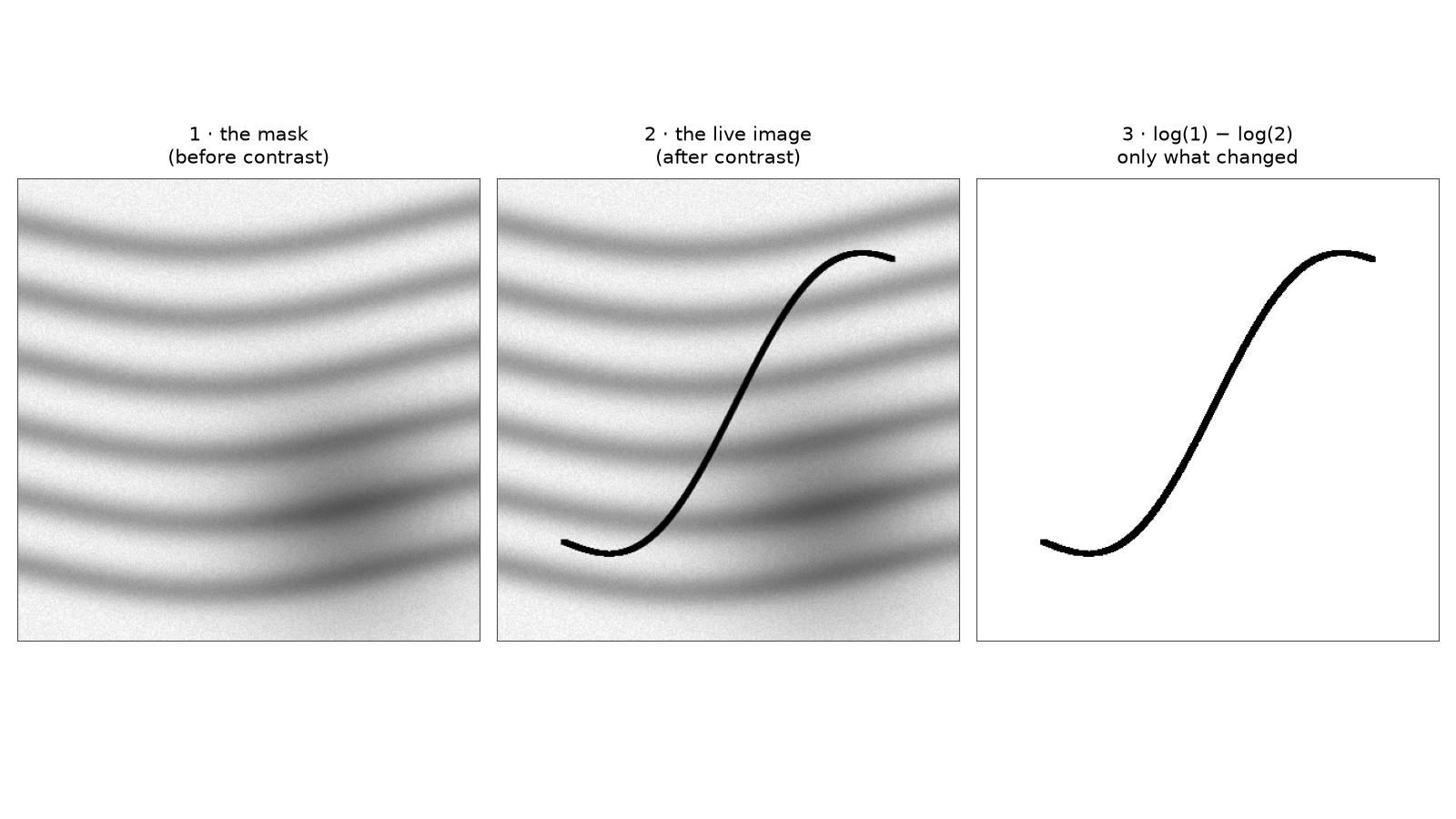


Photographic Subtraction
Planigraphy tried to see one plane by blurring the others. This is the other idea, and it is sharper in every sense: **stop trying to remove what is in the way, and remove what did not change instead.**
Take a radiograph. Inject a contrast agent into the vessels. Take a second radiograph from exactly the same position. Every bone, every muscle, every bowel gas shadow is identical in both. The only thing different is the dye. So make a photographic negative of the first film, lay it on the second, and everything that stayed the same cancels to a flat grey - leaving a picture of the vessels alone, floating on nothing.
**Bernard Ziedses des Plantes** published this in 1935, the same researcher and roughly the same years as planigraphy. As with that technique, this blueprint gives no patent number: the dated publication is solid, the patent record is not verifiable from a primary source here, and a number nobody can check is worse than no number.
**There is a piece of mathematics hiding in it that he got for free, and it is the reason the method works at all.** X-ray attenuation is exponential, so two things in the beam do not add - they MULTIPLY. Subtracting one raw image from another therefore does not cancel a background; it only scales it, and the same dye gives a different answer depending on what it happens to be lying behind. Subtraction only cancels exactly if you take the logarithm first, which turns the multiplication into an addition.
Photographic film density is proportional to the logarithm of exposure across its working range. **The film had already taken the logarithm.** Laying a negative on a positive did the subtraction in the correct domain without anybody having to notice, thirty-five years before there was a computer to do it on purpose - and you will demonstrate exactly that in the notebook.
You will do this with ordinary photographs, because nothing about it is specific to X-rays. And you will meet the one thing that stopped it being routine for forty years: it is ferociously sensitive to the two images being in the same place.
Anfänger
1 hour
Anweisungen
1
1
Two photographs that differ in exactly one thing
Two photographs that differ in exactly one thing
Build a small still life with a lot of confusing structure in it - a tangle of wire, a handful of washers, a crumpled sheet of foil - and light it evenly. This is your "anatomy": the stuff you want to get rid of.
Put the camera on a tripod, focus manually, and switch everything automatic OFF - manual exposure, manual white balance, manual focus. If the camera changes ANY setting between the two frames it will change the whole image, and the whole image is what you are trying to cancel.
Take frame one. Then, without touching the camera or the still life, lay a thin loop of coloured thread across the scene - that is your "contrast agent". Take frame two.
Use a remote release or the self-timer. Pressing the shutter with a finger moves the camera enough to matter, and the notebook step will show you exactly how much that costs.
Materialien für diesen Schritt:
 Kupferdraht1 m
 Unterlegscheibe10 Stück
 Aluminiumfolie1 Stück
 Baumwollgarn1 Stück
Benötigte Werkzeuge:
 Stativ (Carbon, Kugelkopf)
 Digitalkamera
 LED-Inspektionsleuchte
2
2
The photographic route: make a mask and lay it on
The photographic route: make a mask and lay it on
Do it the 1935 way first, physically, because seeing the cancellation happen on a light box is worth more than reading about it.
Print frame one onto transparency film **inverted** - a negative. Print frame two onto transparency film normally - a positive. Same size, same printer, same settings.
Lay the negative of frame one on top of the positive of frame two on a light box or a bright window, and slide it until the two register. Where the negative is dark the positive is light and vice versa, so everything common to both goes to a uniform middle grey. The thread, which exists in only one of them, does not cancel.
Registration is done by hand, by sliding, and you will immediately understand why this was a specialist skill. A fraction of a millimetre out and every edge in the picture reappears as a bright line on one side and a dark line on the other.
Benötigte Werkzeuge:
 Tintenstrahldrucker
 Leuchtkasten
 Lineal
 Inkjet-Folie
3
3
The digital route, and the log that matters
The digital route, and the log that matters
Now do it in arithmetic, where you can control what the film was doing silently.
Load both frames as greyscale arrays. Subtract one from the other directly and look at the result: the background will be reduced but not gone, and it will be reduced by different amounts in different places.
Now take the logarithm of each frame first and subtract those. The background vanishes properly - and it vanishes just as completely behind the dense washers as it does in the empty space, which the direct subtraction could not manage.
That difference is the whole point of the notebook step, and it is a genuinely useful thing to carry away: **whenever a signal passes THROUGH several things in series, the measurements multiply, and you must take a log before you are allowed to subtract.** It is true of X-rays, of optical density, of sound through walls and of anything else obeying Beer-Lambert.
Stretch the contrast on the result hard. A correct subtraction looks like an empty grey field until you do.
Benötigte Werkzeuge:
 Desktop-Computer
4
4
Measure what a misalignment costs
Measure what a misalignment costs
This is the measurement that explains forty years of history.
Take your two frames and deliberately shift one of them by a known amount before subtracting - one pixel, two, five, ten. Do the subtraction at each shift and note when your thread stops being the most visible thing in the picture.
Record the shift in millimetres at the subject, not in pixels, by measuring something of known size in the frame first.
You will find a very small number. Edges are where the image changes fastest, so a misregistration turns every edge into a bright-dark pair whose amplitude is the edge contrast times the shift - and edge contrast in a radiograph is enormous compared with the few per cent difference a contrast agent makes.
**Then correct it.** Shift the mask back in single steps until the edge artefacts minimise. You have just done pixel-shifting re-registration by hand, which is the feature that made digital subtraction angiography clinically usable in the 1970s: not better detectors, but the ability to fix the alignment after the patient had already moved.
Benötigte Werkzeuge:
Desktop-ComputerLineal5
5
Multiply, log, subtract
Multiply, log, subtract
Jupyter-Notebook wird geladen …
6
6
When the difference is a mess
When the difference is a mess
Three questions. The second one is the one that makes people think they have failed when they have succeeded.
Flow
Loading...
7
7
Compendium: what subtraction can and cannot buy you
Compendium: what subtraction can and cannot buy you
**What it buys.** A contrast agent in a small vessel might change the transmitted intensity by one or two per cent. Against the enormous variation of a normal radiograph, that is invisible. Subtract the background and the same one per cent becomes the ONLY thing in the frame, and you can then amplify it as hard as you like. The technique does not improve the signal at all - it removes everything else, which amounts to the same thing.
**What it costs.** Two exposures instead of one, so twice the dose, and complete dependence on the patient not moving. Swallowing, breathing, a heartbeat and bowel gas moving a centimetre are all enough. The mask and the live image must describe the same body in the same place.
**Digital subtraction angiography.** From the late 1970s, the mask is a stored frame rather than a piece of film, subtraction happens in real time, and - crucially - the mask can be shifted, warped, or replaced with a later frame if the patient moved. Radiologists call that pixel shifting and remasking, and it is exactly what you did by hand in step 4. It also allows a road-map: subtract continuously and watch a catheter advance through vessels that are otherwise invisible.
**Dual-energy subtraction**, the elegant variant. Instead of two exposures separated in TIME, take two separated in ENERGY - bone and soft tissue attenuate differently at different kV, so a weighted subtraction of a high-kV and a low-kV image can remove the ribs from a chest film entirely. Both exposures can be taken milliseconds apart, so motion barely matters. The arithmetic is the same logarithmic subtraction; only the thing being held constant has changed.
**And the thread through this batch.** The grid threw away photons arriving from the wrong direction. Planigraphy threw away everything not at one height. This throws away everything that did not change. Each is a different answer to the same question - what can I discard so that what remains is legible? - and each throws away real information to do it. The last two blueprints in this batch stop discarding and start solving.
Materialien
4- 1 mPlatzhalter
- 10 StückPlatzhalter
- 1 StückPlatzhalter
- 1 StückPlatzhalter
Benötigte Werkzeuge
8- Platzhalter
- Platzhalter
- Platzhalter
- Platzhalter
- Platzhalter
- Platzhalter
- Platzhalter
- Platzhalter
Verwandte Blueprints
Diese Blueprints teilen Wissen — Techniken, Materialien oder Prinzipien


CC0 Gemeinfrei
Dieser Blueprint ist unter CC0 veröffentlicht. Sie dürfen dieses Werk für jeden Zweck frei kopieren, ändern, verbreiten und verwenden, ohne um Erlaubnis zu fragen.
Unterstützen Sie den Maker, indem Sie Produkte über seinen Blueprint kaufen, wo er eine Maker-Provision von Anbietern festgelegt, verdient. Oder erstellen Sie eine neue Iteration dieses Blueprints und verbinden Sie ihn in Ihrem eigenen Blueprint, um Einnahmen zu teilen.